


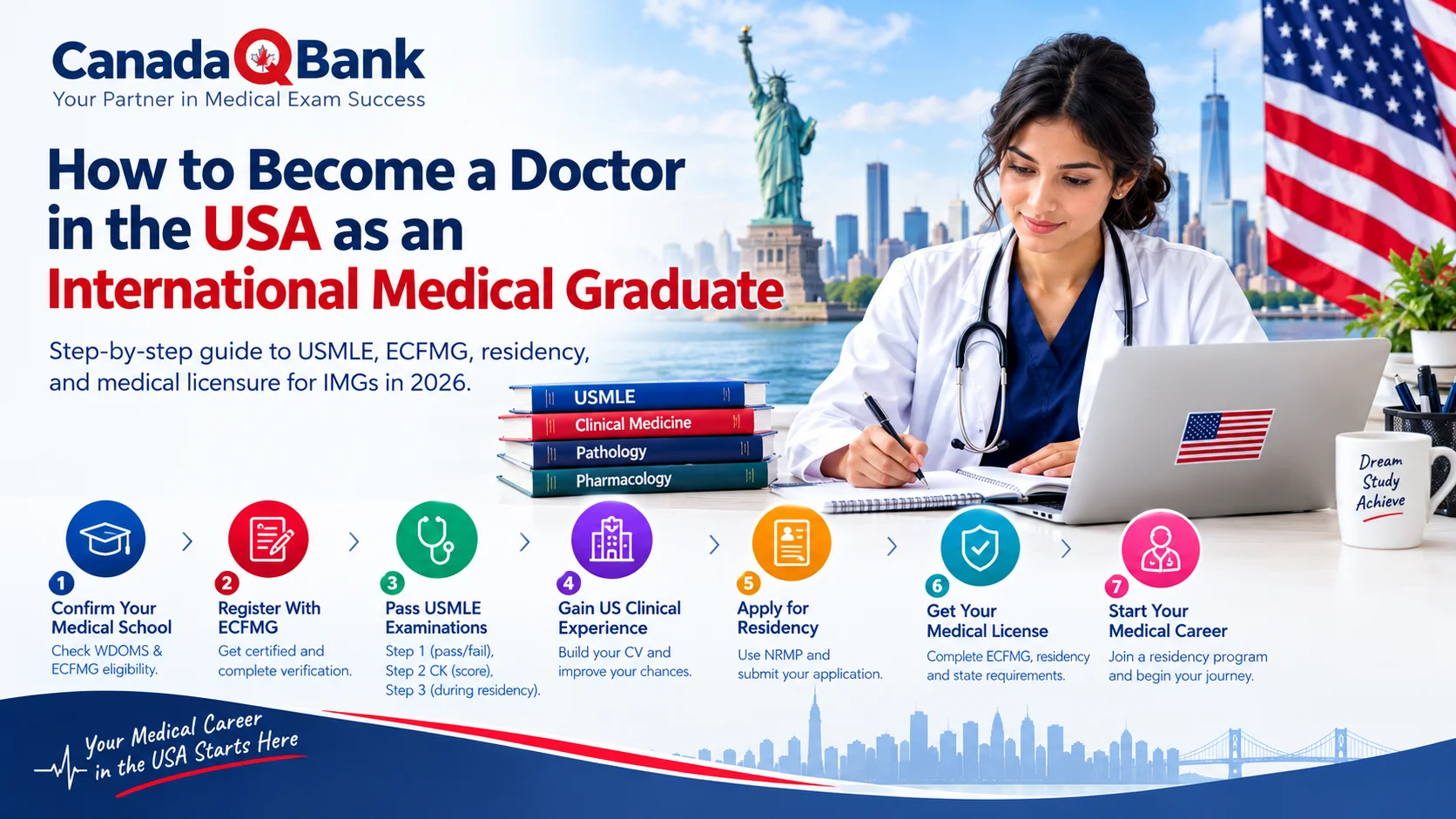
The United States is home to the highest physician salaries in the world, one of the most advanced healthcare systems globally, and a medical culture that values specialisation, innovation, and clinical excellence. For internationally trained physicians, it is also one of the most competitive and demanding licensing environments anywhere.
Approximately 25% of practising physicians in the United States are international medical graduates — a substantial presence that reflects both the size of the US healthcare system and its genuine reliance on IMG talent. But the pathway to joining that workforce is long, multi-step, competitive, and requires careful planning from the very beginning.
This guide gives you a complete, accurate, step-by-step picture of how to become a doctor in the USA as an international medical graduate in 2026.
Who Is an International Medical Graduate in the US Context?
The United States distinguishes between two broad categories of medical graduates:
US Medical Graduates (USMGs): Graduates of accredited US or Canadian medical schools.
International Medical Graduates (IMGs): Graduates of medical schools outside the US and Canada. IMGs are further divided into:
- Non-US IMGs: International citizens who graduated from non-US medical schools
- US-citizen IMGs: US citizens who graduated from non-US medical schools (commonly referred to as US-IMGs)
This distinction matters because IMG match rates, visa requirements, and some licensing steps differ between these groups. US-citizen IMGs typically have higher match rates than non-US IMGs, though both face more competitive conditions than USMGs.
Step 1: Confirm Your Medical School Is Recognised
Your first step — before anything else — is confirming that your medical degree is from a school listed in the World Directory of Medical Schools (WDOMS) with an ECFMG note. The ECFMG note indicates that the school meets the standards required for ECFMG certification eligibility.
If your school is not listed in the WDOMS with an ECFMG note, you will not be eligible for ECFMG certification — and without ECFMG certification, you cannot enter a US residency program.
Check the WDOMS at wdoms.org before investing any time or resources in the US pathway.
Step 2: Register With ECFMG
The Educational Commission for Foreign Medical Graduates (ECFMG) is the organisation that certifies IMGs for entry into US graduate medical education. Every IMG who wants to practise medicine in the United States must obtain ECFMG certification — without it, you cannot apply for or begin a residency program.
ECFMG certification requires all of the following:
- Passing USMLE Step 1
- Passing USMLE Step 2 CK
- Medical school credential verification — ECFMG verifies your primary medical qualification directly with your medical school through its primary source verification process
- Medical school graduation verification — confirmation that your degree has been awarded
Create your ECFMG account through the ECFMG Interactive Web Applications (IWA) portal at ecfmg.org as early as possible — credential verification can take several months and must be completed before your residency application.
Step 3: Pass the USMLE Examinations
The United States Medical Licensing Examination (USMLE) is a three-step examination sequence that all physicians must pass to obtain a medical licence in the United States. For IMGs, Steps 1 and 2 CK must be passed to obtain ECFMG certification. Step 3 is typically taken during residency.
USMLE Step 1
Step 1 assesses foundational medical science knowledge and its application to clinical medicine. It is a one-day examination consisting of 280 questions across 7 blocks (or 14 blocks of 20 questions from May 14, 2026 under the updated format) with an overall duration of 8 hours.
Crucially: USMLE Step 1 is now pass/fail only. Since January 26, 2022, Step 1 no longer produces a numeric score — it reports only a pass or fail result. This was a significant policy change that shifted residency selection emphasis toward Step 2 CK scores.
Passing Step 1 is required for ECFMG certification. Most candidates prepare for 3 to 6 months.
USMLE Step 2 CK
Step 2 CK (Clinical Knowledge) assesses the ability to apply medical knowledge and clinical science to patient care. It is a one-day examination of up to 318 items across 16 blocks of 30 minutes each (from May 7, 2026 under the updated format) with an overall duration of 9 hours.
Step 2 CK produces a numeric score — and in the post-Step 1 pass/fail era, this score carries significant weight in the residency match. A strong Step 2 CK score is now one of the most important differentiating factors in a competitive IMG application.
Most candidates prepare for 2 to 4 months for Step 2 CK, ideally during or after clinical rotations.
USMLE Step 3
Step 3 assesses the ability to practise medicine unsupervised. It is typically taken during residency (most states allow it after the first year) and is required for independent medical licensure. For IMGs, Step 3 eligibility requires ECFMG certification — so it cannot be taken before Steps 1 and 2 CK are passed.
Step 4: Gain US Clinical Experience
US clinical experience is not a formal requirement for ECFMG certification — but it is a practical necessity for a competitive residency application.
Programs use clinical experience in the US as a proxy for several things they cannot easily assess from a file:
- Familiarity with the US healthcare system, its workflows, documentation practices, and patient interactions
- The ability to function effectively in an American clinical environment
- Exposure to US attending physicians — who can then provide reference letters from a US context
Types of US clinical experience:
Observerships: Non-clinical shadowing positions where you observe (but do not participate in) patient care. Observerships do not provide hands-on clinical experience and are less valued than clerkships — but they provide US reference letter opportunities and system familiarity.
Clinical electives and clerkships: Hands-on clinical positions where you actively participate in patient care under supervision. These are significantly more valuable than observerships and are arranged through specific US hospitals and medical schools that offer IMG elective programs. AMO (American Medical Opportunities) and similar organizations facilitate IMG clinical rotations.
Research positions: Research experience in a US institution — particularly with publications — is valued by many residency programs, especially academic programs.
The earlier you begin pursuing US clinical experience, the stronger your application will be. Many IMGs find that securing US reference letters from US-based supervisors is one of the most important steps in making their applications competitive.
Step 5: Apply Through ERAS and the NRMP Match
ERAS — The Electronic Residency Application Service
All residency applications in the United States are submitted through ERAS (Electronic Residency Application Service), managed by the AAMC. ERAS opens in the late summer preceding the match year — for the 2026 match, applications opened in the summer of 2025.
A complete ERAS application for IMGs includes:
- USMLE Step 1 and Step 2 CK scores (and Step 3 if already taken)
- Medical school transcript and diploma
- ECFMG status report
- Personal statement (program-specific, explaining your interest and suitability)
- Letters of recommendation (typically three — US reference letters are particularly valuable)
- Curriculum vitae
- Photo
- MSPE (Medical Student Performance Evaluation) — if available from your medical school
- Any research publications or presentations
The personal statement is program-specific and should not be generic. Each personal statement should explain why you are applying to that specific specialty, what in your background has prepared you for it, and your career goals. Generic personal statements are easily identified and are a common weakness in IMG applications.
Letters of recommendation are critical. US-based reference letters — from physicians who have observed your clinical work in the US — carry significantly more weight than letters from supervisors in your home country. Pursuing US clinical experience specifically to obtain US reference letters is a legitimate and important preparation strategy.
NRMP — The National Resident Matching Program
After programs review applications and conduct interviews, both applicants and programs submit rank order lists (ROLs). The NRMP (National Resident Matching Program) algorithm then produces a stable match.
Match Day takes place in March each year — a single day on which all matched applicants learn which program they have been placed in. A match is a binding commitment.
2025 Match statistics for IMGs:
- IMG applicants accounted for approximately one-third of all active applicants
- Approximately 60.8% of active IMGs were offered a first-year residency position
- Top specialties for matched IMGs: Internal Medicine, Family Medicine, Psychiatry, Neurology, and Pediatrics
IMGs who do not match can apply to the Supplemental Offer and Acceptance Program (SOAP) — formerly called the scramble — for unfilled positions immediately after the main match results, or reapply in the following year’s match.
Step 6: Complete Residency Training
Residency is mandatory for all physicians in the United States — there is no pathway to independent medical practice without completing an ACGME-accredited residency program.
Residency lengths vary by specialty:
| Specialty | Residency Length |
|---|---|
| Family Medicine | 3 years |
| Internal Medicine | 3 years |
| Paediatrics | 3 years |
| Psychiatry | 4 years |
| General Surgery | 5 years |
| Neurology | 4 years |
| Radiology | 5 years |
| Orthopaedic Surgery | 5 years |
| Cardiology (after IM) | Additional 3 years fellowship |
| Neurosurgery | 7 years |
During residency, you will take and pass USMLE Step 3 — required for independent medical licensure.
Step 7: Obtain State Medical Licensure
After completing residency and passing Step 3, you apply for a state medical licence through the relevant state medical board. Each US state has its own licensing requirements and processes — requirements are not uniform across states.
Most states require:
- Completion of an ACGME-accredited residency
- Passing all three USMLE steps
- Criminal background check
- Verification of postgraduate training
- ECFMG certification (for IMGs)
- Proof of identity and citizenship/visa status
Some states impose additional requirements — specific numbers of postgraduate training years, specific examination time limits, or additional documentation for IMG applicants. Research the specific requirements of the state where you intend to practise before applying.
Step 8: Apply for Board Certification (Optional But Practically Essential)
Board certification is technically voluntary — it is not required for licensure. In practice, it is expected by most hospitals for staff privileges and by most employers for clinical positions.
Board certification in your specialty is obtained through the relevant American Board of Medical Specialties (ABMS) member board — the American Board of Internal Medicine, American Board of Surgery, American Board of Psychiatry and Neurology, and so on. Each board has its own examination format, eligibility criteria, and maintenance of certification requirements.
Visa Requirements for IMGs
IMGs who are not US citizens or permanent residents must obtain appropriate visa status to undertake residency training and practice medicine in the US.
J-1 Visa (Exchange Visitor Visa) The J-1 is the most commonly used visa for IMG residency. It is sponsored through the ECFMG J-1 Visa Sponsorship Program. The J-1 carries a two-year home country physical presence requirement — meaning that after completing training, the visa holder must return to their home country for two years before being eligible for an H-1B or permanent residence, unless a waiver is obtained.
J-1 waivers are available through several routes including the Conrad 30 program (committing to work in a medically underserved area for three years), federal agency sponsorship, or exceptional hardship/persecution. Waivers are competitive and not guaranteed.
H-1B Visa (Specialty Occupation Visa) The H-1B is an alternative to the J-1 for physician residency. It does not carry the home country presence requirement, making it attractive for IMGs intending to remain in the US permanently. However, H-1B visas are subject to annual caps and lottery selection — availability is not guaranteed.
EB-1A and EB-2 NIW (Employment-Based Immigration) After completing training and establishing a clinical or research career, many IMG physicians pursue permanent residence through employment-based immigration categories. The EB-2 National Interest Waiver (NIW) is particularly accessible for physicians who commit to working in underserved areas.
IMG-Friendly Specialties and States
Not all specialties are equally accessible to IMGs. Based on 2025 match data, the most IMG-friendly specialties include:
- Internal Medicine — the largest single specialty for IMGs; many community-based programs actively recruit IMGs
- Family Medicine — IMG-friendly, with a significant shortage of family physicians in rural and underserved areas
- Psychiatry — growing shortage of psychiatrists; many programs receptive to strong IMG candidates
- Neurology — historically IMG-friendly; academic programs particularly accessible
- Pathology — research-oriented specialty with above-average IMG match rates
- Physical Medicine and Rehabilitation — accessible to strong IMG candidates
States with the largest IMG physician workforces include New York, New Jersey, Florida, Michigan, and Illinois — each with large hospital systems and established IMG communities that can provide mentorship and networking.
Realistic Timeline for IMGs
| Stage | Approximate Duration |
|---|---|
| USMLE Step 1 preparation and exam | 3 to 6 months |
| USMLE Step 2 CK preparation and exam | 2 to 4 months |
| ECFMG credential verification | 3 to 6 months (run concurrently) |
| US clinical experience | 3 to 12 months (ongoing) |
| ERAS application and interviews | September to January |
| NRMP Match Day | March |
| Residency training (Family Medicine) | 3 years |
| Residency training (Internal Medicine) | 3 years |
| Residency training (surgical specialties) | 5 to 7 years |
| State licensure after residency | 1 to 3 months |
| Total: Family Medicine to independent practice | 5 to 7 years from beginning USMLE prep |
| Total: Surgical specialty to independent practice | 8 to 12 years |
Common Mistakes IMGs Make
Starting USMLE preparation without a timeline. Many IMGs begin preparation without a clear plan tied to a specific match cycle. Without a target match year and backward planning from ERAS opening dates and exam scheduling deadlines, preparation drifts and opportunities are missed.
Neglecting Step 2 CK in favour of Step 1. Since Step 1 became pass/fail in 2022, Step 2 CK is now the primary numeric differentiator in the match. IMGs who invest the majority of their preparation in Step 1 and treat Step 2 CK as secondary are misallocating their effort.
Underestimating the importance of US clinical experience. IMGs who apply without any US clinical experience or US reference letters face a significant disadvantage in most specialties. Securing US experience — even an observership — is worth the investment.
Applying too broadly without strategy. Applying to hundreds of programs without strategic selection based on IMG-friendliness, specialty fit, and geographic preference wastes application fees and dilutes the quality of application materials. A targeted, well-researched application to 80 to 150 programs in accessible specialties produces better outcomes than a scattershot application to 300.
How CanadaQBank Prepares IMGs for the USMLE Pathway
At CanadaQBank.com, our USMLE question banks are built to prepare IMG candidates for every examination in the US licensing pathway.
We offer:
- USMLE Step 1 question bank covering all major basic science and clinical science domains — pathology, pharmacology, microbiology, immunology, biochemistry, physiology, and neuroanatomy — with detailed explanations that build clinical reasoning, not just fact recall
- USMLE Step 2 CK question bank aligned to the current 318-item, 16-block, 30-minute format — covering all major clinical disciplines with the clinical vignette depth and “next step” reasoning development that a strong Step 2 CK score requires
- Timed and tutor modes for every stage of preparation — tutor mode for building knowledge, timed mode for developing exam-pace decisiveness in 30-minute blocks
- Domain-by-domain performance analytics tracking your progress across every USMLE content area and identifying your highest-priority study needs
- Detailed clinical explanations that teach the underlying reasoning behind every correct answer — building the applied clinical thinking that the USMLE tests
- Mobile-friendly access for preparation that continues during clinical work, between patients, and in every available window of your schedule
Visit CanadaQBank.com today and start building the USMLE preparation that opens the door to your US medical career.