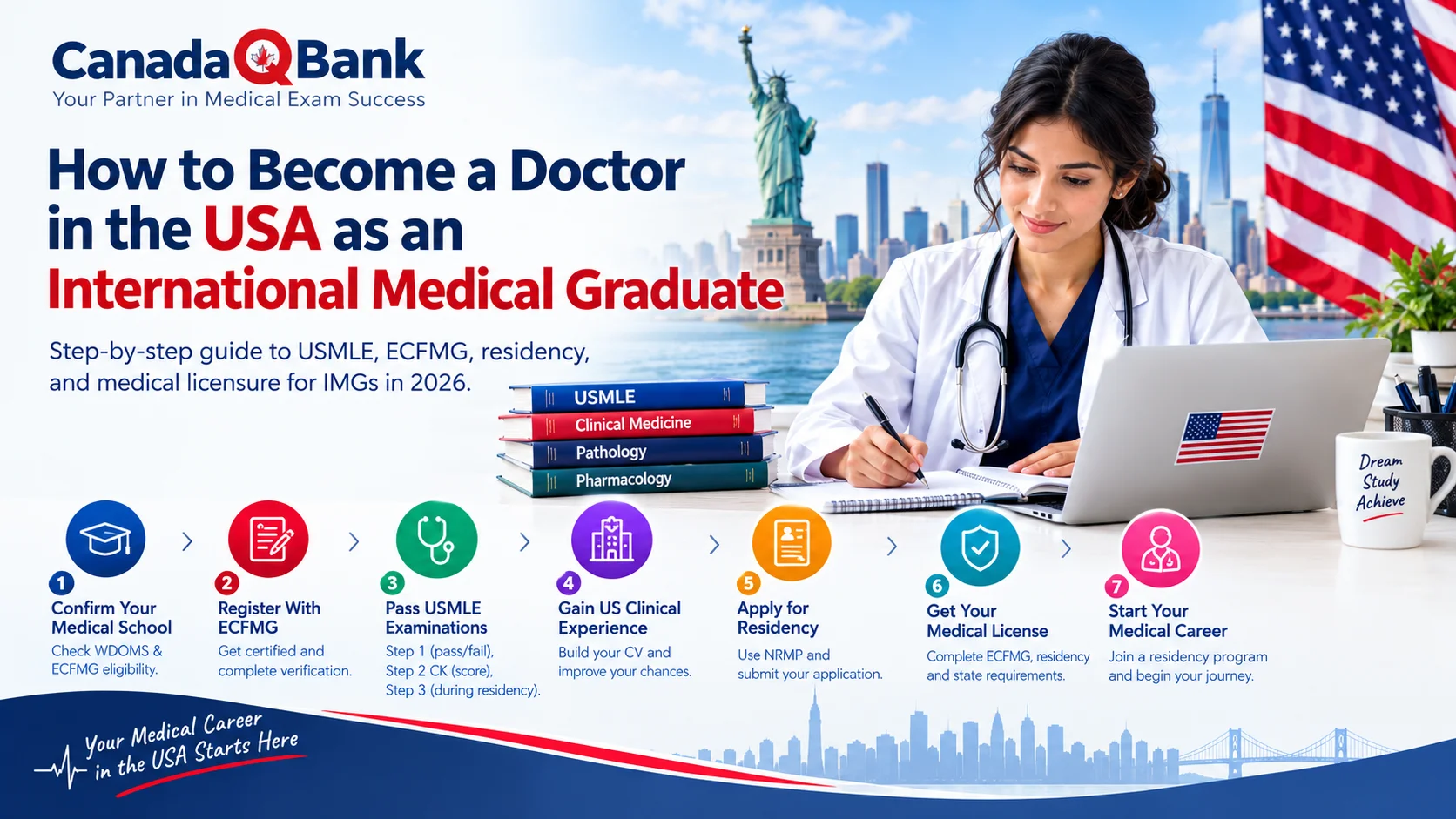
Just Got Your USMLE Step 1 Score? Here’s What to Do Next!

Just Got Your USMLE Step 1 Score? Here’s What to Do Next!

Writing the USMLE Step 1 exam is no easy feat. It demands months of preparation, intense study sessions, and the mental stamina to relearn basic concepts taught during the first years of your medical journey. With that said, we truly congratulate you on crossing this major milestone.

For months, you poured over textbooks, drilled CanadaQBank questions, and probably spent countless nights wondering what your outcome might mean for your future. Now, the wait is finally over. You have your result.

Whether your reaction was relief, excitement, or disappointment, here’s what you need to remember: Step 1 is not the end of the road. It is simply one milestone in your longer medical journey. Whether you passed or failed, what you do in the next few weeks will set the trajectory for the rest of your exam journey.

Below is a clear guide on how to respond to your score and move forward confidently toward your next goal.

When and How You’ll Get Your Result

First, let’s make sure you understand what to expect.

  • Timing: Official reports are typically available within four weeks of your exam day. Many students receive their notification 2–3 weeks after testing.

  • Release day: Results are generally released on a Wednesday around mid-morning in U.S. time zones.

  • Delays: Occasionally, results may be delayed due to national holidays or administrative issues. On rare occasions, results have taken up to 8 weeks.

  • Email notification: Before your result is released, you should receive an email from the NBME informing you that your result is pending. Within 24 hours, you will receive another email with instructions on how to access your report.

  • Important: Download and save your report immediately. It is stored online for only about one year.

Understanding Your Step 1 Report (Pass/Fail Era)

Since Step 1 transitioned to a Pass/Fail format in January 2022, the weight it once carried in residency selection has shifted. Programs no longer see a numerical score — only whether you passed or failed.

  • If you passed: Your report will simply state “Pass.” No numeric score is shown. The report will also indicate which subject areas your specific exam emphasized (e.g., cardiology, gastrointestinal).

  • If you failed: Your report will typically include performance comparison charts against peers and show the minimum passing threshold (a pass score of 196).

If You Passed: Pause and Plan

Passing Step 1 is a genuine achievement. Do not rush past it.

Step 1: Celebrate

Take real time to decompress. You have cleared one of the most challenging academic hurdles in medicine. Passing means you have demonstrated competence in the foundational sciences that underpin clinical practice. This is the direct result of your months of hard work and discipline.

Step 2: Reflect

After celebrating, reflect on the choices you made during preparation. Ask yourself:

  • Which study techniques worked best?

  • What test-day strategies were most effective?

  • Which subject areas still felt shaky?

This honest reflection will help you fine-tune your approach for Step 2 CK.

Step 3: Plan Your Next Move

Depending on where you are in medical school, you will return to coursework, clinical rotations, or begin preparing directly for Step 2 CK.

A critical note: Because Step 1 no longer provides a score, Step 2 CK is now the primary objective metric in many residency application decisions. Ideally, you should aim to take Step 2 CK after completing your core clinical rotations and before your application deadlines. Many students plan their exam so the result is available when they submit residency applications.

If You Failed: Recover Strategically

Seeing “Fail” on your report is disappointing — there is no denying that. But it is not the end of your career.

Many successful physicians have failed an exam at some point. What matters most now is how you respond.

Step 1: Contact Your Medical School (If Applicable)

If you wrote the exam under an institution, contact your medical school immediately. Policies vary:

  • Some schools require you to retake within a specific period.

  • Others offer formal remediation support.

Step 2: Analyze What Went Wrong

You need to identify why you fell short the first time. Use your report’s subject breakdown and peer-comparison charts to pinpoint your weakest areas. Ask yourself honestly:

  • Was it content knowledge?

  • Poor time management?

  • Test anxiety?

  • Ineffective study strategies?

An honest analysis will guide your next study plan.

Step 3: Rebuild Strategically

Take the results of your reflection and rebuild your foundation in underperforming content zones while reinforcing the areas where you excelled.

Step 4: Understand Retake Policies

You are allowed up to four attempts in total, with up to three attempts in a 12-month window. Allow sufficient buffer time to prepare thoroughly.

Remember: Failure is not a verdict on your medical future. Your recovery strategy and performance in subsequent exams can completely reshape your trajectory.

Accelerate Toward Step 2 CK

After passing Step 1, your priority should shift to preparing for USMLE Step 2 CK.

Why Step 2 CK Matters More Than Ever

Step 2 CK gives you a three-digit numeric score — which now serves as the primary numeric performance metric for your residency application. Its importance cannot be overstated.

Step 1: Set a Timeline

Aim to take Step 2 CK 6–9 months before your residency application submission deadline. This gives you a buffer to retake if needed without jeopardizing your application.

Step 2: Design Your Study Schedule

Consider your clerkship rotations, shelf exams, and other responsibilities. Break your study blocks into:

  • Question practice

  • Review sessions

  • Full-length exam simulations

Step 3: Assess Your Baseline

Check your performance on clinical rotations and shelf exams. Are you retaining key concepts from clerkships? Your baseline performance will guide how long you need to study.

Step 4: Build Around Clinical Knowledge

Step 2 CK emphasizes diagnosis and management — testing whether you can apply foundational science in real clinical scenarios.

Recommended Tools for Step 2 CK:

  • UWorld Step 2 CK – Widely considered essential

  • CanadaQBank – Essential for assessments and full exam simulations

  • NBME practice exams – Help benchmark progress

  • Flashcards (Anki or spaced repetition) – Retain high-yield facts

  • Review videos or concise texts – Strengthen weak areas

Pro tip: Regularly simulate full-length tests to build endurance and test pacing. The more realistic your mock exams, the better your preparedness.

Use Your Time Wisely While Waiting

You do not need to jump immediately into intense studying. A strategic pause is actually beneficial.

1. Take a Limited Break

Give yourself a few days — up to one week — to rest and reset mentally and physically.

2. Begin Light Review (If Ready)

After your week of rest, if you feel up to it, begin a light review. Read through your stronger subject areas with short active learning sessions.

3. Plan Your Study Calendar

Dust off your CanadaQBank account. Decide on test date targets. Ensure you have access to all necessary materials and resources.

4. Seek Mentorship and Guidance

Talk to residents, faculty, or mentors about exam strategies or specialty planning. Their insights can help shape your upcoming steps.

Build Your Residency Application Beyond Exam Scores

While exam scores matter, your residency application is more than just test results. Program directors look for well-rounded applicants who demonstrate initiative, teamwork, and commitment to medicine.

Research (Especially for Competitive Specialties)

Research is almost essential if you are considering:

  • Dermatology

  • Neurosurgery

  • Orthopedic surgery

Start seeking opportunities for clinical research, case reports, or quality improvement projects. Even small contributions — like poster presentations — add value to your CV.

Extracurricular Activities

Teaching, volunteer work, or leadership roles in student organizations showcase interpersonal skills and dedication to service. For international medical graduates (IMGs), these activities help demonstrate integration into the North American medical system.

Networking

Attend conferences. Reach out to mentors. Do not hesitate to ask for guidance. Strong letters of recommendation often come from early connections.

Personal Well-Being and Resilience

Exams are stressful. Regardless of your outcome, take a moment to care for your mental and physical health.

Track Your Basics

  • Sleep – Your brain learns best when rested

  • Nutrition – A nourished body supports a focused mind

  • Movement – Regular activity keeps your body functioning properly

Embrace Stress-Relief Routines

Activities like meditation, journaling, or short walks can help reduce anxiety.

Seek Support

Especially if you feel overwhelmed, do not hesitate to reach out to:

  • Friends and peers

  • Academic support services

  • Mental health professionals

Maintain Perspective

Your worth is not defined by one exam. Step 1 is a learning point — not a judgment of your academic worth or your future as a physician.

Final Thoughts

Whether you passed or failed, you have already accomplished something significant: you sat for one of the most demanding medical licensing exams in the world.

  • If you passed: Celebrate, reflect, and channel that momentum into Step 2 CK preparation.

  • If you failed: Grieve briefly, then recover strategically. Your comeback story starts now.

With the right plan, smart use of resources like CanadaQBank, and attention to your well-being, you can move forward confidently. Step 1 is behind you. The next milestone is waiting.

USMLE Step 1 Exam Dates 2026: A Complete Guide for Medical Students

USMLE Step 1 Exam Dates 2026: A Complete Guide for Medical Students

Preparing for the USMLE Step 1 is one of the most important milestones in a medical student’s academic career. Whether you are an international medical graduate (IMG) or a U.S. medical student, understanding how the scheduling system works is essential for a smooth testing experience. Many students search for “USMLE Step 1 exam dates 2026,” hoping to find a list of fixed dates—but the USMLE doesn’t work that way.

Instead, there are no fixed USMLE Step 1 exam dates in 2026. The exam operates on a flexible scheduling model based on three-month eligibility periods, giving applicants the freedom to choose when they want to test within their assigned window. This system is designed to accommodate varied academic calendars, residency timelines, and personal study schedules.

In this comprehensive guide, we break down everything you need to know about USMLE Step 1 exam dates for 2026, eligibility periods, scheduling, important updates, and key deadlines—so you can plan with confidence.

Understanding USMLE Step 1 Exam Dates for 2026

The USMLE Step 1 is available year-round, but students must apply for—and complete—the exam within a designated three-month eligibility period.

No Fixed Exam Dates

Instead of choosing a specific date during application, you select a three-month block. Once approved, you receive a scheduling permit, which you use to book your actual test appointment through Prometric.

This means you control:

  • When you apply
  • Which three-month period you choose
  • Which exact test date you select within that period

This flexibility is one reason many students feel the USMLE process is manageable despite the intensity of the exam.

USMLE Step 1 Eligibility Periods for 2026

For applicants applying through NBME (U.S. & Canadian students), the 2026 eligibility periods consist of three-month blocks beginning November 1, 2025.

For applicants applying through ECFMG (international medical graduates), the eligibility periods follow the same format and also begin with:

  • November 2025 – January 2026

Earliest and Latest 2026 Eligibility Periods

  • Earliest 2026 eligibility period:
    November 2025 – January 2026
  • Latest 2026 eligibility period:
    October – December 2026

These blocks cover the entire 2026 testing year.

Important Note About Holidays & Scheduling Restrictions

While you can test on almost any day within your eligibility period, there are exceptions:

  • Major holidays (varies by location)
  • First week of January (no Step exams administered)

Prometric test centers may also have reduced schedules depending on location and demand, so booking early is highly recommended.

How to Schedule Your USMLE Step 1 Exam

Once your application is approved, you will receive a scheduling permit, which contains instructions for booking your exam on Prometric’s website.

Step-by-Step Scheduling Process

  1. Apply for USMLE Step 1 through NBME or ECFMG.
  2. Choose your three-month eligibility period.
  3. Receive your scheduling permit by email.
  4. Go to the Prometric website and search for USMLE test centers.
  5. Select your preferred date, location, and time.
  6. Confirm your appointment.

Availability Is First-Come, First-Served

Prometric centers fill up quickly—especially during:

  • Summer months
  • Early residency application season
  • Major holidays

To increase your chances of securing your ideal date, schedule immediately upon receiving your permit.

Changing or Extending Your Eligibility Period

Sometimes life happens—clinical rotations change, personal circumstances arise, or you simply realize you need more time. In such cases, you may be able to extend your eligibility period.

USMLE Step 1 Eligibility Extension Rules

  • You can request one-time eligibility extension.
  • Not all eligibility periods may be extendable, depending on the timing.
  • There may be a fee.
  • Extensions must be requested before your original eligibility expires.

If you fail to schedule or reschedule properly, you may lose your exam fee, so staying proactive is important.

USMLE Applications for 2026 Eligibility Periods Open November 1, 2025

All students planning to take Step 1 in 2026 should mark their calendars:

Application opening date:

November 1, 2025

Starting on this date, students may apply for any of the 2026 eligibility periods.

Applying early gives you:

  • More date options
  • Increased flexibility
  • Better study planning
  • Reduced risk of last-minute scheduling issues

Important Update: USMLE Service Transition in January 2026

A major administrative change is expected:

FSMB will transition to managing registrations through the MyUSMLE℠ Portal starting January 2026.

What this means for students:

  • You may experience new login procedures.
  • Some application and scheduling interfaces may change.
  • You should watch for official USMLE announcements.

While this transition should streamline the user experience long-term, it’s important to stay updated in late 2025 and early 2026 to avoid delays.

Tips for Choosing the Best Eligibility Period

Selecting the right three-month block is crucial. Consider:

1. Your study plan

Choose a period that aligns with when you expect to complete your dedicated study time.

2. Your school’s academic schedule

Avoid peak exam seasons, major rotations, and heavy coursework.

3. Residency timeline

If applying to residency in 2026-2027, plan ahead so delays don’t impact your application.

4. Personal commitments

Travel, family events, and health issues can all affect preparation time.

5. Seasonal test center availability

Summer tends to fill up fastest.

Planning 6–12 months ahead is ideal.

How CanadaQBank Helps You Prepare for USMLE Step 1

Once you have your eligibility period selected, the next step is preparing effectively—and that’s where CanadaQBank becomes your most valuable study resource.

CanadaQBank offers:

  • A comprehensive USMLE Step 1 question bank
    Over thousands of high-yield questions, clinical cases, and detailed explanations modeled after the real exam.
  • Realistic exam simulations
    Timed and tutor modes that help you assess your strengths and weaknesses.
  • Expertly crafted questions
    Created by experienced physicians who understand the exam format and difficulty level.
  • Performance tracking dashboards
    Monitor your progress with analytics that help you refine your study strategy.
  • Flexible study options
    Accessible on the web, iOS, and Android—allowing you to study anytime, anywhere.

Thousands of students have boosted their scores and passed Step 1 with the help of CanadaQBank’s proven resources.

If you’re preparing for USMLE Step 1 in 2026, start practicing now with CanadaQBank to build strong foundations, improve retention, and maximize your confidence on exam day.

How to Plan Your USMLE Step 1 Study Routine

How to Plan Your USMLE Step 1 Study Routine

The USMLE Step 1 exam remains one of the most demanding milestones in a medical student’s journey. Although the exam transitioned to a Pass/Fail scoring system, it is still an intensive 8-hour examination that evaluates how effectively you can apply foundational science concepts to clinical scenarios.

Step 1 emphasizes the principles underlying health, disease, and treatment, drawing heavily from disciplines such as anatomy, biochemistry, behavioral sciences, microbiology, pathology, pharmacology, and physiology. Strong Step 1 preparation continues to be essential, not only to pass, but to build the knowledge base needed for USMLE Step 2 CK, where numerical scores matter most.

With so much content to cover, many students struggle to design an effective study plan. The key to success is not copying someone else’s schedule, but creating a routine that fits your learning style, timeline, and responsibilities. This guide walks you through how to plan your USMLE Step 1 study routine effectively in 2026.

How Long Should You Study for USMLE Step 1?

There is no single “perfect” timeline. Most students begin preparation 4–6 months before their exam date, but the ideal start time depends on your baseline knowledge and learning style.

Starting early does not mean studying 7–8 hours every day. That approach is unrealistic for most students, especially those balancing coursework, clinical responsibilities, or personal commitments. Instead, early preparation should focus on consistency, not intensity.

If you have a strong grasp of foundational sciences, you may need less time for content review and can start closer to your exam date. However, regardless of background, dedicated studying should begin at least 4 months before the exam to allow sufficient time for revision, practice, and consolidation.

Think of Step 1 like training for a marathon: preparation should be gradual, strategic, and sustainable.

Steps to Plan Your USMLE Step 1 Study Schedule

1. Building Your Foundation Phase

Every strong Step 1 performance begins with a solid foundation. This phase is about learning how the exam thinks, not chasing high scores.

During the early months:

  • Pair content review with moderate Qbank usage
  • Aim for:
    • 30–60 minutes of focused reading
    • 20–40 practice questions per day
  • Use weekends for:
    • Higher question volume
    • Thorough error review

The goal here is not perfection—it’s building:

  • Question literacy
  • Pattern recognition
  • Awareness of weak areas

Consistency matters more than speed. If you fall behind, use buffer days rather than rushing or skipping topics.

2. Launching Into Dedicated Study

Your dedicated study period typically begins 6–8 weeks before exam day. This is when preparation becomes more intensive and exam-focused.

Start by completing a timed practice block to understand your real pacing. This helps you calculate how many questions you can realistically complete and review per day.

Organize your study by systems (cardiovascular, respiratory, renal, etc.), but avoid isolating them entirely. Instead, use spaced repetition, revisiting systems multiple times across your schedule to strengthen retention.

A typical dedicated study day might include:

  • Morning content review (e.g., First Aid, Sketchy)
  • Qbank blocks of 40–60 questions
  • Deep review of explanations
  • Regular breaks, hydration, and light exercise

Your brain performs best when it’s treated well—burnout helps no one.

3. Practicing Full-Length Exams

Full-length practice exams are non-negotiable. They build stamina, identify weaknesses, and reduce exam-day anxiety.

  • Take your first CanadaQBank full-length exam early in the dedicated phase
  • Use it as a baseline, not a judgment
  • Schedule follow-up mock exams every 2–3 weeks
  • Aim for 2–3 full-length exams total

After each exam:

  • Review mistakes carefully
  • Focus on accuracy in weak areas rather than chasing raw score jumps
  • Adjust your study plan based on trends, not single results

4. Tapering and Final Preparation

In the final two weeks, shift your focus from volume to precision.

  • Reduce question load by about 50%
  • Revisit weak topics and flagged questions
  • Use concise notes and flashcards for reinforcement
  • Keep a few buffer days for last-minute gaps

At this stage, consolidation matters more than cramming.

The day before the exam, choose one:

  • Rest completely, or
  • Do light review only (high-yield notes or flashcards)

Avoid full question blocks. Sleep well, eat familiar foods, and trust your preparation.

Strategy & Mindset Throughout Preparation

A few principles can make your preparation smoother and more effective:

  • Mix difficult and lighter subjects daily to prevent burnout
  • Track progress (accuracy, timing, weak topics) and adjust accordingly
  • Treat Qbank review as the core learning tool—not just right vs. wrong
  • Build endurance gradually; don’t jump straight into long blocks
  • Watch for burnout and use rest days strategically
  • Prioritize mental health with exercise, breaks, and social connection

A calm, focused mind learns faster than an exhausted one.

Final Exam Day Tips

  • Wake up early and eat a balanced, familiar breakfast
  • Pack essentials: ID, snacks, water, earplugs (if allowed)
  • Arrive at the test center early to reduce stress
  • Pace yourself and flag difficult questions instead of dwelling
  • Remember: Step 1 tests application, not memorization

You’ve trained for this moment—trust the process.

After the Exam

Once you submit your exam, step away from studying. Avoid replaying questions in your head. Take time to rest, celebrate, and reset before your next milestone.

You’ve completed a major chapter in your medical journey—well done.

Prepare for USMLE Step 1 with CanadaQBank

Success on Step 1 starts with high-quality practice.

CanadaQBank offers:

  • 3,000+ USMLE-style MCQs
  • Detailed explanations for every question
  • Timed exam simulations
  • Updated content aligned with the latest USMLE blueprint
  • Anytime, anywhere access

Prepare with confidence—CanadaQBank is your partner for USMLE success.

Is it Possible to Work As a Doctor in the USA Without USMLE?

Is it Possible to Work As a Doctor in the USA Without USMLE

For many medical graduates, working in the United States is a lifelong dream. The promise of advanced healthcare systems, better working conditions, and higher earning potential attracts doctors from all over the world. However, the pathway to medical practice in the U.S. is known to be long, complex, and expensive, involving multiple licensing exams and regulatory requirements.

Two of the most well-known medical licensing exams are the United States Medical Licensing Examination (USMLE) in the U.S. and the Professional and Linguistic Assessments Board (PLAB) exam in the UK. Because preparing for and taking these exams can be financially and emotionally demanding, many international medical graduates (IMGs) ask an important question:

Is it possible to work as a doctor in the USA without passing the USMLE?

This article explores that question in detail.

Understanding the USMLE

The Educational Commission for Foreign Medical Graduates (ECFMG) requires IMGs to meet specific criteria before they can enter U.S. residency training or clinical practice. One of the most critical requirements is passing the USMLE, a three-step examination designed to assess whether a physician has the competence needed to provide safe and effective care in the U.S. healthcare system.

The Three Steps of the USMLE:

  • Step 1: Tests foundational medical sciences and clinical reasoning
  • Step 2 Clinical Knowledge (CK): Assesses application of medical knowledge in patient care
  • Step 3: Evaluates readiness for independent medical practice

Together, these steps ensure that physicians meet U.S. standards of medical competence.

Why the USMLE Is So Important

Passing the USMLE is not just a formality—it is a gateway requirement for most medical careers in the U.S.

Key Reasons the USMLE Is Essential:

Integration into the U.S. Healthcare System

The USMLE evaluates clinical reasoning, decision-making, and communication skills to ensure physicians can safely integrate into the American healthcare system.

Standardized Assessment of Medical Competence

The USMLE provides a uniform benchmark for comparing medical graduates from different educational systems. This is especially important for IMGs whose schools may not follow U.S. accreditation frameworks.

Residency Program Eligibility

To be considered for most U.S. residency programs, candidates must pass USMLE Step 1 and Step 2 CK, and Step 3 is often required later for full licensure.

Competitive Advantage

High USMLE scores significantly improve an applicant’s chances in the competitive residency match process, helping candidates stand out among thousands of applicants.

Global Recognition

The USMLE is widely respected worldwide and strengthens a physician’s professional profile, even outside the U.S.

Because of its importance, most doctors recommend using high-quality preparation tools such as CanadaQBank, which offers exam-style questions and realistic simulations to improve performance.

Can Doctors Work in the USA Without USMLE?

The short answer is: you cannot practice independently as a licensed clinical physician in the U.S. without passing the USMLE.

However, medicine includes more than just direct patient care. Doctors may work in non-clinical or limited clinical roles without completing the USMLE.

Below are some alternative pathways.

Non-Clinical and Alternative Opportunities Without USMLE

1. Clinical Research Positions

Physicians can work in research-focused roles involving:

  • Clinical trials
  • Data collection and analysis
  • Pharmaceutical research

These roles exist in universities, research institutions, and biotech companies and do not involve direct patient care.

2. Teaching and Academic Roles

IMGs with strong academic backgrounds may work as:

  • Medical educators
  • Research lecturers
  • Teaching assistants

These roles typically focus on education rather than patient treatment.

3. Limited Licensure Programs

Some U.S. states offer restricted or limited medical licenses, allowing physicians to practice under supervision—often in underserved areas. These programs are:

  • State-specific
  • Highly regulated
  • Often require comparable exams or experience

4. Military Medical Services

The U.S. Armed Forces offer specialized recruitment programs for foreign-trained physicians. These programs may include:

  • Additional training
  • Service commitments
  • Non-traditional licensure pathways

Eligibility varies by military branch.

5. Telemedicine Roles (Highly Restricted)

Telemedicine opportunities may exist during:

  • Public health emergencies
  • Collaborative agreements

These roles are limited and usually require supervision by U.S.-licensed physicians.

6. O-1 Visa (Extraordinary Ability)

The O-1 visa is granted to individuals with exceptional achievements in their field. While extremely rare, it allows work in specialized medical or research roles—but does not replace medical licensure.

7. J-1 Visa Programs

The J-1 Exchange Visitor Physician category allows IMGs to:

  • Complete U.S. residency training
  • Work in underserved areas after training through waiver programs

This pathway still requires passing the USMLE but can support long-term employment opportunities.

8. Public Health and Policy Roles

IMGs may work in:

  • Public health organizations
  • NGOs
  • Government agencies

These positions focus on healthcare systems, policy development, and population health.

9. Healthcare Administration and Management

Physicians with leadership skills may transition into:

  • Hospital administration
  • Healthcare consulting
  • Medical management roles

These positions focus on operations rather than patient care.

Conclusion

While passing the USMLE is essential for full, independent clinical practice in the United States, it is not the only way for medical graduates to work or build a career in the U.S. Non-clinical, research, educational, and administrative roles remain viable options for those unable to pursue USMLE immediately.

That said, for IMGs who wish to practice medicine freely and independently in the U.S., the USMLE remains the gold standard and most reliable pathway.

Whether you’re:

  • Saving money for the exam
  • Preparing for a retake
  • Exploring non-clinical roles

there are multiple ways to move forward while planning your long-term goals.

USMLE Step 2 CK (Clinical Knowledge)

USMLE Step 2 Clinical Knowledge

The United States Medical Licensing Examination (USMLE) is a three-step examination designed to assess a physician’s ability to apply medical knowledge, clinical skills, and professional judgment in patient care, in accordance with U.S. healthcare standards. Passing the USMLE is a mandatory requirement for obtaining medical licensure in the United States, and it is open to both U.S. medical graduates and international medical graduates (IMGs).

While the USMLE consists of three steps, this article focuses specifically on USMLE Step 2 CK (Clinical Knowledge)—one of the most critical exams for securing competitive residency placements.

What Is USMLE Step 2 CK?

USMLE Step 2 CK is a computer-based, multiple-choice examination that evaluates your ability to apply clinical knowledge in real-world patient scenarios. The exam focuses on patient-centered care, clinical reasoning, and the integration of medical knowledge across disciplines.

Unlike Step 1, which emphasizes foundational sciences, Step 2 CK assesses your readiness to practice medicine as a supervised physician. It does not test procedural skills or autonomy but rather your theoretical and clinical decision-making abilities.

Most students take Step 2 CK during their fourth year of medical school, and performance on this exam plays a major role in residency selection, making it an exam that must be taken seriously.

USMLE Step 2 CK Exam Format

USMLE Step 2 CK is completed in one day and consists of:

  • 8 blocks, each lasting 1 hour
  • Up to 40 questions per block
  • A total of no more than 318 multiple-choice questions
  • Total testing time: 9 hours

Break Time

You are given approximately 45 minutes of mandatory break time, plus an optional 15-minute tutorial. If you have already completed the tutorial beforehand, you may skip it and add that time to your break.

Additionally:

  • If you finish a block early, the unused time can be added to your break
  • The exam is administered at Prometric test centers worldwide

If you have a medical or physical condition requiring extra break time (e.g., diabetes, lactation), you must submit a request form with medical documentation before your exam date.

To become fully comfortable with the test structure and timing, practice under exam-like conditions using CanadaQBank’s USMLE Step 2 CK preparation course.

USMLE Step 2 CK Exam Content

USMLE Step 2 CK evaluates your understanding of:

  • Patient safety
  • Legal and ethical principles
  • Professionalism
  • Diagnosis and management of common and high-impact clinical conditions

The exam follows a detailed outline published by the USMLE and is organized by organ systems and clinical disciplines. Questions are drawn from approximately 18 major content categories, although not every category appears on every exam.

Key subject areas include:

  • Internal Medicine
  • Surgery
  • Obstetrics & Gynecology
  • Pediatrics
  • Psychiatry
  • Behavioral Sciences
  • Biostatistics & Epidemiology
  • Cardiovascular System
  • Respiratory System
  • Renal & Urinary System
  • Gastrointestinal System
  • Musculoskeletal System
  • Nervous System & Special Senses
  • Immune System
  • Blood & Lymphatic System
  • Multisystem Processes & Disorders
  • Foundational Science Principles
  • Legal, Ethical Issues & Professionalism

Questions are structured around normal and abnormal processes and require application rather than recall.

USMLE Step 2 CK Passing Score

The current passing score for USMLE Step 2 CK is 209 (subject to change).
While passing is essential, higher scores significantly improve your chances of matching into competitive residency programs.

How to Apply for USMLE Step 2 CK

Passing USMLE Step 1 is a prerequisite for taking Step 2 CK. Because Step 2 CK is more clinically demanding, it is important not to rush into scheduling the exam.

Application Process:

  • S. and Canadian students: Apply through the NBME website
  • International Medical Graduates (IMGs): Apply via the ECFMG portal

Steps include:

  1. Selecting a three-month eligibility period
  2. Scheduling your exam through the Prometric website
  3. Receiving your scheduling permit (usually within 3 weeks)

Rescheduling Policy:

  • Free rescheduling if done 31+ days before the exam date
  • Fees apply for changes within 30 days
  • If you miss your eligibility period, you may request a one-time extension for an additional fee
  • The current exam fee is $645

If the exam is not taken within the original or extended eligibility period, you must reapply and pay new fees, as payments are non-refundable and non-transferable.

Preparing for USMLE Step 2 CK

Preparing for USMLE Step 2 CK requires consistent, high-quality practice—and that’s where CanadaQBank comes in.

CanadaQBank offers:

  • 3,989 high-yield MCQs aligned with Step 2 CK content
  • Timed and untimed practice modes
  • Detailed explanations for every question
  • Performance analytics to track progress
  • Global accessibility—study from anywhere in the world

Whether you are strengthening weak areas or simulating full exam conditions, CanadaQBank provides the tools you need to prepare with confidence.

Affordable plans range from $95 per month to $335 per year, making comprehensive preparation accessible to every student.

Final Thoughts

USMLE Step 2 CK is a challenging but achievable exam. With a solid understanding of the exam format, strategic planning, and consistent practice using reliable resources like CanadaQBank, you can maximize your score and strengthen your residency application.

Preparation is not just about studying harder—it’s about studying smarter.

5 Proven Tips to Study Effectively for the USMLE in 2026

5 Proven Tips to Study Effectively for the USMLE in 2026

The United States Medical Licensing Examination (USMLE) remains a critical milestone for aspiring physicians in the United States. While Step 1 is now pass/fail, Step 2 CK and Step 3 still rely heavily on scoring. Preparing for these exams requires strategic planning, consistent effort, and the right study techniques. Here are five expert-backed tips to maximize your study efficiency and reduce stress.

Tip #1 – Start Early and Build Consistency

Cramming at the last minute is rarely effective. Starting your USMLE prep months in advance allows for spaced repetition, which improves long-term retention.

  • Review new information once or twice per week
  • Spend additional days reviewing material already covered
  • Break content into manageable chunks to prevent overwhelm

Early preparation ensures a strong foundation and reduces pre-exam panic.

Tip #2 – Study Daily, Even in Small Blocks

Consistency beats intensity. Studying every day—even for short periods—keeps information fresh and reduces forgetting.

  • Aim for 1–4 hours daily, depending on your schedule
  • Include brief breaks to prevent burnout
  • Use weekends or lighter days for mock exams or deeper review

Daily study habits build momentum and improve recall under exam conditions.

Tip #3 – Use a Variety of Study Tools

Relying on a single resource is rarely sufficient. Use multiple formats to reinforce learning and mimic the USMLE exam experience:

  • Qbanks like CanadaQBank or UWorld for practice questions
  • Flashcards for memorizing key facts and pathways
  • Textbooks and online lectures for conceptual understanding
  • Study groups for discussion and clarification

Mixing methods keeps your study engaging and ensures you understand, not just memorize, material.

Tip #4 – Don’t Hesitate to Seek Help

Everyone struggles with challenging topics. Seeking guidance accelerates learning and prevents gaps in knowledge.

  • Join study groups to leverage peer strengths
  • Ask professors or mentors for clarification
  • Use online forums or communities for advice and tips

Getting help early prevents frustration and builds confidence.

Tip #5 – Take Timed Mock Exams

Simulated exams are one of the most effective ways to prepare. They replicate real testing conditions and help you refine strategies:

  • Complete full-length timed exams
  • Review missed questions and understand why answers were incorrect
  • Focus on high-yield weak areas in subsequent study sessions

Mock exams also improve time management, stamina, and test-day confidence.

Final Thoughts

Studying for the USMLE can be intense, but strategic planning makes it manageable.

  • Start early and review consistently
  • Study daily with breaks
  • Mix study tools and seek guidance when needed
  • Take mock exams to simulate real conditions

By following these strategies and leveraging tools like CanadaQBank, you can make your USMLE preparation more efficient, less stressful, and highly effective.

Remember, success is built on smart preparation, not just hard work.