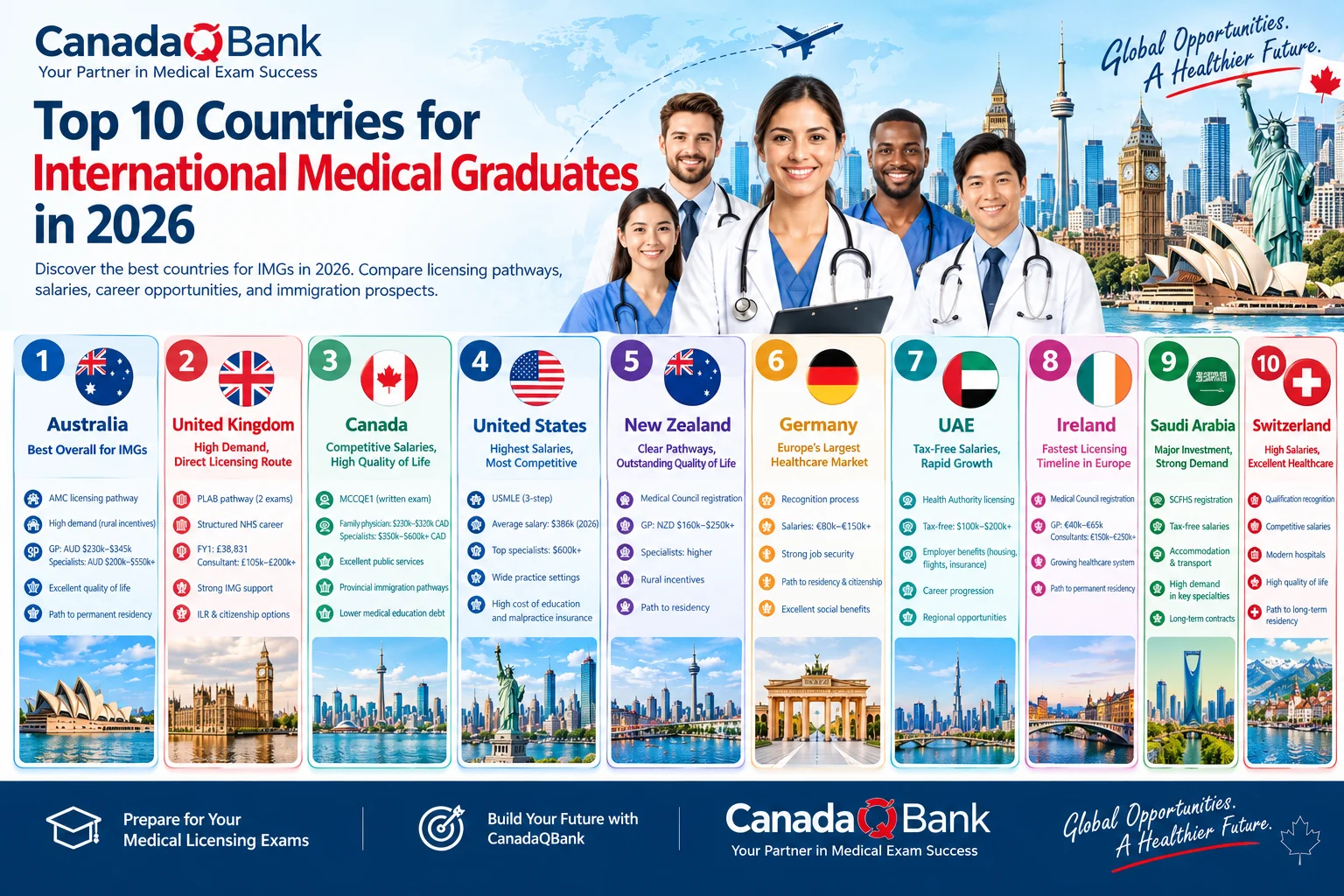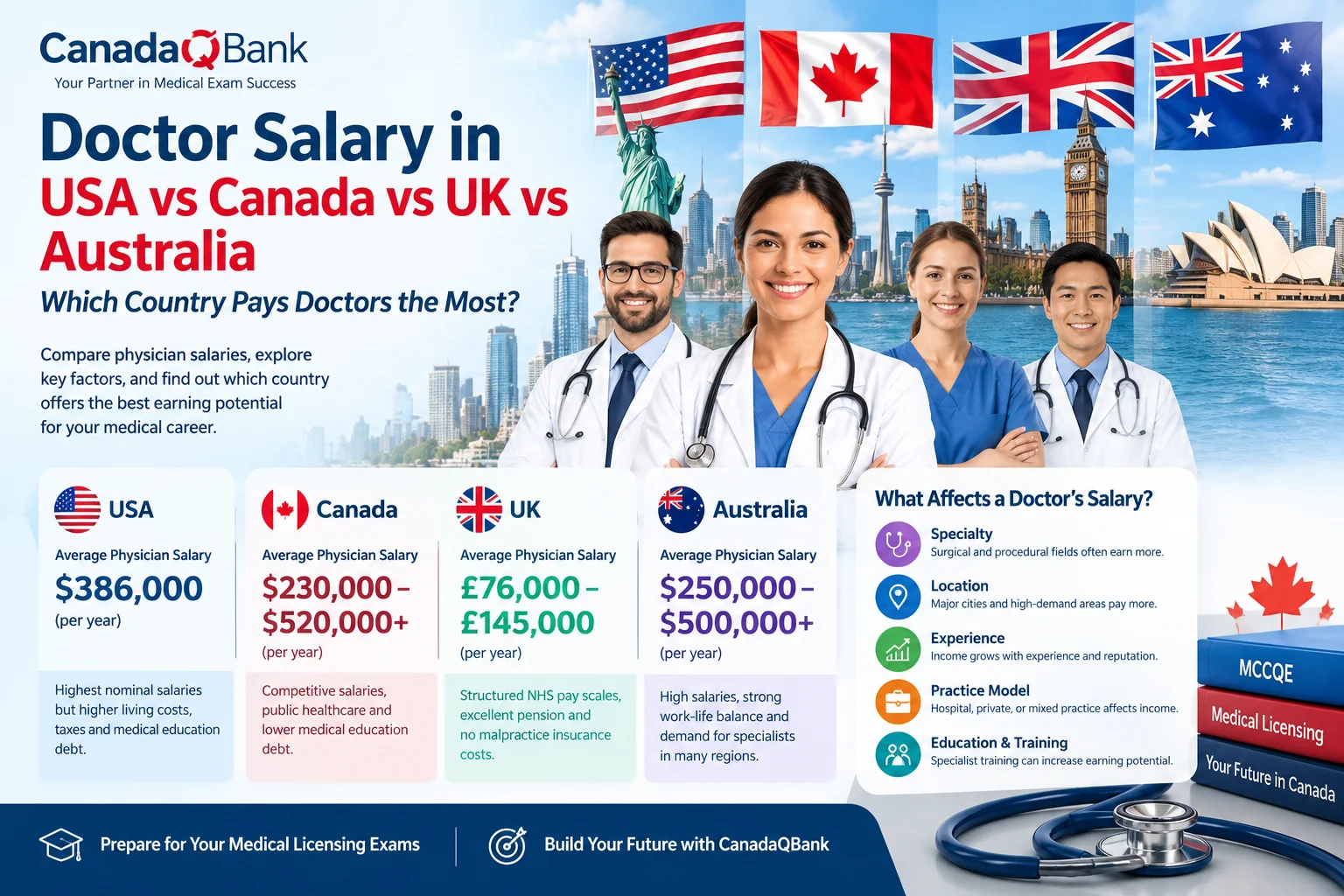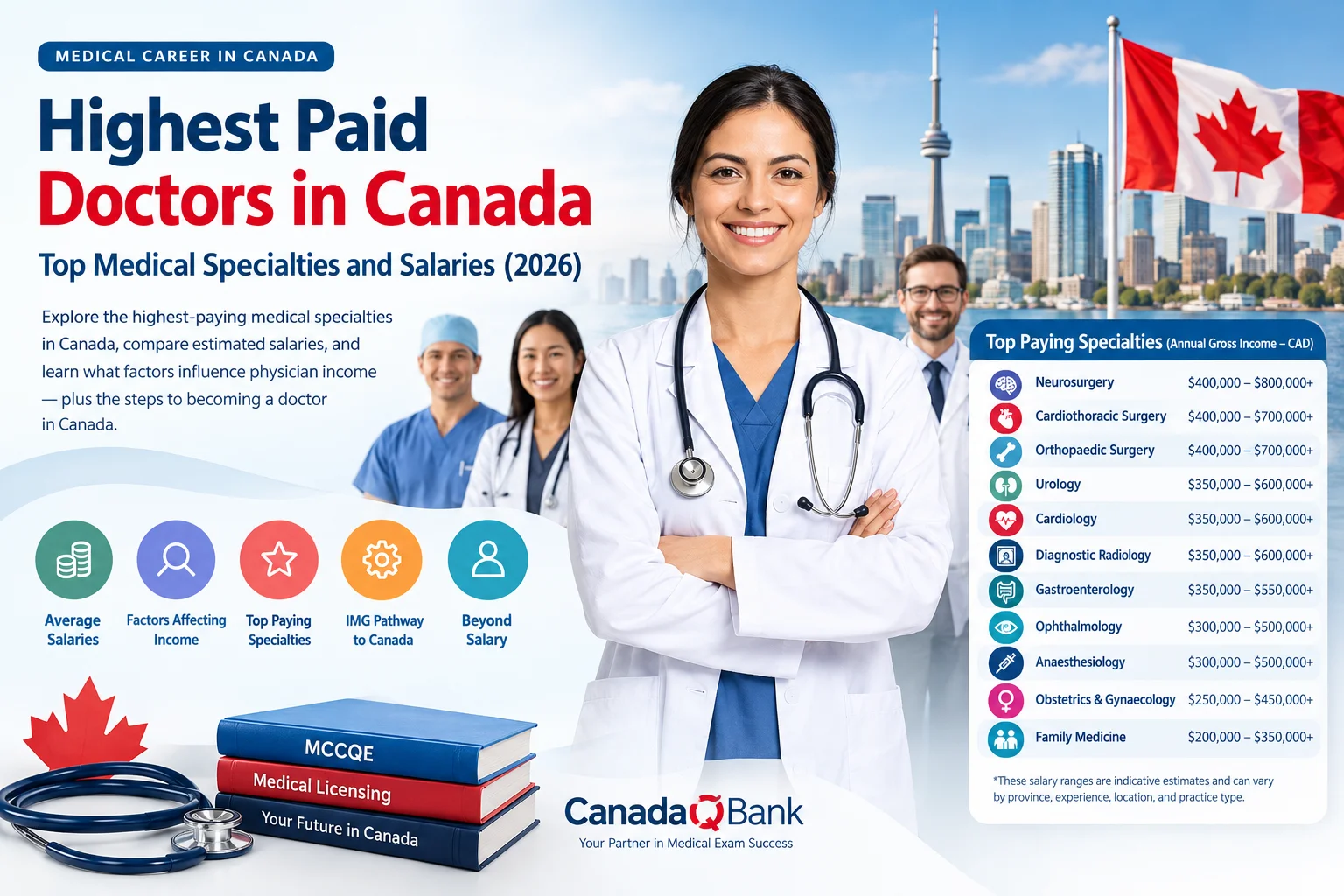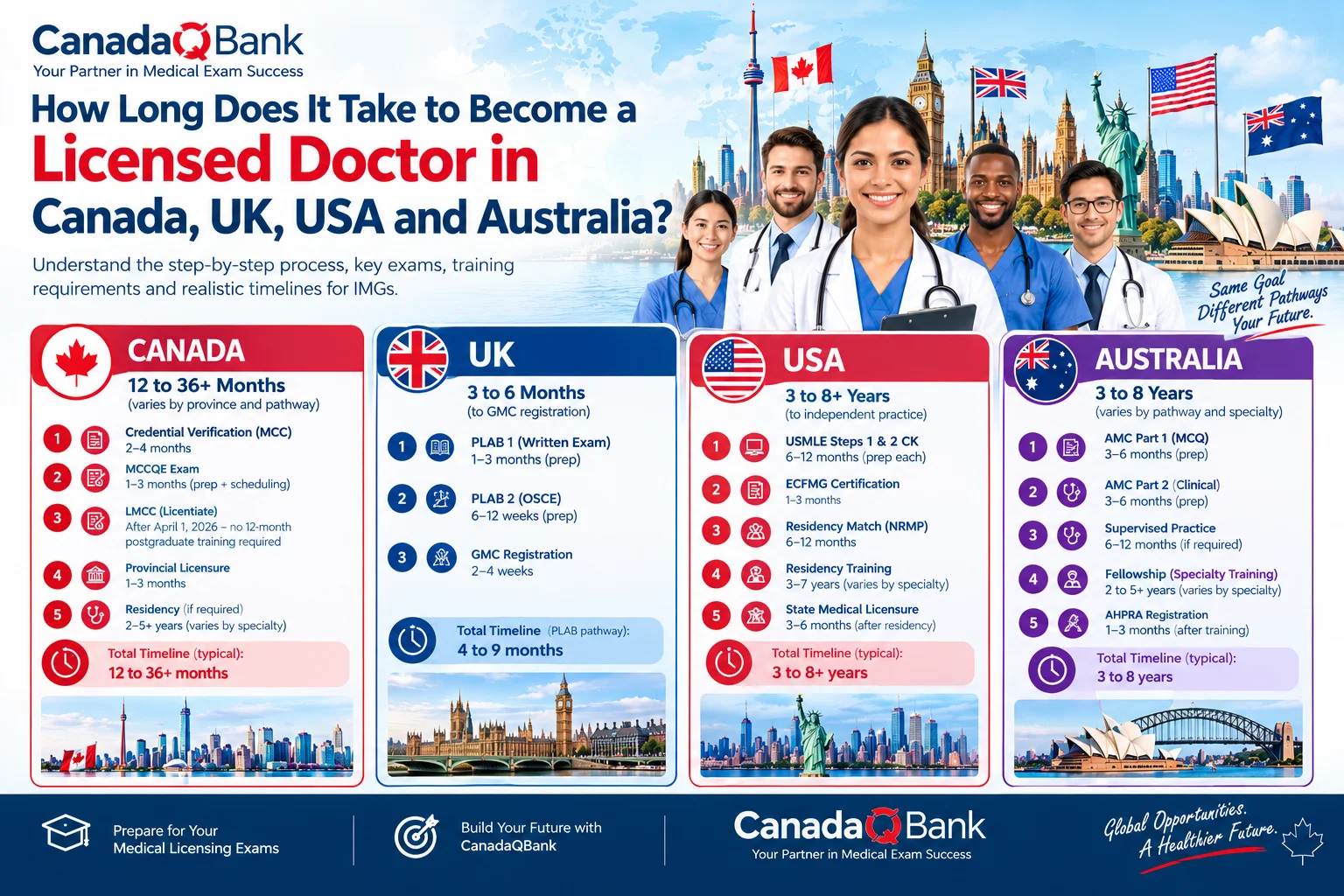
For international medical graduates (IMGs), earning a medical degree is only the first step towards practising in another country. Before you can work as a doctor, you may need to verify your qualifications, pass licensing examinations, demonstrate English-language proficiency, complete postgraduate training, and obtain registration from the relevant medical regulator.
So, how long does it take to become a licensed doctor in Canada, the United Kingdom, the United States, or Australia?
The answer depends on your medical qualifications, previous clinical experience, chosen specialty, examination results, and eligibility for the licensing pathway available to you. Some doctors may qualify for a relatively direct registration route, while others must compete for residency positions or complete additional supervised training.
This guide explains the main licensing routes for international medical graduates, the stages that take the most time, and the factors to consider when choosing where to practise.
Important: The timelines in this article are planning estimates, not guaranteed processing times or official promises. Licensing rules can change, and the medical regulator in your intended country—and, where relevant, state or province—should be your final source for current eligibility requirements.
At a Glance: Medical Licensing Timelines
The four countries do not use identical licensing systems. The following table gives broad planning estimates for common IMG pathways rather than a single timeline that applies to every doctor.
| Country | Main examination or assessment route | What affects the timeline most? |
|---|---|---|
| Canada | Medical Council of Canada examinations and an eligible provincial or territorial licensing pathway | Residency access, provincial rules, and eligibility for alternative pathways |
| United Kingdom | PLAB or another GMC-accepted registration route | Exam availability, English-language requirements, documentation, and the type of registration sought |
| United States | USMLE Steps and ECFMG certification, followed by residency for most IMGs | Residency matching, examination completion, visa eligibility, and specialty choice |
| Australia | AMC Standard Pathway assessments or another eligible pathway | Assessment route, supervised practice opportunities, registration requirements, and specialist recognition |
It is useful to separate three milestones when comparing countries:
- Registration or initial licensure: Permission from the regulator to practise within the scope of the registration granted.
- Completion of postgraduate training: Residency, supervised practice, or other required training.
- Specialist recognition: Approval to practise as a recognised specialist, which may require additional training or assessment.
These milestones are not interchangeable. A doctor may obtain registration without yet being qualified as a specialist, and passing an examination alone does not automatically grant permission to practise.
1. Canada: How Long Does Medical Licensing Take?
Canada can be a challenging destination for international medical graduates because the licensing process involves national credential and examination requirements as well as provincial or territorial regulation. The route depends heavily on your training history and the type of medical practice you intend to enter.
There is no single Canadian timeline that applies to all IMGs.
Step 1: Verify Your Medical Credentials
International medical graduates generally need to have their medical credentials verified through the appropriate Medical Council of Canada (MCC) process.
This involves confirming that the medical qualification was issued by the institution listed in the application. You may need to submit identity documents, degree certificates, and other records according to the applicable instructions.
Start credential verification early. Delays can occur when documents are incomplete, institutions take time to respond, or additional information is required.
Step 2: Complete the Required Examinations
The MCC examination requirements depend on the pathway you are pursuing. The MCC Qualifying Examination (MCCQE) is an important assessment for many IMGs seeking Canadian licensure.
Candidates should confirm the current examination name, eligibility criteria, format, application deadlines, and result arrangements directly with the MCC. Do not rely on an old exam guide because examination policies and formats may change.
Passing an examination is an important milestone, but it does not, by itself, guarantee a residency position or a licence to practise.
Step 3: Determine Whether You Need Canadian Residency
For many IMGs, the main challenge is securing a postgraduate training position through the Canadian Resident Matching Service (CaRMS) or another eligible route.
The residency route is particularly important for doctors who need Canadian postgraduate training to meet the requirements for their intended licence or specialty.
Competition can be substantial, and eligibility may depend on citizenship or immigration status, examination results, language proficiency, previous training, and the rules of the specific program.
Training length varies by specialty. Family medicine programs commonly take about two years, while many other specialties require longer training. Some specialties also require additional fellowship training.
Step 4: Explore Practice-Ready Assessment Pathways
Experienced international family physicians may be eligible for a Practice-Ready Assessment (PRA) pathway in certain provinces or territories.
These programs assess whether a physician with relevant postgraduate training and clinical experience can practise safely in the local healthcare system. Eligibility criteria, assessment arrangements, return-of-service obligations, and licensing conditions vary.
PRA is not a universal shortcut for all IMGs. You should check the requirements of the specific province or program before planning around this route.
Step 5: Apply for Provincial or Territorial Licensure
Medical regulators in Canada’s provinces and territories issue licences. The requirements can differ according to the licence category, training history, examination results, and intended scope of practice.
Depending on your route, you may need to provide evidence of credentials, postgraduate training, professional standing, language proficiency, or other required documentation.
How Long Does Canada Take?
For an IMG pursuing an examination-and-registration route, the process can take many months and may extend beyond a year. If you must secure a residency position and complete postgraduate training, the overall journey can take several years.
A realistic plan should account for credential verification, exam preparation, examination dates, the residency application cycle, training duration, and the time needed for provincial registration.
Key takeaway: Before investing in examinations, identify the exact Canadian licensing pathway for which you may qualify. Your province, previous training, and eligibility for residency or PRA can make a substantial difference to your timeline.
2. United Kingdom: How Long Does It Take to Obtain GMC Registration?
The United Kingdom has a structured registration system administered by the General Medical Council (GMC). Many international medical graduates use the PLAB route, although PLAB is not the only possible route to registration.
For a candidate who already has an acceptable medical qualification, meets the relevant English-language requirements, passes the required assessments, and submits complete documentation, the process may be completed in months. However, examination availability, preparation time, and individual circumstances can extend the timeline.
Step 1: Check Your Eligibility for GMC Registration
Before booking an examination, confirm that your primary medical qualification is acceptable to the GMC and that you meet the current requirements for the registration route you intend to use.
You may also need to demonstrate English-language proficiency and provide evidence of identity, internship or clinical experience where applicable, and other required documentation.
The exact requirements depend on your qualification and circumstances. Some applicants may qualify through routes other than PLAB, such as an accepted postgraduate qualification or another recognised registration pathway.
Step 2: Prepare for PLAB 1
PLAB 1 is a written examination designed to assess whether a doctor has the knowledge and skills expected at the relevant stage of entry into UK medical practice.
Preparation time varies. Some candidates need a few months of structured study, while others need longer depending on their clinical knowledge, familiarity with UK guidance, and available study time.
Candidates should check the GMC’s current examination information for the format, dates, fees, eligibility rules, and booking availability.
Step 3: Pass PLAB 2
PLAB 2 is a practical clinical assessment conducted in person at the GMC assessment centre in Manchester. It evaluates clinical and communication skills through structured stations.
Candidates should allow time for practice with clinical scenarios, communication, history-taking, examination techniques, and management decisions. Passing PLAB 1 does not guarantee an immediate PLAB 2 appointment, so availability can affect the overall schedule.
Step 4: Apply for GMC Registration With a Licence to Practise
After completing the required assessments and meeting the other criteria, eligible candidates can apply for the appropriate GMC registration.
The GMC must assess the application and supporting documents. Missing or inconsistent information can delay the decision.
A successful registration application is not the same as securing an NHS job. Employment, immigration permission, employer checks, and any role-specific requirements are separate considerations.
How Long Does the UK Pathway Take?
A well-prepared candidate may be able to complete the PLAB and registration stages within several months, but there is no guaranteed three-, six-, or nine-month deadline. Exam availability, preparation needs, application processing, and document verification all matter.
Obtaining GMC registration also does not make a doctor a consultant. Doctors seeking specialist or general-practice recognition may need to complete approved training or meet the relevant specialist registration requirements.
What About the UKMLA?
The UK Medical Licensing Assessment (UKMLA) framework applies to UK medical graduates and informs the assessment standards for doctors entering UK practice. International graduates should follow the GMC’s current guidance on PLAB and any applicable changes to assessment requirements.
Do not assume that PLAB will automatically be replaced for all international applicants in a particular year. Confirm the current rules with the GMC before booking an examination.
Key takeaway: The UK may offer a comparatively direct registration route for eligible IMGs, but registration, employment, postgraduate training, and specialist recognition are separate steps.
3. United States: How Long Does It Take to Become a Licensed Doctor?
The United States has a multi-stage pathway for most international medical graduates. Candidates typically need to complete the relevant United States Medical Licensing Examination (USMLE) requirements, obtain Educational Commission for Foreign Medical Graduates (ECFMG) certification, and secure a residency position before progressing through postgraduate training.
The process can be lengthy because examination success does not guarantee a residency match.
Step 1: Complete USMLE Step 1
USMLE Step 1 assesses the foundations of medical science and their application to health, disease, and clinical practice.
Step 1 is reported as pass or fail; it does not currently provide a three-digit numerical score. Candidates should therefore avoid study resources or articles claiming that Step 1 produces a numerical score under the current scoring system.
Preparation time depends on your medical background, familiarity with the examination, and daily study schedule. Some candidates prepare over several months, but there is no universally appropriate preparation period.
Step 2: Pass USMLE Step 2 CK
USMLE Step 2 Clinical Knowledge (CK) assesses the application of clinical knowledge in patient care. It is scored numerically and can be an important part of a residency application.
Candidates should build their preparation around the current USMLE content outline and official examination guidance. A strong performance can support an application, but it cannot guarantee a residency position.
Step 3: Meet ECFMG Certification Requirements
Most international medical graduates entering US residency through the standard route need ECFMG certification.
Requirements include verification of the medical school’s eligibility and the candidate’s credentials, successful completion of the required USMLE examinations, and satisfaction of the applicable clinical and communication skills requirements or approved pathways in force at the time of application.
The exact requirements can change. Candidates should check the ECFMG website for their graduation year, medical school, and intended application cycle rather than relying on a fixed checklist from an older article.
Step 4: Apply for Residency and Participate in the Match
For most IMGs, residency is the most consequential stage of the US pathway.
Applicants typically submit applications to residency programs and may be invited to interviews. Many programs participate in the National Resident Matching Program (NRMP) Main Residency Match, although the applicable process depends on the program and specialty.
A candidate who does not match may need to strengthen the application and apply again in a later cycle. That can add a year or more to the overall journey.
Residency competitiveness varies by specialty and program. It is not accurate to label an entire specialty or state as guaranteed to be IMG-friendly. Applicants should evaluate current program eligibility, visa sponsorship, selection criteria, and published match data.
Step 5: Complete Residency Training
Residency length depends on the specialty. Examples of common training lengths include:
- Family medicine: typically three years.
- Internal medicine: typically three years.
- General surgery: typically five years.
- Neurology: commonly four years, depending on the training structure.
- Other specialties: duration varies according to the relevant training pathway.
Some doctors then pursue fellowship training, which adds further time.
Step 6: Complete USMLE Step 3 and Meet State Licensing Requirements
USMLE Step 3 is generally taken after the candidate meets the examination’s eligibility requirements, which for IMGs normally include ECFMG certification. It is often completed during residency.
A state medical licence is issued by the relevant state medical board, not by USMLE or ECFMG. Requirements can include examination completion, postgraduate training, credential verification, background checks, and other state-specific conditions.
Passing Step 3 does not automatically grant a state licence.
How Long Does the US Pathway Take?
For an IMG who secures a residency position, completes the required examinations and certification steps, and follows a standard training route, the journey from beginning the licensing process to completing residency can take several years.
As a broad planning guide, the pre-residency examination and application stages may take one or more years, depending on preparation and match timing. Residency then commonly adds three to five years or longer, depending on specialty. Additional fellowships, repeat examinations, unsuccessful match attempts, or visa issues may extend the timeline.
Key takeaway: In the United States, planning for residency is just as important as planning for USMLE examinations. Candidates should evaluate the entire pathway rather than treating exam completion as the finish line.
4. Australia: How Long Does Medical Registration Take?
Australia offers several pathways for international medical graduates. The appropriate route depends on whether you are seeking general registration, applying through a recognised competent-authority route, or pursuing recognition as a specialist.
The Australian Medical Council (AMC) assesses many IMGs, while registration is handled by the Medical Board of Australia through the Australian Health Practitioner Regulation Agency (AHPRA).
Step 1: Identify the Correct Registration Pathway
Before booking an examination, determine which pathway applies to your qualifications and experience.
Common routes include:
- Standard Pathway: Commonly used by IMGs who need to demonstrate that their medical knowledge and clinical skills meet Australian standards.
- Competent Authority Pathway: Available to eligible applicants who have completed specified assessments or training in recognised jurisdictions.
- Specialist Pathway: For doctors with specialist qualifications who are seeking assessment for specialist recognition in Australia.
These routes have different eligibility criteria. Completing the AMC examinations is not necessarily required for every IMG, and the specialist pathway should not be confused with the standard route to general registration.
Step 2: Complete the Required AMC Assessments if Applicable
Under the Standard Pathway, candidates generally need to pass the AMC CAT Multiple-Choice Question (MCQ) examination and then demonstrate clinical competence through an accepted route.
Depending on the pathway and current rules, the clinical component may involve the AMC Clinical Examination or an approved workplace-based assessment (WBA) program.
Candidates should check the AMC’s current guidance for exam eligibility, format, assessment availability, fees, and the requirements for progressing to the next stage.
Step 3: Apply for Registration Through AHPRA
Passing the required AMC assessments is not the same as receiving medical registration. Applicants must satisfy the Medical Board of Australia’s registration requirements and submit the necessary evidence.
This may include verification of qualifications, proof of identity, English-language proficiency, professional history, and other checks required for the relevant registration category.
The Medical Board determines the conditions under which an applicant can practise. AHPRA administers the registration process on the Board’s behalf.
Step 4: Complete Supervised Practice if Required
Depending on the registration pathway and the applicant’s background, supervised practice or other approved clinical requirements may be necessary before general registration is granted.
The exact arrangement is not identical for every IMG. Requirements can depend on the registration category, previous internship or postgraduate experience, and the Board’s decision.
Candidates should not assume that everyone must complete the same internship, or that passing both AMC examinations automatically grants unrestricted general registration.
Step 5: Pursue Specialist Recognition if Needed
Doctors seeking recognition as specialists must follow the relevant specialist assessment pathway. The appropriate specialist medical college assesses overseas qualifications and experience and determines whether additional training, assessment, or supervised practice is required.
For example, the requirements for recognition in general practice differ from those for surgery or internal medicine. Specialist recognition may add several years, particularly when additional Australian training is required.
How Long Does Australia Take?
The timeline varies considerably by pathway. Candidates following the Standard Pathway may need months for exam preparation and assessment, followed by registration and any required supervised practice. The complete process may take multiple years.
Applicants who qualify for a different pathway may have a different timeline, while those seeking specialist recognition may need additional assessment or training.
Key takeaway: Confirm your registration pathway before estimating the time or cost of moving to Australia. The AMC assessment route, competent-authority eligibility, and specialist recognition route are not interchangeable.
5. Canada vs the UK vs the USA vs Australia
Which country is fastest? There is no reliable answer for every IMG because each country measures different milestones and applicants enter with different qualifications.
| Factor | Canada | United Kingdom | United States | Australia |
|---|---|---|---|---|
| Main regulator or assessment bodies | MCC and provincial/territorial medical regulators | GMC | ECFMG, USMLE, and state medical boards | AMC, Medical Board of Australia, and AHPRA |
| Common assessment route | MCC examinations, where required | PLAB or another accepted route | USMLE and ECFMG certification for most IMGs | AMC Standard Pathway assessments, where required |
| Is passing an exam enough to practise? | No | No | No | No |
| Is postgraduate training relevant? | Yes; requirements depend on the licence and route | Yes, for many training and specialist routes | Residency is central to the standard IMG route | Supervised practice or further training may be required |
| Main planning challenge | Finding an eligible route and, where needed, residency | Exam access, registration requirements, and employment | Residency matching and completing training | Choosing the correct pathway and meeting registration requirements |
The most useful comparison is not simply the number of months to pass an exam. It is the time, cost, and eligibility requirements from your current position to the level of practice you want to achieve.
6. What Can Make the Licensing Process Take Longer?
Several factors can change your timeline in any of these countries.
Your Medical School and Graduation Details
Regulators and certification bodies may need to confirm that your medical school and qualification meet their requirements. Graduates from different institutions or graduation years may face different verification or eligibility rules.
Your Previous Internship and Postgraduate Training
Previous clinical experience can affect which routes are open to you. It may be relevant to registration, residency eligibility, supervised practice, or specialist assessment.
However, experience is not automatically accepted as equivalent to local training. The regulator or assessment body makes that determination under its current rules.
Examination Preparation and Availability
Candidates need time to prepare, obtain an examination appointment, sit the exam, and receive the result. A failed attempt may require additional preparation and a later sitting.
Booking availability can also affect progress even when a candidate is ready to take the exam.
Residency or Supervised Practice Opportunities
In the United States and Canada, obtaining a suitable residency position can be a major factor in the overall timeline. In Australia and other pathways, access to an approved supervised practice or assessment position can also matter.
Passing examinations does not guarantee that a training position will be available immediately.
Documents, English-Language Evidence, and Background Checks
Missing documents, inconsistencies in professional history, delayed credential verification, and outstanding language requirements can hold up an application.
Prepare these requirements early and use the current checklist from the relevant regulator or certification body.
Your Intended Specialty
A doctor seeking general registration may have a different timeline from one seeking specialist recognition. Surgical and other specialist training routes can require several additional years beyond initial registration.
For this reason, always estimate the time to your specific goal: initial registration, completion of residency, general registration, or specialist qualification.
7. How to Plan Your Licensing Journey
A practical plan begins with your eligibility, not with an examination booking.
- Choose your target country and intended level of practice. Decide whether you want initial registration, residency training, general registration, or specialist recognition.
- Check the official pathway. Use the relevant medical regulator’s current guidance to determine your eligibility and required assessments.
- Verify your credentials early. Find out which documents must be verified and how long the process may take.
- Build an examination plan. Set realistic preparation targets and account for examination dates, result schedules, and possible resits.
- Research training and employment requirements. Check residency eligibility, supervised practice requirements, job availability, visa conditions, and any return-of-service obligations.
- Budget for the full process. Include examination fees, credential verification, preparation resources, travel where required, application fees, and living expenses.
- Recheck official guidance before each major step. Requirements and examination policies can change, so use current official information when making decisions.
This approach helps you avoid spending time and money on an examination or pathway that does not lead to your intended registration outcome.
8. How CanadaQBank Can Support Your Exam Preparation
Preparing for licensing examinations takes more than memorising facts. Candidates need to apply clinical knowledge, recognise common presentations, interpret investigations, and make decisions in the style expected by the examination.
CanadaQBank offers question-bank resources for several medical examination pathways, including MCCQE, USMLE, PLAB, and AMC preparation. Depending on the product, candidates can use practice questions, explanations, timed study sessions, and performance review tools to identify weaker areas.
A structured question-bank routine can help you:
- Identify gaps in clinical knowledge.
- Practise applying concepts to patient scenarios.
- Review explanations and understand why answers are correct or incorrect.
- Track performance by subject or category where those tools are available.
- Build familiarity with question-based examinations.
A question bank is a preparation resource, not a guarantee of passing an examination, obtaining registration, or securing a residency position. Combine practice with the official examination blueprint, relevant clinical guidance, and a study schedule suited to your background.
Explore the available preparation resources at CanadaQBank.com and choose the question bank that matches the examination you intend to take.
Conclusion
Becoming a licensed doctor in Canada, the UK, the USA, or Australia can take months to several years, depending on your qualifications, the pathway available to you, and whether further postgraduate training is required.
The UK may offer a relatively direct route to GMC registration for eligible candidates. Canada’s timeline often depends on the applicable provincial pathway and, for many doctors, access to postgraduate training. In the United States, residency matching and training are major components of the journey. In Australia, the timeline depends on whether the Standard, Competent Authority, or Specialist Pathway applies and whether supervised practice or further training is required.
The most important first step is to identify the correct licensing pathway for your own qualifications. Then confirm the current requirements with the relevant official body, plan for examinations and documents, and allow for the possibility of delays.
With realistic expectations and structured preparation, you can make better-informed decisions about where to pursue your medical career.
Frequently Asked Questions
Which country is the fastest for an international medical graduate to get licensed?
There is no single fastest country for every IMG. The answer depends on your qualifications, previous training, eligibility for the available registration route, exam availability, and the level of practice you want to achieve. Compare the requirements that apply to your own situation rather than relying on a universal ranking.
Can I work as a doctor immediately after passing PLAB?
No. Passing the required PLAB assessments does not automatically grant GMC registration or a job. You must meet the GMC’s other registration requirements and obtain the appropriate registration with a licence to practise. Employment and immigration requirements are separate.
Does passing USMLE Step 1 and Step 2 CK guarantee a US residency position?
No. Most IMGs pursuing the standard US route also need to meet ECFMG certification requirements and apply for residency. Selection depends on each program’s criteria and the competitiveness of the application cycle.
Do all international doctors need to take the AMC examinations in Australia?
No. The required route depends on the applicant’s qualifications and eligibility. The Standard Pathway commonly involves AMC assessments, while other eligible applicants may qualify for a Competent Authority or Specialist Pathway.
Does medical registration mean I am a specialist?
Not necessarily. Registration or licensure permits practice under the relevant conditions, but specialist recognition may require further postgraduate training, assessment, or approval by the appropriate authority.
What should I do before choosing a country?
Check the current official requirements for your medical qualification, examination eligibility, postgraduate training, language evidence, registration category, immigration status, and intended specialty. These details are more useful for estimating your timeline than a general country-level average.