


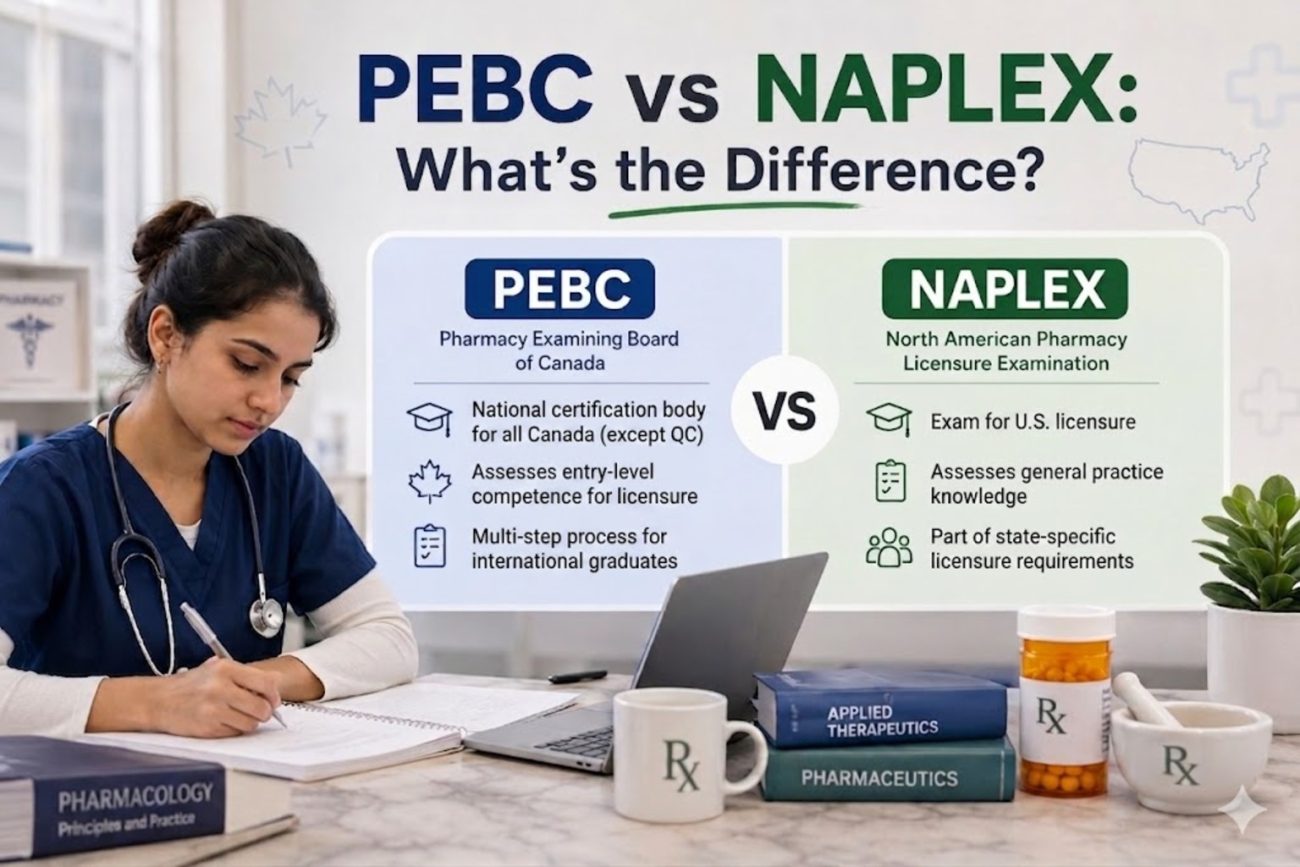
For internationally trained pharmacists and pharmacy graduates looking to build a successful career abroad, understanding the licensing requirements in different countries is essential. Two of the most commonly discussed pharmacy licensing examinations are the PEBC Evaluating Examination and the NAPLEX. While both exams assess the competency of pharmacy professionals, they serve different purposes, apply to different countries, and follow distinct examination formats.
If you’re planning to practice pharmacy in Canada or the United States, knowing the differences between PEBC and NAPLEX can help you choose the right pathway and prepare effectively. In this guide, we’ll compare both exams in detail, discuss eligibility requirements, exam structure, career opportunities, and explain how CanadaQBank can help you succeed on your first attempt.
What Is the PEBC?
The Pharmacy Examining Board of Canada (PEBC) is the national certification body responsible for assessing the qualifications and competencies of pharmacists seeking licensure in Canada.
The PEBC certification process is primarily designed for:
- International Pharmacy Graduates (IPGs)
- Canadian pharmacy graduates
- Pharmacists seeking registration in Canadian provinces
Before obtaining a pharmacy license in Canada, candidates typically need to pass several assessment stages administered by PEBC.
PEBC Examination Pathway
For International Pharmacy Graduates, the process usually includes:
1. Document Evaluation
Candidates submit their educational credentials and supporting documents to verify that their pharmacy education meets Canadian standards.
2. PEBC Evaluating Examination
This exam evaluates whether an international graduate’s pharmacy knowledge is equivalent to that of a Canadian pharmacy graduate.
3. PEBC Qualifying Examination
The Qualifying Examination consists of:
- Part I: Multiple Choice Questions (MCQ)
- Part II: Objective Structured Clinical Examination (OSCE)
Successful completion demonstrates readiness for pharmacy practice in Canada.
4. Provincial Licensing Requirements
Each province may require:
- Jurisprudence examinations
- Language proficiency tests
- Internship or practical training
What Is the NAPLEX?
The North American Pharmacist Licensure Examination (NAPLEX) is the primary licensing examination for pharmacists in the United States.
The exam is administered by the National Association of Boards of Pharmacy (NABP) and is designed to assess whether a candidate possesses the knowledge and skills required to practice pharmacy safely and effectively.
Unlike PEBC, NAPLEX is generally taken after graduation from an accredited pharmacy program or after completing foreign pharmacy graduate certification requirements.
NAPLEX Examination Pathway
International pharmacists who wish to practice in the United States typically follow this route:
1. Foreign Pharmacy Graduate Equivalency Certification (FPGEC)
Candidates must obtain certification through NABP.
Requirements generally include:
- Pharmacy degree evaluation
- English proficiency requirements
- Passing the Foreign Pharmacy Graduate Equivalency Examination (FPGEE)
2. Internship Hours
Most states require a specific number of supervised internship hours.
3. NAPLEX
Candidates take the NAPLEX to demonstrate competency in pharmacy practice.
4. MPJE or State Law Exam
Many states also require the:
- Multistate Pharmacy Jurisprudence Examination (MPJE)
or
- State-specific pharmacy law examination
PEBC vs NAPLEX: Key Differences
Let’s compare both examinations side by side.
| Feature | PEBC | NAPLEX |
|---|---|---|
| Country | Canada | United States |
| Governing Body | Pharmacy Examining Board of Canada | National Association of Boards of Pharmacy |
| Purpose | Certification and licensure in Canada | Licensure in the United States |
| Target Candidates | Canadian and International Pharmacy Graduates | U.S. and Foreign Pharmacy Graduates |
| Exam Stages | Evaluating Exam + Qualifying Exam | NAPLEX after FPGEC or accredited degree |
| Clinical Assessment | Includes OSCE | No OSCE |
| Focus | Knowledge + Clinical Skills | Pharmacy Practice Competency |
| Additional Requirements | Provincial registration requirements | State board requirements |
PEBC Exam Format
The PEBC Evaluating Examination primarily focuses on foundational pharmaceutical sciences and clinical knowledge.
Major Areas Tested
- Biomedical sciences
- Pharmaceutical sciences
- Pharmacology
- Therapeutics
- Pharmacy practice
- Patient care
Question Style
Candidates encounter:
- Multiple-choice questions
- Clinical scenarios
- Therapeutic decision-making questions
The Qualifying Examination further evaluates practical clinical skills through the OSCE component.
This makes PEBC particularly comprehensive because it tests both theoretical knowledge and real-world patient interactions.
NAPLEX Exam Format
NAPLEX focuses heavily on pharmacy practice and patient-centered care.
Areas Covered
- Pharmacotherapy
- Medication dispensing
- Patient safety
- Pharmacy calculations
- Drug information
- Clinical decision-making
Question Types
The NAPLEX includes:
- Multiple-choice questions
- Case-based scenarios
- Select-all-that-apply questions
- Calculations
- Clinical application questions
Unlike PEBC, there is no OSCE component.
Instead, NAPLEX emphasizes practical clinical judgment through computer-based scenarios.
Which Exam Is More Difficult?
This is one of the most frequently asked questions among international pharmacists.
The truth is that difficulty depends largely on your educational background and career goals.
PEBC Challenges
Many candidates find PEBC challenging because:
- It includes multiple stages
- Clinical skills are tested through OSCE
- Canadian healthcare standards may differ from their home country
- Communication skills are heavily assessed
NAPLEX Challenges
Candidates often find NAPLEX demanding because:
- Questions are highly application-based
- Clinical decision-making is emphasized
- Calculations can be extensive
- Time management is crucial
Both exams require serious preparation and should not be underestimated.
Career Opportunities After PEBC
Passing PEBC opens the door to pharmacy careers throughout Canada.
Potential roles include:
Community Pharmacist
Working in retail pharmacies and providing patient counseling.
Hospital Pharmacist
Managing medication therapy within healthcare institutions.
Clinical Pharmacist
Collaborating with healthcare teams to optimize patient outcomes.
Pharmacy Manager
Overseeing pharmacy operations and staff.
Pharmaceutical Industry Roles
Working in:
- Drug development
- Medical affairs
- Regulatory affairs
- Pharmacovigilance
Canada continues to experience demand for qualified pharmacists in many provinces, making PEBC certification a valuable investment.
Career Opportunities After NAPLEX
Passing NAPLEX enables pharmacists to pursue careers throughout the United States.
Popular career paths include:
Retail Pharmacy
Working for major pharmacy chains and independent pharmacies.
Hospital Pharmacy
Providing specialized pharmaceutical care.
Ambulatory Care Pharmacy
Managing chronic disease therapies.
Specialty Pharmacy
Supporting patients with complex conditions.
Industry and Research
Opportunities exist in:
- Clinical research
- Pharmaceutical companies
- Drug safety
- Regulatory affairs
The U.S. pharmacy market offers extensive career flexibility and competitive earning potential.
PEBC or NAPLEX: Which Should You Choose?
Your choice depends entirely on where you intend to practice.
Choose PEBC If:
- You want to practice in Canada.
- You plan to immigrate to Canada.
- You are pursuing Canadian pharmacy licensure.
- You want opportunities within Canada’s healthcare system.
Choose NAPLEX If:
- You want to practice in the United States.
- You intend to pursue state licensure.
- You are completing the FPGEC pathway.
- Your long-term career goals are U.S.-based.
Attempting one exam does not automatically qualify you for practice in the other country because each licensing pathway has its own regulatory requirements.
How CanadaQBank Helps You Pass PEBC and Other Licensing Exams
Success in pharmacy licensing examinations depends heavily on preparation quality. Many candidates spend months studying but struggle because they use outdated materials or insufficient practice questions.
At CanadaQBank, we provide comprehensive exam preparation resources designed specifically for healthcare professionals pursuing licensing and certification exams.
Our platform offers:
- High-quality exam-style questions
- Detailed answer explanations
- Realistic practice exams
- Performance tracking
- Flexible online access
- Updated content aligned with current exam standards
Thousands of healthcare professionals worldwide use CanadaQBank to prepare for exams such as:
- PEBC
- MCCQE Part I
- USMLE
- PLAB
- AMC
- SMLE
By practicing with realistic question banks and identifying weak areas early, candidates can build confidence and improve their chances of passing on the first attempt.
Whether you’re preparing for the PEBC Evaluating Examination or planning your broader healthcare licensing journey, CanadaQBank provides the tools needed to study smarter and perform at your best.
Final Thoughts
Both PEBC and NAPLEX play critical roles in ensuring pharmacists meet the professional standards required for safe patient care. While the PEBC pathway is designed for pharmacy licensure in Canada and includes both knowledge and clinical skills assessments, NAPLEX focuses on evaluating pharmacy practice competency for licensure in the United States.
Understanding the differences between these examinations can help you make informed career decisions and develop an effective preparation strategy. Regardless of which path you choose, success depends on consistent study, comprehensive practice, and access to high-quality preparation resources.
For aspiring pharmacists seeking exam success, CanadaQBank remains a trusted partner in helping candidates prepare with confidence and achieve their professional goals.