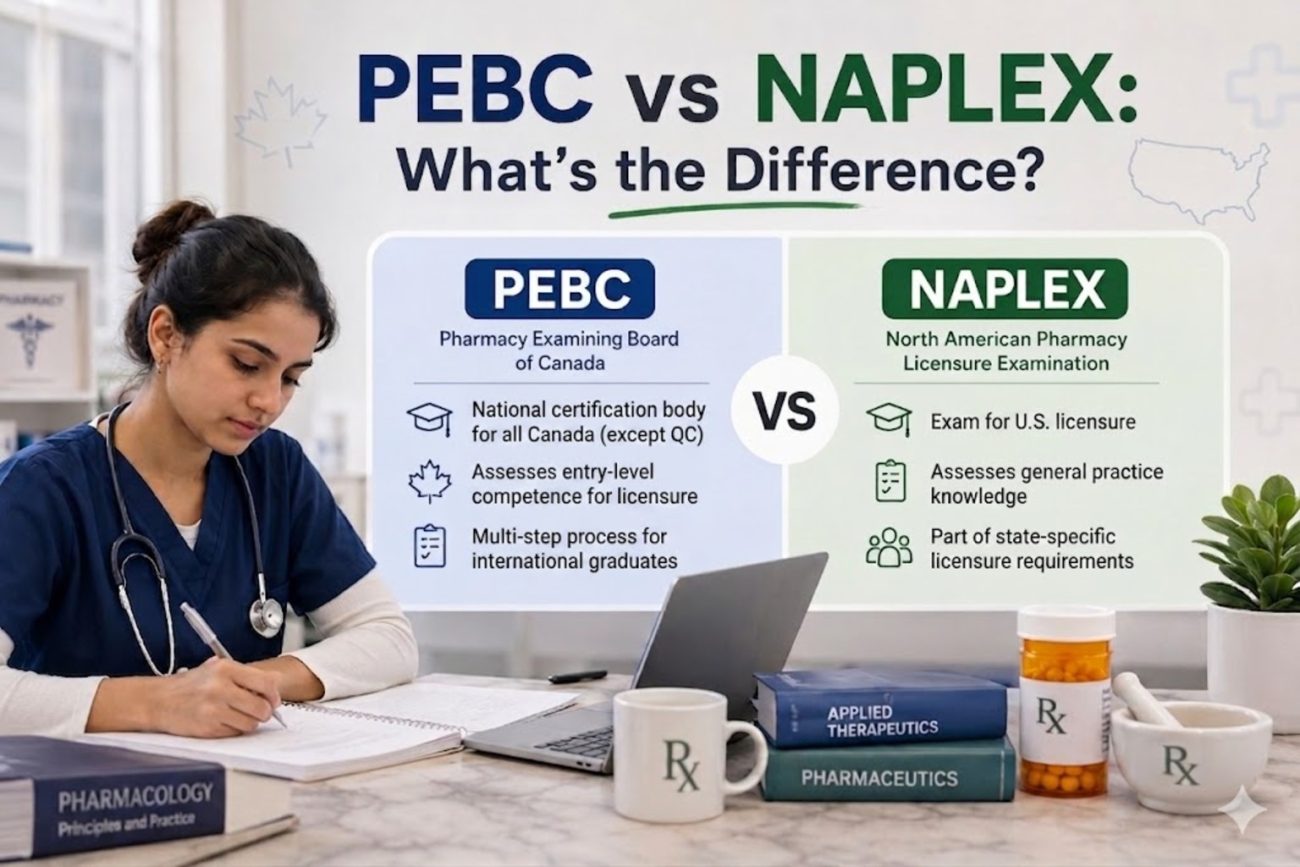
PEBC vs NAPLEX: What’s the Difference?

PEBC vs NAPLEX: What’s the Difference?

For internationally trained pharmacists and pharmacy graduates looking to build a successful career abroad, understanding the licensing requirements in different countries is essential. Two of the most commonly discussed pharmacy licensing examinations are the PEBC Evaluating Examination and the NAPLEX. While both exams assess the competency of pharmacy professionals, they serve different purposes, apply to different countries, and follow distinct examination formats.

If you’re planning to practice pharmacy in Canada or the United States, knowing the differences between PEBC and NAPLEX can help you choose the right pathway and prepare effectively. In this guide, we’ll compare both exams in detail, discuss eligibility requirements, exam structure, career opportunities, and explain how CanadaQBank can help you succeed on your first attempt.

What Is the PEBC?

The Pharmacy Examining Board of Canada (PEBC) is the national certification body responsible for assessing the qualifications and competencies of pharmacists seeking licensure in Canada.

The PEBC certification process is primarily designed for:

  • International Pharmacy Graduates (IPGs)
  • Canadian pharmacy graduates
  • Pharmacists seeking registration in Canadian provinces

Before obtaining a pharmacy license in Canada, candidates typically need to pass several assessment stages administered by PEBC.

PEBC Examination Pathway

For International Pharmacy Graduates, the process usually includes:

1. Document Evaluation

Candidates submit their educational credentials and supporting documents to verify that their pharmacy education meets Canadian standards.

2. PEBC Evaluating Examination

This exam evaluates whether an international graduate’s pharmacy knowledge is equivalent to that of a Canadian pharmacy graduate.

3. PEBC Qualifying Examination

The Qualifying Examination consists of:

  • Part I: Multiple Choice Questions (MCQ)
  • Part II: Objective Structured Clinical Examination (OSCE)

Successful completion demonstrates readiness for pharmacy practice in Canada.

4. Provincial Licensing Requirements

Each province may require:

  • Jurisprudence examinations
  • Language proficiency tests
  • Internship or practical training

What Is the NAPLEX?

The North American Pharmacist Licensure Examination (NAPLEX) is the primary licensing examination for pharmacists in the United States.

The exam is administered by the National Association of Boards of Pharmacy (NABP) and is designed to assess whether a candidate possesses the knowledge and skills required to practice pharmacy safely and effectively.

Unlike PEBC, NAPLEX is generally taken after graduation from an accredited pharmacy program or after completing foreign pharmacy graduate certification requirements.

NAPLEX Examination Pathway

International pharmacists who wish to practice in the United States typically follow this route:

1. Foreign Pharmacy Graduate Equivalency Certification (FPGEC)

Candidates must obtain certification through NABP.

Requirements generally include:

  • Pharmacy degree evaluation
  • English proficiency requirements
  • Passing the Foreign Pharmacy Graduate Equivalency Examination (FPGEE)

2. Internship Hours

Most states require a specific number of supervised internship hours.

3. NAPLEX

Candidates take the NAPLEX to demonstrate competency in pharmacy practice.

4. MPJE or State Law Exam

Many states also require the:

  • Multistate Pharmacy Jurisprudence Examination (MPJE)

or

  • State-specific pharmacy law examination

PEBC vs NAPLEX: Key Differences

Let’s compare both examinations side by side.

FeaturePEBCNAPLEX
CountryCanadaUnited States
Governing BodyPharmacy Examining Board of CanadaNational Association of Boards of Pharmacy
PurposeCertification and licensure in CanadaLicensure in the United States
Target CandidatesCanadian and International Pharmacy GraduatesU.S. and Foreign Pharmacy Graduates
Exam StagesEvaluating Exam + Qualifying ExamNAPLEX after FPGEC or accredited degree
Clinical AssessmentIncludes OSCENo OSCE
FocusKnowledge + Clinical SkillsPharmacy Practice Competency
Additional RequirementsProvincial registration requirementsState board requirements

PEBC Exam Format

The PEBC Evaluating Examination primarily focuses on foundational pharmaceutical sciences and clinical knowledge.

Major Areas Tested

  • Biomedical sciences
  • Pharmaceutical sciences
  • Pharmacology
  • Therapeutics
  • Pharmacy practice
  • Patient care

Question Style

Candidates encounter:

  • Multiple-choice questions
  • Clinical scenarios
  • Therapeutic decision-making questions

The Qualifying Examination further evaluates practical clinical skills through the OSCE component.

This makes PEBC particularly comprehensive because it tests both theoretical knowledge and real-world patient interactions.

NAPLEX Exam Format

NAPLEX focuses heavily on pharmacy practice and patient-centered care.

Areas Covered

  • Pharmacotherapy
  • Medication dispensing
  • Patient safety
  • Pharmacy calculations
  • Drug information
  • Clinical decision-making

Question Types

The NAPLEX includes:

  • Multiple-choice questions
  • Case-based scenarios
  • Select-all-that-apply questions
  • Calculations
  • Clinical application questions

Unlike PEBC, there is no OSCE component.

Instead, NAPLEX emphasizes practical clinical judgment through computer-based scenarios.

Which Exam Is More Difficult?

This is one of the most frequently asked questions among international pharmacists.

The truth is that difficulty depends largely on your educational background and career goals.

PEBC Challenges

Many candidates find PEBC challenging because:

  • It includes multiple stages
  • Clinical skills are tested through OSCE
  • Canadian healthcare standards may differ from their home country
  • Communication skills are heavily assessed

NAPLEX Challenges

Candidates often find NAPLEX demanding because:

  • Questions are highly application-based
  • Clinical decision-making is emphasized
  • Calculations can be extensive
  • Time management is crucial

Both exams require serious preparation and should not be underestimated.

Career Opportunities After PEBC

Passing PEBC opens the door to pharmacy careers throughout Canada.

Potential roles include:

Community Pharmacist

Working in retail pharmacies and providing patient counseling.

Hospital Pharmacist

Managing medication therapy within healthcare institutions.

Clinical Pharmacist

Collaborating with healthcare teams to optimize patient outcomes.

Pharmacy Manager

Overseeing pharmacy operations and staff.

Pharmaceutical Industry Roles

Working in:

  • Drug development
  • Medical affairs
  • Regulatory affairs
  • Pharmacovigilance

Canada continues to experience demand for qualified pharmacists in many provinces, making PEBC certification a valuable investment.

Career Opportunities After NAPLEX

Passing NAPLEX enables pharmacists to pursue careers throughout the United States.

Popular career paths include:

Retail Pharmacy

Working for major pharmacy chains and independent pharmacies.

Hospital Pharmacy

Providing specialized pharmaceutical care.

Ambulatory Care Pharmacy

Managing chronic disease therapies.

Specialty Pharmacy

Supporting patients with complex conditions.

Industry and Research

Opportunities exist in:

  • Clinical research
  • Pharmaceutical companies
  • Drug safety
  • Regulatory affairs

The U.S. pharmacy market offers extensive career flexibility and competitive earning potential.

PEBC or NAPLEX: Which Should You Choose?

Your choice depends entirely on where you intend to practice.

Choose PEBC If:

  • You want to practice in Canada.
  • You plan to immigrate to Canada.
  • You are pursuing Canadian pharmacy licensure.
  • You want opportunities within Canada’s healthcare system.

Choose NAPLEX If:

  • You want to practice in the United States.
  • You intend to pursue state licensure.
  • You are completing the FPGEC pathway.
  • Your long-term career goals are U.S.-based.

Attempting one exam does not automatically qualify you for practice in the other country because each licensing pathway has its own regulatory requirements.

How CanadaQBank Helps You Pass PEBC and Other Licensing Exams

Success in pharmacy licensing examinations depends heavily on preparation quality. Many candidates spend months studying but struggle because they use outdated materials or insufficient practice questions.

At CanadaQBank, we provide comprehensive exam preparation resources designed specifically for healthcare professionals pursuing licensing and certification exams.

Our platform offers:

  • High-quality exam-style questions
  • Detailed answer explanations
  • Realistic practice exams
  • Performance tracking
  • Flexible online access
  • Updated content aligned with current exam standards

Thousands of healthcare professionals worldwide use CanadaQBank to prepare for exams such as:

  • PEBC
  • MCCQE Part I
  • USMLE
  • PLAB
  • AMC
  • SMLE

By practicing with realistic question banks and identifying weak areas early, candidates can build confidence and improve their chances of passing on the first attempt.

Whether you’re preparing for the PEBC Evaluating Examination or planning your broader healthcare licensing journey, CanadaQBank provides the tools needed to study smarter and perform at your best.

Final Thoughts

Both PEBC and NAPLEX play critical roles in ensuring pharmacists meet the professional standards required for safe patient care. While the PEBC pathway is designed for pharmacy licensure in Canada and includes both knowledge and clinical skills assessments, NAPLEX focuses on evaluating pharmacy practice competency for licensure in the United States.

Understanding the differences between these examinations can help you make informed career decisions and develop an effective preparation strategy. Regardless of which path you choose, success depends on consistent study, comprehensive practice, and access to high-quality preparation resources.

For aspiring pharmacists seeking exam success, CanadaQBank remains a trusted partner in helping candidates prepare with confidence and achieve their professional goals.

PEBC Evaluating Exam Dates 2026: Schedule, Fees & Deadlines

PEBC Evaluating Exam Dates 2026

If you’re an international pharmacy graduate planning to practice as a pharmacist in Canada, the Pharmacy Examining Board of Canada (PEBC) Evaluating Exam is your essential first step. This comprehensive examination assesses your knowledge and readiness to enter the Canadian pharmacy profession, serving as a foundation for progressing to the PEBC Qualifying Exams.

As 2026 approaches, it’s crucial for all aspiring pharmacists to familiarize themselves with the PEBC Evaluating Exam dates, key deadlines, fees, and preparation strategies. In this detailed guide, we’ll cover everything you need to know about the 2026 PEBC Evaluating Examination — and how CanadaQBank can help you prepare effectively and confidently.

Understanding the PEBC Evaluating Examination

The PEBC Evaluating Examination is designed for international pharmacy graduates (IPGs) who have completed their pharmacy education outside of Canada or the United States. It tests your fundamental pharmaceutical knowledge across key subject areas, including:

  • Pharmaceutical sciences (pharmacology, pharmaceutics, medicinal chemistry)
  • Pharmacy practice and law
  • Clinical therapeutics and patient care
  • Communication and professional ethics

Passing this exam confirms that your academic training aligns with Canadian pharmacy standards and allows you to progress toward the Qualifying Examination (Part I and Part II).

PEBC Evaluating Exam Dates 2026: Full Schedule

For 2026, the PEBC has announced multiple sittings of the Evaluating Exam to accommodate international candidates. Here are the official PEBC Evaluating Exam dates, deadlines, and key details for 2026:

January 2026 PEBC Evaluating Examination

  • Exam Date: Tuesday, January 6, 2026
  • Application Available By: Friday, August 1, 2025
  • Application Deadline: Thursday, September 18, 2025 (12:00 pm ET)
  • Results Release: Wednesday, February 4, 2026 (12:00 pm ET)
  • Exam Centres: List of Prometric Test Centres (worldwide)

March 2026 PEBC Evaluating Examination

  • Exam Date: Wednesday, March 25, 2026
  • Application Available By: Friday, October 10, 2025
  • Application Deadline: Thursday, November 20, 2025 (12:00 pm ET)
  • Results Release: Monday, May 4, 2026 (12:00 pm ET)
  • Exam Centres: List of Prometric Test Centres

💡 Important Note:
The PEBC reserves the right to cancel examinations at specific locations if there are insufficient applicants or unforeseen circumstances. Always verify your test centre availability through the PEBC Candidate Portal before applying.

PEBC Exam Fees for 2026

Understanding the fee structure helps you plan ahead financially. As per the 2025–2026 PEBC schedule, the applicable fees for the Evaluating Exam are:

  • Document Evaluation Fee: CAD $715
  • US Document Evaluation Fee: CAD $250
  • Evaluating Examination Fee: CAD $910
  • Re-scoring (Hand Scoring) Fee: CAD $100
  • Rescheduling/Cancellation Fee: CAD $60 + HST

All payments are made in Canadian currency, and online payments are accepted via Visa or MasterCard.

Application Tips and Key Deadlines

Missing a PEBC deadline can delay your journey by several months. Here’s how you can stay on track:

  1. Create Your PEBC Portal Account Early:
    Register and verify your documents well before the application opens.
  2. Submit Before the Deadline:
    The application portal closes at 12:00 pm (noon Eastern Time) on the final day — not midnight. Avoid last-minute submissions to prevent system delays.
  3. Check Document Evaluation Status:
    You must have your Document Evaluation approved before applying for the Evaluating Exam.
  4. Monitor Email & Portal Updates:
    PEBC communicates primarily through your portal and email. Keep an eye out for important notices about eligibility, scheduling, and results.

What to Expect on Exam Day

The PEBC Evaluating Exam is a computer-based test (CBT) administered through Prometric Testing Centres globally. Here’s what you can expect:

  • Format: Multiple-choice questions (MCQs)
  • Duration: Typically around 4 hours (divided into sections)
  • Focus Areas: Foundational pharmacy knowledge, clinical application, and Canadian healthcare context
  • Scoring: Results are released approximately four weeks after the exam

You’ll need two forms of valid identification and should arrive early at your Prometric test centre to allow time for security checks.

Why Preparation Matters More Than Ever

The PEBC Evaluating Exam is highly competitive, and many candidates underestimate its difficulty. Success requires not just knowledge but also exam strategy and familiarity with Canadian pharmacy standards.

Here’s where CanadaQBank becomes your ultimate preparation partner.

How CanadaQBank Helps You Ace the PEBC Evaluating Exam

CanadaQBank is one of the most trusted and widely used online resources for PEBC exam preparation. It provides a structured, exam-focused approach tailored specifically for international pharmacy graduates.

1. Extensive Question Bank

CanadaQBank offers thousands of PEBC-style multiple-choice questions (MCQs) designed to simulate the real exam environment. Each question is accompanied by detailed explanations and rationales to help you understand both correct and incorrect options.

2. Realistic Exam Simulation

Practice under timed conditions with mock exams that mirror the actual PEBC format. This builds familiarity, improves time management, and boosts your test-day confidence.

3. Topic-Based Practice

Study smarter by targeting specific areas such as:

  • Pharmacokinetics
  • Drug mechanisms and interactions
  • Therapeutics and clinical pharmacy
  • Canadian pharmacy law and ethics

This allows you to focus on your weak points while strengthening your core knowledge base.

4. Performance Analytics

Track your progress over time with performance reports that highlight your strengths and areas needing improvement. You’ll know exactly where to focus your efforts.

5. Accessible Anytime, Anywhere

Whether you’re in Toronto, Dubai, or Mumbai, CanadaQBank’s cloud-based platform lets you study on the go — via desktop, tablet, or smartphone.

6. Trusted by Thousands of Pharmacists

Over the years, thousands of international pharmacy graduates have successfully passed the PEBC Evaluating and Qualifying Exams using CanadaQBank’s resources. It’s not just a study tool — it’s a proven system for success.

Step-by-Step Plan to Prepare for the 2026 PEBC Evaluating Exam

Here’s a simple yet effective 6-step plan to guide your preparation journey:

  1. Start Early (4–6 months before the exam):
    Begin reviewing fundamental subjects and familiarize yourself with the Canadian pharmacy framework.
  2. Use CanadaQBank Daily:
    Dedicate at least 1–2 hours each day to practice questions, review explanations, and take notes.
  3. Simulate Real Exams:
    Take full-length mock tests every few weeks to assess your readiness and adjust your study plan.
  4. Review and Reflect:
    Analyze incorrect answers and revisit related topics to strengthen your understanding.
  5. Stay Updated on Deadlines:
    Keep track of PEBC’s key dates for application, results, and re-registration through the official portal.
  6. Maintain a Balanced Routine:
    Don’t forget rest, exercise, and stress management — a clear mind performs better.

Final Thoughts

The PEBC Evaluating Exam 2026 is your gateway to a fulfilling pharmacy career in Canada. With exams scheduled in January and March 2026, now is the time to start your preparation journey.

Remember, consistent preparation, a strategic approach, and the right resources are key to success. That’s exactly what CanadaQBank offers — a comprehensive, user-friendly, and results-driven platform to help you achieve your PEBC goals with confidence.

So why wait?
Start your PEBC preparation today with CanadaQBank.com and take the first step toward becoming a licensed pharmacist in Canada.

PEBC 2025 Update: New Pathway for International Pharmacy Graduates

PEBC 2025 Update: New Streamlined Pathway for International Pharmacy Graduates Explained

The Pharmacy Examining Board of Canada (PEBC), in their drive to prove their steadfastness and uphold their national mandate of ensuring that Canadians are served by the best and most qualified pharmacists available, recently announced changes to the PEBC exam pathway for internationally trained pharmacists. These changes were made considering the principles that guide PEBC’s decisions, which include integrity, fairness, transparency, innovation, and collaboration.

After reviewing the exam format and requirements for internationally trained pharmacists seeking to work in Canada, the PEBC concluded the review with a few changes made to the structure and requirements of the exams.

Starting May 13, 2025, eligible international pharmacy graduates will be exempt from taking the Pharmacist Evaluation Exam and can move directly to the Qualifying Exam, reducing redundancy in the pathway. Another change, enacted in June 2025, altered the percentage of question sources and the number of questions asked. This article gives a detailed review of both changes and what they mean for IPGs seeking to migrate to Canada.

The Evaluating Exam

The PEBC Evaluating Exam is a prerequisite for initial registration and licensure as a pharmacist in Canada. The exam assesses an applicant’s knowledge and skills and grants the right to move on to the Qualifying Exam. Historically, this exam has served as a gatekeeper to ensure international pharmacy graduates meet a baseline level of competence before undertaking the qualifying process’s MCQ and OSCE components.

With the 2025 updates, however, the role and format of the Evaluating Exam have been adjusted to better reflect modern-day practice and the shifting landscape of pharmacy education internationally.

What the Evaluating Exam Now Looks Like

Under the revised framework, the Evaluating Exam has been refocused on content that maps directly to entry-level pharmacy practice in Canada. Rather than treating biomedical sciences as a standalone domain, the exam now integrates essential scientific principles into clinically relevant contexts—placing greater emphasis on:

  • Pharmaceutical sciences (25%)
  • Clinical pharmacy practice (55%)
  • Behavioural, social, and administrative aspects of care (20%)

The total number of items has been streamlined, and question distribution realigned. Candidates now face a test that is shorter but more tightly linked to what pharmacists do in practice: evaluating medications, designing therapeutic plans, identifying and managing drug interactions or adverse effects, and communicating effectively with patients and healthcare professionals.

Why This Matters to International Graduates

For internationally trained pharmacists, these changes bring two main outcomes:

  1. Exam content more closely mirrors the work they will perform in Canadian settings. Study time once spent on basic science recall can now be redirected to case-based reasoning, pharmacotherapeutics, and patient-centred decision-making.
  2. Because the Evaluating Exam’s function has been narrowed—and the new Streamlined Pathway allows eligible applicants to bypass it—certain pharmacists with equivalent credentials and recent practice experience can progress faster toward licensure.

The Streamlined Pathway: Who Benefits and How It Works

Introduced in mid-May 2025, the Streamlined Pathway is the most significant operational change PEBC announced. It recognises that some international programs and jurisdictions maintain standards comparable to Canada’s, and that repeating another assessment can cause unnecessary delay and cost.

Eligible candidates—those whose education, accreditation status, or recent practice meet PEBC’s criteria—may now move directly to the Qualifying Examination Part I (MCQ), provided their documentation is verified and all administrative requirements are met.

PEBC has outlined two main routes to qualify:

  • Based on the accreditation status of the graduate’s pharmacy program
  • Based on recent, full, unrestricted licensure plus practice in jurisdictions with comparable regulatory frameworks

Candidates should carefully review the board’s guidelines and, where needed, provide clear documentary evidence of accreditation or practice history.

Preparing for the Qualifying Exams Under the New Pathway

For those who qualify for the Streamlined Pathway, preparation shifts immediately toward the Qualifying Exam blueprint.

  • Part I (MCQ): Assesses applied clinical knowledge and decision-making. Success is required before attempting Part II.
  • Part II (OSCE): Evaluates hands-on clinical skills, communication, and professional behaviours.

Prospective candidates should focus preparation on clinical therapeutics, the patient-care process, case-based problem solving, and simulated patient interactions. High-yield areas include pharmacotherapy across major disease states, safe prescribing, monitoring strategies, patient counselling, and jurisdiction-specific topics such as controlled substances regulation, public health, and scope of practice.

For Candidates Still Taking the Evaluating Exam

Not every internationally trained pharmacist will qualify for the Streamlined Pathway. For those in the traditional track, the June 2025 blueprint is important.

Since biomedical content is no longer a separate category, study strategies should focus on integrated clinical application rather than memorization of basic science facts. Candidates should align their revision with the new subject weightings—placing more time on pharmaceutical sciences and pharmacy practice, while also preparing for behavioural and administrative science issues that influence patient safety and outcomes.

Practical Exam-Taking Guidance

Across both pathways, the basics of strong exam technique remain critical:

  • Read clinical vignettes carefully, noting comorbidities, age, renal or hepatic function, pregnancy status, and allergies.
  • Be precise with doses and routes—avoid ranges unless specified.
  • Provide only the number of answers requested.
  • If no treatment is indicated, state so clearly.
  • Use generic drug names whenever possible.
  • Keep patient communication clear and actionable in counselling-style questions.

Systemic and Professional Implications

PEBC’s revisions are not merely administrative; they reflect evolving expectations around competency and public protection. By recognising comparable international training and recent practice, the board aims to maintain high standards while reducing unnecessary barriers to workforce entry—an important consideration in the context of pharmacy workforce planning and health-system demands.

At the same time, the rebalanced Evaluating Exam blueprint and the emphasis on behavioural and social determinants of health point to a profession increasingly attentive to equity, cultural safety and interprofessional collaboration. These are not peripheral topics: regulators and employers alike are placing increased value on clinicians who can navigate complex social contexts and work effectively in diverse healthcare teams.

Actionable Checklist for Candidates

  1. Confirm your status: Use PEBC’s published criteria to determine whether you might qualify for the Streamlined Pathway. Gather program accreditation documentation or proof of recent, full licensure and practice where applicable.

  2. Complete document verification: Ensure your transcripts, licenses and other documents are submitted and verified early. There are bound to be administrative delays so it would be best to get ahead of the curve by applying early.

  3. Select your study target: If you qualify for the streamlined route, prioritize Part I (MCQ) materials and practice items. If not, align study time with the updated Evaluating Exam blueprint. Thankfully, CanadQbank stays current with the latest changes made by the PEBC, as our Qbanks reflect real-time decisions.

  4. Practice OSCE-style skills: Even if you begin with the MCQ, part of the qualifying sequence is the OSCE; work on patient communication, counselling scripts, and problem-solving under time pressure.

  5. Monitor timelines and sittings: PEBC has adjusted scheduling to reflect increased demand; keep an eye on application windows and test dates so you can secure your preferred administration.

  6. Network and seek mentorship: Connect with peers who have recently completed the pathway or with professional groups for internationally trained pharmacists; they can serve as a fount of invaluable practical tips and moral support.

How to Become a Pharmacist in Canada

Becoming a pharmacist in Canada is a rewarding prospect that opens you to many opportunities and allows you to stay at the forefront of medical development.

Pharmacists serve an essential role in every community; they serve as a bridge for people who need medication by explaining how the drugs are taken, their effects, side effects, and potential drug interactions. Ideally, a person should use the same pharmacist as their supplier; this way, they can warn of any adverse interaction that could develop.

Having the knowledge and skill to fulfill the duties required of pharmacists is no easy feat, which is why Canada employs such strict barriers to deter those who do not meet the requirements. To help you navigate the complex process of becoming a pharmacist in Canada, this article discusses the process and materials required of you.

Canada’s requirements to be a pharmacist

Becoming a pharmacist in Canada requires a few things. For one, the process can take as long as 8 years if you’re starting the process from high school. For International Pharmacy Graduates (IPGs), the process takes about three years and can cost anywhere from $12,000 to $24,000.

  1. First on the list is a Bachelor of Science in Pharmacy or Doctor of Pharmacy degree from one of 11 Canadian programs accredited by the Canadian Council for Accreditation of Pharmacy Programs or from any university accredited by the U.S. Accreditation Council for Pharmacy Education (ACPE).
  2. Next is to pass a national board examination through the Qualifying Exam of the Pharmacy Examining Board of Canada (PEBC). This applies to most territories except Québec, which has its own process.
  3. Despite your credentials, everyone is expected to undergo a 12-month supervised apprenticeship/internship program to gain hands-on experience.
  4. Due to pharmacists’ role in the community as one of the faces of the healthcare system, it’s no wonder there is a requirement for proof of fluency in English or French, depending on the province where you plan to work.
  5. Canada’s healthcare system is heavily provincial, meaning each province and territory has its own regulators. They serve as licensing authorities, assessing competency, issuing licenses, and ensuring pharmacists meet professional standards. Before you can practice, you must obtain provincial licensure.

The process for International Pharmacy Graduates (IPGs)

The process is a little different for IPGs seeking to practice in Canada. For one, the process starts with:

  1. Registering with Pharmacists’ Gateway Canada, a platform that serves as an introduction to the Canadian pharmaceutical system. It provides a detailed explanation of the exam, what to expect from it, how to enroll and apply for it, and even an online learning program for international pharmacy graduates, pharmacy students, and pharmacists. This applies to most provinces except Québec and IPGs applying to Nova Scotia’s streamlined licensure pathway.
  2. The Pharmacists’ Gateway Canada serves another purpose beyond introduction. It is also a repository of confidential national documents, accessible to the candidate, the PEBC, and the pharmacy regulatory authority. Thus, it is to them that you submit your documents for evaluation. All applicants must submit transcripts and professional credentials to PEBC for primary source verification. Only those whose education is deemed equivalent to a Canadian program become eligible to write the Evaluating Examination. A minimum of a four‑year pharmacy degree is required.
  3. Depending on the province, you will be asked to prove fluency in English or French. Most provinces accept IELTS (Academic) or CELPIP (General) with minimum scores (e.g., IELTS 7.0 overall, no band below 6.5) to ensure there will be effective patient communication and ethical practice.
  4. Next comes the first exam on this journey, the Pharmacist Evaluating Examination (MCQ). To progress, IPGs must pass this 200‑question multiple‑choice exam, which tests core pharmaceutical sciences and practice knowledge. Candidates are given three attempts, with a fourth possible after at least six months of preparation and remediation approval. This single-day exam lasts for 4.25 hours and is notoriously challenging, with a pass rate of 36%. However, proper preparation will help you overcome any barriers that may come up.
    CanadaQBank provides question banks that are indispensable resources to anyone preparing for the EE. It has a bank of over 1500 questions, and its features are second to none.
  5. After passing the EE, the next step is to complete pre-registration with your provincial regulatory authority. Each province has its own College of Pharmacy or regulatory body that oversees the profession and thus has its own requirements.
  6. In the weeks leading up to the next exam, it is expected that IMGs take a bridging course to fill any gaps in their knowledge of Canadian pharmacy practice. IPGs benefit from the additional education as it teaches them about the local systems and their peculiarities. This period can also be used to learn about the different provinces and what they require from potential workers.
  7. After passing the Evaluating Exam and completing the bridging course, candidates can attempt the PEBC Qualifying Exam. It is a two-part exam spread out over two half‑days.
    • Part I is a written 200‑question MCQ.
    • Part II is an OSCE involving 12 scored clinical stations simulating real‑world scenarios.
      Passing the exam yields the PEBC Certificate of Qualification.
  8. After gaining the PEBC certification, pharmacists must complete any required practical training mandated by their province’s regulatory authority (PRA). Many provinces require a supervised internship, often 1,000 hours across multiple practice settings, and the passage of a jurisprudence exam covering provincial pharmacy law and ethics. This will be followed by a practice assessment where your skills and knowledge will be scrutinized in a practical setting.

Final step: licensure

Upon completing both the practical assessment and the jurisprudence exam, you are finally awarded the thing you labored so hard for. You become a licensed pharmacist, certified to practice and serve Canada’s people with your battle-tested skills.

However, not all provinces require every step. Also, depending on your background and the province where you want to practice, different pathways might be available to you. Your best bet would be to check with Pharmacists’ Gateway Canada and your provincial regulatory authority of choice for the most current and specific requirements.

Conclusion

To conclude, becoming a pharmacist in Canada is long and expensive, but the rewards and opportunities gained are undeniable. Estimates suggest that pharmacists take home an average salary of $100,694 per year and an estimated total pay of $107,321 annually. So, your hard labour will definitely pay off.