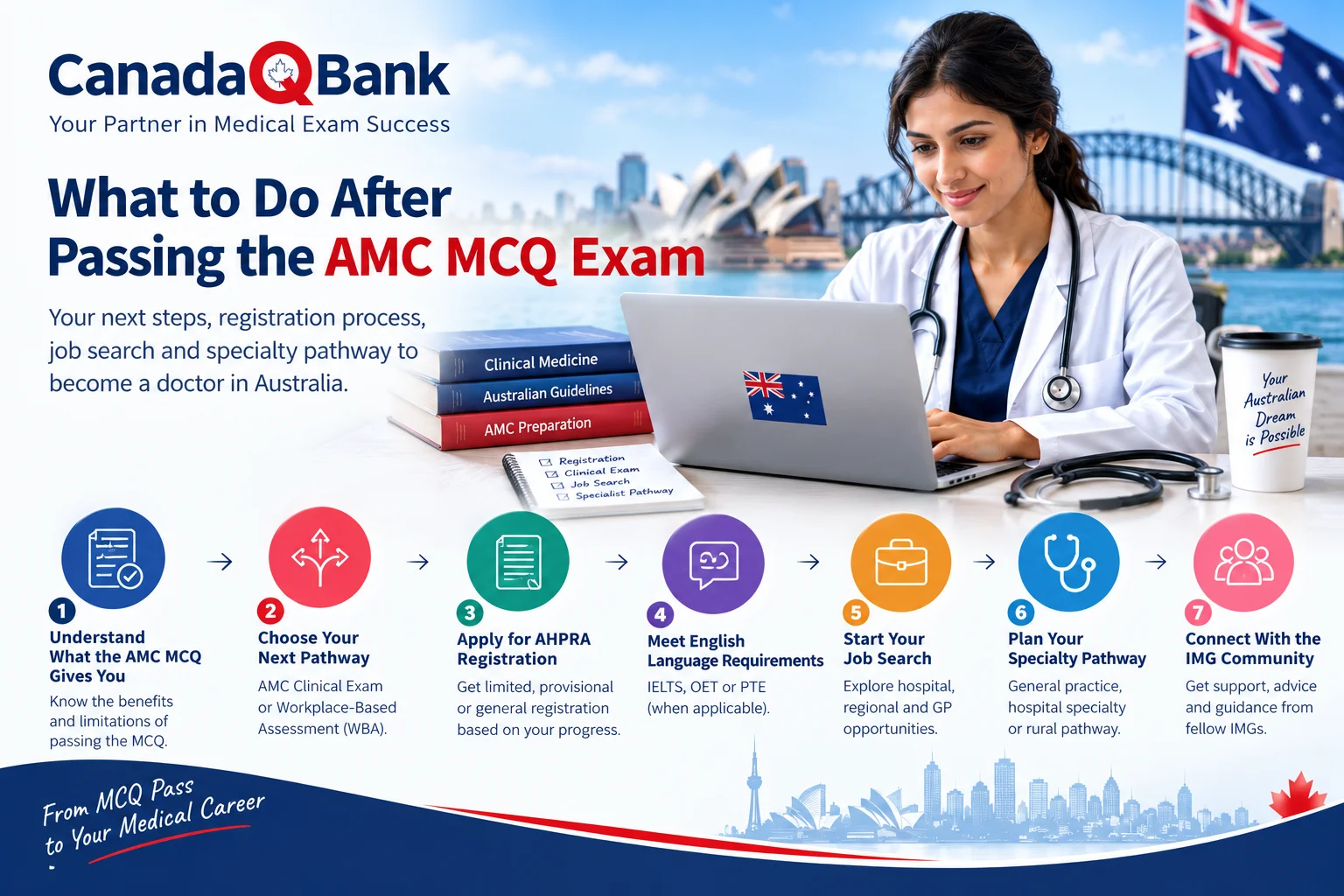
AMC Exam Practice Strategies 2026: A Complete Preparation Guide

AMC Exam Practice Strategies 2026: A Complete Preparation Guide

Passing the Australian Medical Council (AMC) examinations is one of the most critical steps for international medical graduates seeking to practise medicine in Australia.

These rate-limited exams are not designed to test how much you can memorize, but how effectively you can apply clinical knowledge, reason through patient scenarios, and make safe, logical decisions under pressure. Many candidates underestimate this distinction and focus heavily on reading rather than practising. In reality, how you practise is just as important as what you study.

This guide breaks down the most effective AMC exam practice strategies for 2026. Whether you are preparing for the AMC MCQ (CAT) exam or planning for the AMC Clinical exam, these strategies will help you study smarter, manage your time better, and approach the exam with confidence.

Understanding the AMC Exam

Before discussing strategies, it is essential to understand the AMC exam and how examiners approach it.

AMC MCQ (CAT) Exam

The AMC MCQ exam is a 3-hour 30-minute computer-adaptive test, where you are expected to answer 150 questions. The exam doesn’t have negative marking, but its adaptive nature means that the difficulty of the following questions is adjusted based on your past answers.

The exam is scored on a range of 0–500, with the pass mark being 250. Therefore, every question answered correctly matters and can be the difference between a pass and a fail.

The MCQ covers core medical knowledge, disease processes, clinical examinations, diagnosis, investigations, and management across various specialties.

AMC Clinical Exam

Part 2 of the AMC is a clinical exam that focuses on practical, scenario-based questions spread across stations, assessing your hands-on skills. Your skills will be evaluated based on your performance in history taking, physical examination, diagnosis, management, communication, and ethics in:

  • Medicine

  • Surgery

  • Paediatrics

  • Obstetrics and Gynaecology

  • Psychiatry

The exam is typically held in specific locations in Australia, as opposed to the MCQ, which is administered at Pearson VUE test centres in Australia and other countries.

What Examiners Expect

The AMC exams are clinically oriented and heavily focused on patient safety, decision-making, and Australian-style medical practice. Questions are rarely straightforward recall-based items. Instead, under timed constraints, you are presented with real-world clinical scenarios where multiple answers may seem plausible, but only one represents the safest or most appropriate next step.

This means your preparation must shift from passive learning to active clinical reasoning. Reading textbooks alone will not adequately prepare you. Success depends on repeated exposure to exam-style questions, learning from mistakes, and refining your approach over time.

Start With a Strong Question-Based Foundation

One of the most effective practice strategies for AMC candidates is early and consistent use of a high-quality question bank. Practising questions is not something you do at the end of your preparation — it should be integrated from the very beginning.

This forms a bedrock for you to actively build and improve your understanding of the different subjects you are expected to master. At the start of your preparation, questions should be done in tutor mode, untimed, with careful review of explanations. This phase should be about broadening your understanding of concepts, rather than how quickly you can speed through the questions.

Using a structured QBank like CanadaQBank allows you to:

  • Familiarise yourself with AMC-style question formats

  • Learn how Australian clinical scenarios are framed

  • Identify weak areas early in your preparation

  • Develop clinical reasoning rather than memorization habits

Focus on How You Review Questions

Doing questions alone is not enough. The real learning happens during review. Many candidates rush through explanations or only review incorrect answers. This is a missed opportunity, as quality reviews can help you focus on understanding why each option is right or wrong, to identify why you picked the wrong answer, or to point out your weak areas.

CanadaQBank’s detailed explanations are particularly valuable because they walk you through the clinical logic step by step, helping you think the way the AMC expects you to believe.

Effective review involves:

  • Understanding why the correct answer is correct

  • Identifying why each incorrect option is wrong

  • Linking the explanation back to core clinical principles

  • Noting patterns in mistakes, such as misreading stems or overthinking

Practise Systematically, Not Randomly

A common mistake is jumping randomly between topics without structure. While mixed-question practice is essential later, early preparation benefits from a system-based approach.

By focusing on one system at a time, you build confidence and depth before integrating topics. Once you are comfortable, you can transition to mixed-question sets that more accurately reflect the actual exam.

For example, dedicate time blocks to:

  • Cardiovascular medicine

  • Respiratory conditions

  • Gastroenterology

  • Obstetrics and Gynaecology

  • Paediatrics

  • Psychiatry and ethics

Develop Effective Time Management Skills

Time pressure is a significant challenge in the AMC MCQ exam. You are given 150 questions in 3.5 hours, which means you get roughly 80–85 seconds per question. Without proper practice, even knowledgeable candidates will struggle to complete their tasks on time.

To improve time management:

  • Gradually introduce timed practice sessions towards the middle of your prep period

  • Start with short, timed blocks before progressing to longer ones to build your endurance without sacrificing accuracy

  • Avoid spending too much time on a single challenging question — you can always flag it and return to it later

Practising under timed conditions trains your brain to think efficiently and reduces exam-day anxiety. CanadaQBank’s exam-mode settings allow you to simulate real testing conditions, making this transition smoother.

Train Yourself to Read Questions Strategically

AMC questions often contain long clinical vignettes. Reading every word carefully is essential, but inefficient reading wastes time. To be among the successful candidates, you have to learn how to extract key information quickly.

It may prove difficult at first, but with repeated practice, you will slowly begin to recognize common AMC question patterns, which will significantly improve your speed and accuracy.

A helpful approach is to:

  • Identify the patient’s age, gender, and main complaint first

  • Look for red flags in vital signs or lab values

  • Understand what the question is actually asking before reviewing options

Use Mistakes as a Learning Tool

Mistakes are an essential part of the preparation process. Candidates who fear making mistakes often avoid challenging questions, limiting their growth. In contrast, successful candidates actively analyze errors to see where they faltered and learn how to prevent a repeat of that error.

After each practice session, ask yourself:

  • Was this a knowledge gap or a reasoning error?

  • Did I misinterpret the question?

  • Did I rush or second-guess myself?

Keeping a simple error log can help track recurring issues and guide future study sessions. Over time, this reflective approach leads to measurable improvement. CanadaQBank’s Notes feature allows you to write notes while you review, which can then be compiled together to ease your studying further.

Simulate Full-Length Exams Before Test Day

In the final phase of preparation, full-length mock exams become critical. You should complete at least two to three full-length simulations before the real exam.

Treat them seriously, replicating exam conditions as closely as possible — take the exam at a stretch in a room without distractions. Review performance thoroughly afterward, focusing on both accuracy and timing.

These sessions help you:

  • Build mental endurance

  • Fine-tune pacing strategies

  • Identify concentration dips

  • Reduce exam-day surprises

Balance Study With Rest and Mental Health

Burnout is a significant risk during AMC preparation, especially for IMGs who juggle work, family, and relocation stress. Studying longer hours does not always lead to better results. A rested mind processes information more efficiently and performs better under pressure. This balance is often overlooked but plays a significant role in exam success.

Effective practice includes:

  • Scheduled breaks

  • Adequate sleep

  • Regular meals and hydration

  • Days off from studying, where you go and do things that bring you joy

Prepare With the Clinical Exam in Mind

Even while focusing on the MCQ exam, it is wise to think ahead to the AMC Clinical exam. Strong clinical reasoning, clear communication, and structured decision-making developed during MCQ preparation translate directly into clinical performance.

Practising questions with an emphasis on patient safety, appropriate investigations, ethical considerations, and clear management plans will serve you well beyond the written exam.

Why a Structured QBank Matters in 2026

As the AMC exam continues to evolve, so must preparation strategies. Question banks that emphasize outdated recall-based content are no longer sufficient.

CanadaQBank supports AMC candidates by offering:

  • Clinically relevant, exam-style questions

  • Clear, educational explanations

  • Flexible study modes

  • Performance tracking to guide focused revision

These features allow candidates to practise efficiently, identify weaknesses early, and build confidence steadily over time.

Final Thoughts

Passing the AMC exam is not about studying harder — it is about practising smarter.

Candidates who succeed are those who consistently engage with questions, reflect on mistakes, manage their time effectively, and maintain balance throughout their preparation.

By adopting structured practice strategies and using reliable tools like CanadaQBank, AMC candidates in 2026 can approach the exam with clarity, confidence, and control. With the right approach, the AMC exam becomes less of an obstacle and more of a stepping stone toward practising medicine in Australia.

Top 10 Mistakes to Avoid When Preparing for the AMC Exam

Top 10 Mistakes to Avoid When Preparing for the AMC Exam

The Australian Medical Council (AMC) Exam serves as the testing ground for doctors who wish to practice in Australia. It is a taxing but passable exam that checks your competency in medical knowledge and clinical skills to ensure they meet Australian standards for medical practice. It encompasses a broad range of domains, including, but not limited to, adult health, women’s health, child health, mental health, population health, and ethics.

The exam is divided into multiple-choice questions (MCQs) and a clinical skills exam or a workplace-based assessment program. However, the AMC exam is designed to be passable for newly qualified graduates of Australian medical schools who are about to begin their internship training.

Passing the AMC exam is a key step for many international medical graduates (IMGs) seeking to practise medicine in Australia. But knowing what not to do is just as important as knowing what to study. Many candidates struggle not from lack of intelligence, but from avoidable strategic errors. Drawing on lessons from seasoned tutors and AMC-prep educators, here are the top 10 mistakes IMG candidates commonly make and how to steer clear of them.

Building a Smarter Preparation Strategy

Avoiding mistakes requires more than being careful; it demands that you be strategic in your decisions. Successful AMC candidates plan their study timeline around three core pillars:

  1. Structured Content Review: Cover the Blueprint methodically, system by system, instead of jumping between random topics.
  2. Question-Based Practice: Reinforce learning through active recall using trusted platforms like CanadaQBank, which mirrors real AMC question patterns.
  3. Self-Evaluation and Adaptation: Continuously refine your focus based on feedback and results.

1. Ignoring the AMC Blueprint

One of the biggest errors candidates make is diving into preparation without first understanding what the exam truly assesses. The AMC Blueprint outlines the scope of topics, competencies, and professional standards expected of doctors in Australia. It’s a framework showing how clinical reasoning, communication, and patient safety are integrated into every question.

Failing to align your study plan with the Blueprint can render your preparation inefficient. Every topic, from cardiovascular disease to ethics, should be studied through the lens of Australian practice standards and patient-centred care.

Tip: Start your preparation by downloading the official AMC Handbook and mapping your resources and study time against the Blueprint. It helps you lock in on what topics and views actually matter.

2. Treating AMC Like a Memory Test

Many candidates come from systems where exams reward rote memorization. The AMC is not one of them. It’s a reasoning-based exam, emphasizing how you apply knowledge to patient problems, not how many facts you can recall.

Questions are often structured as evolving clinical scenarios where every line of the stem matters. Memorizing guidelines won’t help if you can’t prioritize, interpret data, or make safe management decisions.

Tip: Practice clinical reasoning daily. Ask yourself, “What’s the most likely diagnosis?”, “What’s the next best step?”, “What’s the safest option?” and always justify your reasoning.

3. Neglecting Practice under Exam Conditions

Knowing the material is one thing; performing under time pressure is another. The AMC Part 1 is a computer-based test (MCQ), which can be compared to a marathon of over 150 questions spread across several hours. Without timed practice, even strong candidates will find themselves running out of time or second-guessing easy questions.

Tip: Use mock exams and timed question blocks to simulate the pressure and pace of the real test. Tools like CanadaQBank, which replicates AMC-style clinical questions and timing, can help you build endurance and confidence while identifying weak areas early.

4. Ignoring Australian Context and Guidelines

Even if you’ve practised medicine elsewhere, the AMC expects you to answer questions based on Australian standards, not what you did in your home country. Management guidelines, first-line treatments, and ethical frameworks can differ substantially between countries.

For example, antibiotic stewardship, mental health pathways, and Indigenous health considerations hold significant weight in Australian medical practice. Failing to adapt your answers to these expectations can cost you marks even if your reasoning is sound.

Tip: Familiarize yourself with the Royal Australian College of General Practitioners and Therapeutic Guidelines (eTG). Incorporate these into your practice sessions so that your clinical reasoning reflects the Australian context.

5. Overloading with Too Many Resources

With so many books, courses, and question banks available, it’s tempting to use everything. But information overload leads to confusion and burnout. The best candidates know that depth beats breadth.

Tip: Choose one or two high-yield resources and stick with them. Combine the AMC Handbook, the AMC Qbank or CanadaQBank, and one clinical review text like John Murtagh’s General Practice. Repetition from reliable sources is more effective than skimming dozens of materials once.

6. Postponing Revision and Self-Assessment

Many study for weeks before realizing they never tested what they know. Without periodic self-assessment, you can’t track your progress or pinpoint weaknesses. Revision is crucial because it improves your ability to retrieve the varied information you’ve assimilated. You must be able to recall and apply knowledge quickly, especially under pressure.

Tip: While studying, have a note by your side where you write down your understanding of the topic you are reading. This will help you when revising or answering question banks. After every two weeks of study, take a mini mock or review your question bank analytics. Focus your next revision phase on weak systems or frequently missed question types. Self-evaluation keeps your preparation active and adaptive to your progress.

7. Underestimating Clinical Reasoning and Ethics

The AMC exam rewards candidates who think like safe, reflective practitioners. It tests your medical knowledge and your ethical judgment, professionalism, and communication in clinical settings. Neglecting these areas, especially ethics and doctor–patient interaction, will lead to missed opportunities for easy marks.

Tip: Read ethical guidelines from the Medical Board of Australia and review common clinical communication themes—practice questions that test what to do, and why and how you justify it. The safest, most ethical answer often earns full marks.

8. Failing to Build Exam Stamina and Focus

The AMC exam is long, mentally draining, and requires sustained focus. Going into the exam without preparing yourself for a marathon session would be setting yourself up for a tough time. Many candidates report that their performance drops in the second half due to fatigue, anxiety, or loss of concentration.

Tip: Build your stamina like you would for a physical challenge. Start by completing shorter, timed blocks, then progress to full-length simulated exams. During study breaks, train your focus with mindfulness or brief breathing techniques. Small habits, like avoiding caffeine spikes or improving sleep, can significantly impact cognitive endurance.

9. Ignoring Weak Areas Because They’re “Too Hard”

Everyone has topics they dislike, be it psychiatry, obstetrics, or biostatistics. But skipping these sections is one of the fastest ways to fail. The AMC tests integrated medicine, so weak areas inevitably appear in complex clinical vignettes.

Tip: Tackle your weakest subjects first. Use a “2+1” strategy; for every two strong-system study sessions, include one focused on a weaker area. Over time, discomfort decreases, and your confidence across the Blueprint becomes more balanced.

10. Letting Anxiety or Isolation Take Over

Preparing for the AMC can be lonely, especially for IMGs balancing work, relocation, or family life. The stress of studying in isolation or obsessing over scores can erode motivation and focus. Anxiety is another major hurdle, as it can cause you to waste time worrying over things you cannot immediately affect. Excessive anxiety directly impairs your recall and decision-making during the test.

Tip: Don’t prepare alone. Join study groups or online forums where IMGs share questions, motivation, and updates, as this sense of community will positively impact your preparation. Set healthy study hours, take rest days, and focus on consistency over intensity. A calm, rested mind always performs better than an exhausted one.

Bonus Tips

Putting Off Exam-Day Logistics

Neglecting test-day preparation is a silent trap. If you forget your IDs, don’t know the test center location, or fail to check remote exam requirements, you risk chaos that can cause you to miss your exam time.

Preempt these errors by confirming your exam center address or remote-testing software setup. Plan arrival times, transit logistics, meals, and rest breaks, and verify that your identification is accounted for.

Neglecting Health, Wellbeing, and Mental Resilience

Medical preparation is a marathon and ignoring wellness will undo your best efforts. Maintain healthy habits like getting 7–8 hours of sleep per night, keeping active, scheduling regular breaks into your study period, and managing stress by being mindful, journaling, or seeking peer/family support. Finally, monitor warning signs of burnout: memory lapses, irritability, fatigue.

How to Pass the AMC Clinical Exam on The First Attempt

How to Pass the AMC Clinical Exam on The First Attempt

To the doctors and medical graduates reading this, I congratulate them on passing the AMC 1; it is no easy feat, and you deserve to be proud of yourself. Next up is the AMC Clinical Exam, and depending on when you choose to write, you should begin practicing for it months in advance.

Given the hefty fee you will have to pay, AUD 4,391 for the online clinical examination and AUD 3,991 for the in-person examination, it goes without saying that no one wants to apply and write the exam multiple times. This article will help you avoid that, as following it is a surefire path to passing the exam on your first attempt.

Overview of the AMC Clinical Exam

The Australian Medical Council Clinical Exam is the practical part of the overall AMC exam. It came after the AMC Computer Adaptive Test (CAT), which was traditionally conducted only in Melbourne, Australia until COVID-19 struck and forced the world to transition to the virtual world. Thanks to that crisis, the online clinical exam conducted through supervised video calls has now become a permanent part of the AMC assessment process; in-person testing began earlier this month.

The Clinical Exam comprises 20 stations, four of which are rest stations and two pilot stations that contain trial questions. In comparison, the remaining fourteen stations assess clinical skills relating to medical, surgical, women’s health, pediatrics, and mental health presentations.

Each station lasts ten minutes; two minutes will be spent reading and understanding the question, and the remaining eight will be spent completing whatever task is required of you. The stations may use simulated patients or videotaped patient presentations. Some questions may contain relevant materials, such as charts, digital images, and photographs, to provide more details. However, the questions will focus on one of four predominant assessment areas, namely: history taking, examination, diagnostic formulation, management/counseling/education.

How to Succeed on Your First Attempt

Preparation for the AMC Clinical Exam should begin well before your chosen date. This exam isn’t a test you can pass by rote memorization; it requires you to think on your feet and apply your knowledge in dynamic situations. Following the steps listed below will help you prepare to be at your best when you write the exam.

1. Set Clear Goals and Deadlines:

Before you start, it is crucial that you outline your goals. First, you familiarize yourself with the subjects from which questions will be pulled, then determine which areas you need to cover and set realistic deadlines. By identifying these areas early, you can tailor your study sessions to focus more on weaker subjects. For instance, if you have six months before your exam date, break your study schedule into weekly or even daily goals. This systematic approach helps prevent last-minute cramming and builds confidence gradually.

2. Plan Your Study Time Strategically:

Think of your study plan as a roadmap that guides you through the exam’s diverse territories. Your study sessions should cover each topic identified systematically according to your needs. This means that areas you struggle with should be given more time compared to areas in which you have a firm foundation. Use tools like calendars, planners, or digital apps to block out dedicated study time. A good study plan should include space for active learning sessions, group study, and practice exams. This structured approach ensures comprehensive coverage and prevents burnout by pacing your workload.

3. Practice with Realistic Scenarios:

Practice makes perfect. You should engage in simulated clinical scenarios as often as possible and organize mock sessions with peers or mentors. Studying in a group can be powerful. When you discuss clinical cases with others, you expose yourself to different perspectives and problem-solving approaches. Explaining a concept to someone else is one of the best ways to solidify your understanding. Rotate roles—one day, you’re the teacher; the next, you’re the student. These sessions should be as true to life as possible, so you and your group should engage in role-play to practice patient interviews, physical examinations, and case discussions. After each simulation, solicit honest feedback. Identify areas where you hesitate or struggle, and work on them until you’re comfortable. Finally, it is advisable that you work in a clinic or hospital because this will give you real-time experience in diagnosing and treating patients which will better prepare you for the exam.

4. Develop Effective Communication Skills:

The heart of the AMC CE is clear and empathetic communication. This is not merely about speaking proper English; it’s about making patients feel understood and cared for. You should practice explaining complex medical ideas in simple, relatable terms. Consider it as you breaking down an intricate recipe into easy-to-follow steps so anyone can understand. Next, it’s essential that you listen more than you speak. By focusing intently on your patient’s words, you can address their concerns more effectively and show that you genuinely care. Remember that behind every clinical scenario is a human being who might be anxious or frightened. Your ability to display genuine compassion can set you apart. Use phrases like, “I understand how difficult this can be,” to build rapport.

5. Master Time Management:

The importance of managing your time during both study sessions and on exam day cannot be overstressed, as you have less than 10 minutes to complete your tasks. Regularly practicing under timed conditions will build speed and efficiency. This will help you get used to answering questions quickly without sacrificing accuracy. Develop a strategy for each station. For example, in a history-taking station, you should plan to quickly summarize the patient’s main complaint, ask targeted questions, and articulate a clear plan. Finally, you should practice in settings that simulate the exam day conditions. This should include dressing using a timer to mimic station durations, and you can also choose to practice in clinical attire.

6. Stay Updated on Australian Healthcare:

While the AMC exam tests clinical skills, being conversant with the Australian healthcare system can give you an extra edge. Australia is a multicultural mosaic. Familiarize yourself with local cultural sensitivities so you can deliver patient-centered care. Having a good understanding of how cultural backgrounds affect patient expectations and communication is crucial. When preparing for the exam, study the structure of the Australian healthcare system—its public and private sectors, referral pathways, and common clinical guidelines. This knowledge may be woven into exam scenarios and can help you demonstrate context-specific reasoning. Lastly, reading local medical journals or following news outlets can help you understand recent changes in clinical practice and healthcare delivery.

Conclusion

Passing the AMC Clinical Exam on your first attempt is a formidable challenge—but it is achievable with the right blend of preparation and strategy. This guide has covered the key elements of success, from crafting a solid study schedule to understanding healthcare nuances and strengthening communication. Remember, success isn’t about memorizing facts—it’s about combining knowledge, skill, and empathy into a well-rounded approach.

To further strengthen your preparation, consider using CanadaQBank—a trusted resource offering high-quality practice questions and clinical cases tailored for the AMC exams. It’s an excellent tool to help you study smarter and boost your chances of passing on the first try.

A Complete Guide to AMC Exam Preparation

Are you a medical graduate looking to practice in Australia and wondering how to prepare for the Australian Medical Council (AMC) exams? In that case, this article is for you! This exam assesses your knowledge of the theoretical and practical aspects of medicine. In this article, you’ll find detailed steps that will aid your study and help ensure that you ace the exams.

The AMC exam is divided into two sections: Multiple Choice Questions (MCQs) and the Clinical Examination. Each aspect is different from the other and, therefore, requires a different approach. We will discuss in detail the different ways to approach studying for each aspect.

Multiple Choice Questions

This part is called the Computer Adaptive Test (CAT) because it is computer-based and tailored to each candidate. It consists of 150 questions that must be completed in 3.5 hours. The questions cover important medical knowledge such as:

  • Disease Processes
  • Clinical Examination and Diagnosis
  • Investigation, Therapy, and Management.

Additionally, the following fields are covered:

  • Adult Health (Medicine and Surgery)
  • Women’s Health (Obstetrics and Gynaecology)
  • Child Health
  • Mental Health
  • Population Health and Ethics.

Some questions will also require you to identify X-rays, ECGs, scans, clinical photographs, etc.

Now, let’s talk about some steps you can take when studying for these daunting MCQs.

Step I: Find Resources

For this exam, there are some texts recommended by the council, which can be found on their website or in the examination specifications. These will help guide you on what to read for specific topics. It is essential to read through the council’s document on examination specifications, as it will familiarize you with the exam’s format.

Step II: Practice Questions

For the MCQs, the council gets 50% of the questions from a pool of past questions, so ensure you get questions from past years and practice them as much as possible. By the time the exam rolls around, you’ll find that you can recall a lot of these questions and their answers without a second thought.

Step III: Time Yourself

All 150 questions are expected to be answered within the 3.5 hours of the stipulated time, so you need to practice the amount of time you spend on each question. When going through the past questions, set a timer with increasing levels of difficulty as you progress. This will help you get quicker and more accurate with your answers. You need to be able to finish all the questions with enough time to go over them at least twice before submission.

Step IV: Active Recall

When you’re taking a break from studying or doing some chores, try to recall some of the questions you’ve previously practiced or a topic you’ve studied. If you find it difficult to remember, it shows you need to pay more attention to that topic or go back to it.

Step V: Allocate Different Study Times to Each Field

All the fields in this exam have a different percentage of questions. For example, 30% of the questions will be from the Medicine field, 20% from the Surgery field, and so on. This means that when you’re studying, you will need to pay more attention to certain fields over others, e.g., the Medicine field will require the most attention.

Clinical Examination

Once you have passed your MCQs, the next step is the Clinical Examination, where you’ll be tested on:

  • History Taking
  • Examination
  • Diagnostic Formulation
  • Management/Counseling.

You can see it is a completely different ballgame from the MCQs.

During the exam, you will rotate through 16 stations for 10 minutes each, in which you will be provided with scenarios that test your knowledge of one or more of the areas mentioned above. You will have 2 minutes to read the questions and strategize how to handle the scenario. Then, you’ll be expected to provide an answer within the next 8 minutes.

Let’s discuss some steps you can use to study for this aspect.

Step I: Find Resources

For this part of the examination, it is recommended that you use medical journals that contain information relevant to the areas where you will be tested.

Step II: Seek Help

If you have access to experienced medical professionals, ask for their help in creating hypothetical scenarios where you can brush up on your knowledge of all the categories. If that’s not possible, you can look up these scenarios on the internet. It also helps to practice with a friend.

Step III: Time Yourself

As you will only have 10 minutes for each question, out of which you have 2 minutes to read and strategize, you will need to practice going through these scenarios with a timer. This will help you learn proper time allocation, and just like with the MCQs, you can progress to varying levels of difficulty, so you will have enough time for cross-checking if possible. The more familiar you are with working under a time constraint, the more composed you will be when there are examiners in the room.

Step IV: Active Recall

You will also need this step for this aspect of the exam because it helps with your memory and quick thinking, which will be essential when taking this part of the test.

General Tips

These tips apply to both MCQs and the Clinical exams:

  • Start preparing for the exam early to reduce the amount of stress you’ll be under.
  • Give more time to the areas where you are weakest.
  • Make sure to take breaks between study sessions.
  • Eat well and stay hydrated during the preparation period and before the examination, so your body has enough energy to get through the tedious process.
  • As much as possible, minimize the use of stimulants, e.g., coffee, which may impair your focus and performance on the day of the examination.
  • Get enough rest the day before the examination so you will be well-rested and alert.
  • Make sure to arrive at the examination venue early so you’re well-settled before the exam begins.
  • Read through all the instructions carefully before you begin the exam.
  • Do not spend too much time on one question; remember to allocate your time properly.

Conclusion

Passing this examination is an attainable goal once you have put in the time, hard work, and dedication. Don’t focus on the obstacles you may encounter; just remain focused on your goal, and your chances of succeeding are very high. Stick to your study plan, and in no time, you will be a medical professional in Australia. Don’t forget that sites like Qbank have resources that can make your preparation journey seamless. Good luck!

What Every Med Student Should Know about the Australia Medical License Exam

question bank amc cat

If you want to practice medicine in Australia, you must first pass an extensive and rigorous examination. This exam, known as the AMC CAT, or Australian Medical Council Computer Adaptive Test, is incredibly difficult, but you must pass it to receive your licensure. Below are some of the most important facts all medical students need to know about the AMC CAT.

It Tests Your Knowledge in All Categories

The AMC CAT consists of multiple choice questions that are designed to help test how much you know about the principles and practice of medicine. It covers a wide range of categories, including general practice, internal medicine, pediatrics, psychiatry, surgery, and obstetrics and gynecology. These are incredibly broad categories, and there’s a lot to cover in each one. It takes most students a long time to adequately prepare.

There’s a Clinical Exam or Workplace-Based Assessment, Too

There’s more to passing the AMC exam than the AMC CAT examination you will take on a computer. You will also need to pass the AMC Clinical Exam or the AMC Workplace-Based Assessment, which tests your knowledge and ability in a real-world environment. You cannot participate in either of these until you have successfully passed the AMC CAT. Either is acceptable, but you must apply for a WBA program directly through a provider that offers it.

You Can Find a Trial Exam on the AMC’s Website

Though you can utilize AMC CAT qbank questions to create your own mock exams as a study guide, the Australian Medical Council makes an actual trial examination available through its website. This trial exam is identical to the actual test you will take, but it asks different questions at random. Your ability to pass the trial AMC CAT within the given time limit is a good indicator of your readiness to sit for the actual exam and pass. There is a fee to take the trial exam, but there are no limits on the number of times you can take it.

It is a Pass/Fail Exam

Like most other medical licensing examinations around the world, the AMC CAT exam operates on a pass/fail basis. You will be given the ability to participate in a Clinical Exam or Workplace-Based Assessment if you can pass the CAT portion of the exam, and if you fail, you will need to retake the exam according to the AMC’s guidelines. The exam consists of 150 standard MCQs, and of these, only 120 are scored. Your performance will be measured on a scale from zero to 500 with each question weighted individually, and the pass mark is set at 250.

You Can Take the Exam Again if You Fail

It is important to note that not all students who take the AMC CAT exam pass the first time. If you are one of these students, you have the option to retake the test as soon as you have received your results from your original examination. You will need to reapply for the next available exam, and you will need to pay the exam fees a second time, as well. Unlike licensing exams in other parts of the world, you can continue to pay for and sit for the AMC CAT as many times as you wish until you have passed.

The AMC CAT is a difficult test, and it’s only the first step toward getting your license to practice medicine in Australia. However, there are numerous study materials available to you, and if you study wisely and use those resources, you can absolutely pass with flying colors on your very first attempt.

Tips on How to Pass the AMC CAT Examination

The Australian Medical Council Computer Adaptive Test, or AMC CAT, is one of the most difficult examinations any aspiring doctor will ever take. The exam consists of 150 tough multiple-choice questions administered over the course of three and a half hours. Students often start preparing months or even a year in advance to give themselves an advantage. The following tips are those that come most recommended from those who have passed.

Start Studying Early & Access the AMC’s Preparation Info

By far, the best advice for passing the AMC CAT involves preparing early on – up to a year in advance of the exam itself. The Australian Medical Council has produced some publications to help you better understand the process and the best ways to prepare, and the earlier you access these, the better off you will be. The AMC even provides its own MCQ Online Trial Examination designed to help you familiarize yourself with the question and exam format.

Stay Healthy

Medical students work very hard during their time in university and medical school, and many simply forget to take care of themselves along the way. It is absolutely vital that you remember to eat a balanced, healthy diet, to stay hydrated at all times, and to get at least seven or eight hours of sleep eat night. Remember that you need to be healthy and rested in order to retain information, so taking care of yourself is important.

Utilize a Variety of Study Methods

Another important tip directly from those who have successfully completed the AMC CAT involves utilizing numerous different study methods over the course of several months. For example, reading textbooks and taking notes is important, but it simply isn’t enough to help you retain all the information you need. Be sure to group up with other students to quiz each other, make yourself some flash cards for terminology, and access an online study tool, such as CanadaQBank, to put your knowledge to the test regularly. Studying via all these different formats will help you retain more information over time than using any one of them alone.

Take Recall Exams

Finally, one of the most popular means of preparing for the AMC CAT examination involves taking recall exams from the last several years. These are available from the Australian Medical Council, and they provide you with the absolute best opportunity to truly familiarize yourself with the exam format and the types of questions you will be asked. Dedicating several hours each week to this will benefit you. Aim to take the last five years’ worth of exams, and if you can, perhaps even the last 10.

Passing the AMC CAT examination is about preparing early on, studying in the right ways, and taking care of yourself and your health throughout the process. Though it is a very difficult examination, it is possible to pass on your very first attempt if you dedicate your time and energy to learning as much as you possibly can during your classroom studies, labs, clinicals, and study sessions.