


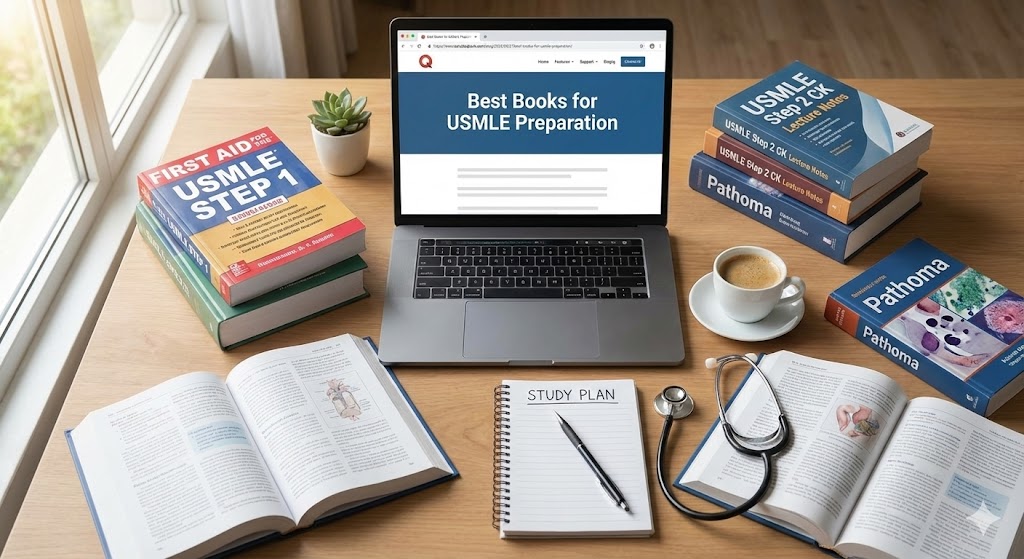
The United States Medical Licensing Examination (USMLE) is widely regarded as one of the most demanding medical licensing exams in the world. Across its three Steps, the USMLE assesses everything from foundational medical sciences to real-world clinical decision-making and independent patient management.
With such a broad syllabus, preparing without the right study resources can be overwhelming. Many students waste valuable time on outdated or low-yield materials, making preparation harder than it needs to be. Choosing the correct books—and knowing how to use them—is essential for efficient and effective USMLE preparation.
Below is a curated, up-to-date guide to the best books and resources for USMLE Step 1, Step 2 CK, and Step 3, along with guidance on how to use them strategically.
Types of USMLE Preparation Resources
To prepare thoroughly for the USMLE, most successful candidates rely on four core resource types:
1. Textbooks
Textbooks provide structured explanations and conceptual clarity. They are most useful early in your preparation to build or reinforce foundational knowledge.
2. Question Banks
Question banks are the cornerstone of USMLE success. They expose you to exam-style questions, teach you how concepts are tested, and help you develop clinical reasoning and time management skills.
3. Flashcards
Flashcards are ideal for active recall and spaced repetition. They are especially helpful for memorizing facts, formulas, associations, and high-yield details closer to exam day.
4. Case-Based Resources
Case studies help bridge theory and practice, sharpening clinical reasoning skills—particularly important for Step 2 CK and Step 3.
Best Resources for USMLE Step 1 (Pass/Fail Era)
Although USMLE Step 1 is now Pass/Fail, it remains critically important. A strong Step 1 foundation directly impacts performance on Step 2 CK, which is numerically scored and heavily weighted in residency selection.
1. First Aid for the USMLE Step 1
Widely regarded as the gold standard for Step 1 preparation, First Aid provides a concise, high-yield overview of every tested subject. Its bullet-point format, mnemonics, and diagrams make it ideal for repeated review. Updated annually, it remains aligned with the latest exam blueprint.
2. Kaplan USMLE Step 1 Lecture Notes
This seven-volume series offers in-depth coverage across disciplines such as pathology, pharmacology, physiology, biochemistry, anatomy, microbiology, and behavioral sciences. It is best suited for students who want a deeper conceptual understanding before transitioning fully to question-based learning.
3. CanadaQBank – USMLE Step 1
Although not a traditional book, CanadaQBank is a core learning resource for Step 1. It offers:
3,000+ high-quality USMLE-style MCQs
Timed and tutor modes
Detailed explanations with clinical pearls and lab values
Performance analytics by subject
Question-based learning remains essential—even in the Pass/Fail era.
4. Zanki (Anki Deck)
Zanki is a popular, community-built flashcard deck based on First Aid, Kaplan, and other core resources. With nearly 20,000 cards organized by system, it supports long-term retention through spaced repetition.
Best Books for USMLE Step 2 CK
USMLE Step 2 CK focuses on clinical knowledge, diagnosis, and management—and is now the most important exam for residency applications.
1. First Aid for the USMLE Step 2 CK
This system-based review condenses essential facts into bullet points, tables, and management algorithms. It is ideal for reinforcing concepts learned through question banks.
2. Step-Up to USMLE Step 2 CK
A well-structured text with concise chapters, flowcharts, and end-of-section clinical cases. It provides an excellent framework when paired with a strong QBank.
3. USMLE Step 2 Secrets
This pocket-sized book uses a question-and-answer format to highlight high-yield facts and exam strategies. It is especially useful for rapid review in the final weeks.
4. Master the Boards – USMLE Step 2 CK
Authored by Dr. Conrad Fischer, this book emphasizes exam-style vignettes, “buzzwords,” and common pitfalls. It is best used after core content review to refine test-taking skills.
Best Books for USMLE Step 3
USMLE Step 3 assesses whether you can practice medicine independently, including outpatient management and emergency decision-making.
1. First Aid for the USMLE Step 3
This book covers both multiple-choice questions and Computer-Based Case Simulations (CCS). It includes algorithms, CCS strategies, and high-yield ambulatory care topics.
2. Crush Step 3 CCS
Dedicated entirely to CCS preparation, this resource provides structured case walkthroughs, command templates, and time-saving strategies—making it essential for the simulation component.
3. Master the Boards – USMLE Step 3
Focused on management decisions and commonly tested scenarios, this book highlights “don’t miss” diagnoses and practical clinical reasoning.
4. Kaplan USMLE Step 3 Lecture Notes
Kaplan’s multi-volume series offers comprehensive coverage across core specialties. It is best for candidates who prefer structured reading before intensive practice.
How to Use These Resources Effectively
Do not try to use every book simultaneously
Choose 1–2 core texts per Step
Prioritize question banks over passive reading
Use flashcards consistently for retention
Focus on clinical application, not memorization
Final Thoughts
There is no single “perfect” book for the USMLE. Success comes from using high-yield, up-to-date resources in a strategic way—combined with consistent question-based practice.
CanadaQBank complements these books by helping you apply knowledge, identify weaknesses, and simulate real exam conditions across all USMLE Steps.