
How to Pass PLAB 1: Top Tips with Do’s and Don’ts

How to Pass PLAB 1: Top Tips with Do’s and Don’ts

If you’re preparing to practice medicine in the UK, you may have noticed an important update. The General Medical Council (GMC) has introduced the Medical Licensing Assessment (MLA) and revised the content map that defines what new doctors must know to qualify.

For international medical graduates (IMGs), the route remains through the PLAB pathway for now. However, the content and blueprint of PLAB 1 have been aligned with the MLA’s Applied Knowledge Test (AKT). This means PLAB 1 candidates are now expected to meet the same standard and cover the same topics as UK medical students sitting for their national licensing exam.

This article breaks down what these changes mean for your preparation and provides a practical strategy, including key Do’s and Don’ts to help you pass on your first attempt.

What Changed

The PLAB exam hasn’t been replaced for IMGs; instead, the GMC has standardized content across UK medical schools through the MLA content map. This ensures that PLAB meets the same requirements expected of UK graduates.

In practice:

  • PLAB 1 now maps to the Applied Knowledge Test (AKT) content.
  • PLAB 2 aligns with the Clinical and Professional Skills Assessment (CPSA) requirements.

As a result, the questions and topics tested in PLAB now directly reflect UK-wide learning outcomes—emphasizing clinical priorities, patient safety, and preventive care more clearly than before.

Before starting your preparation, use GMC updates and the MLA content map as your main guide.

Know the Exam You’re Studying For

Although formats can evolve slightly, PLAB 1 continues to use the single-best-answer (SBA) format. You’ll face 180 multiple-choice questions under strict timed conditions.

Most questions are clinical vignettes designed to test your ability to handle diagnostic steps, select initial investigations, manage urgent cases, and interpret ethics or communication scenarios. Time pressure is significant—you’ll get about one minute per question—so developing speed and strong pattern recognition is key.

The exam covers a wide range of subjects: general medicine, surgery, pediatrics, obstetrics and gynecology, psychiatry, emergency medicine, and primary care. The MLA mapping also ensures inclusion of public health, data interpretation, and professionalism.

Understanding this blueprint helps you allocate your study time wisely. With the UKMLA alignment, a few changes stand out:

  • Focuses on applied clinical reasoning rather than rote memorization.
  • Prefers scenarios where you identify the next best step in assessment or management.
  • Tests common conditions, patient safety, ethics, and UK guideline-based care (like NICE recommendations).
  • Includes questions on public health, preventive medicine, and basic epidemiology.

Registration and Timeline — Practical Steps

  1. Verify your eligibility early.
    Create a GMC account and start your primary source verification (via EPIC/ECFMG or equivalent) well before you plan to sit for the exam. Verification and booking often take several weeks.
  2. Book early.
    Seats, especially at overseas centers, fill up fast—book at least 6–8 weeks in advance, if possible.
  3. Confirm exam format and location.
    Some centers may have special rules or technical requirements. If sitting overseas, double-check travel, visa, and test center logistics early.

Top Practical Tips

1. Make Exam Behavior Your Priority

You’re not studying to become a walking encyclopedia. The goal is to make safe and practical decisions for patients. Focus on understanding what to do next in clinical scenarios. Convert passive reading into active question practice and apply concepts immediately.

2. Emphasize Applied Knowledge and UK Practice

Learn how UK guidelines (like NICE or NHS protocols) shape clinical decisions. If multiple answers seem reasonable, pick the one that aligns with UK guideline practicality and patient safety.

3. Practice Under Timed Conditions

Build your pace and stamina through timed question blocks. Occasionally simulate full-length sessions to improve endurance and maintain concentration.

4. Read Explanations Thoroughly

A quality Qbank, such as CanadaQBank, provides detailed answer explanations—this is where real learning happens. Reading why wrong answers are incorrect will sharpen your clinical reasoning.

5. Use an Error Log and Active Recall

After every Qbank session, note the questions you missed and write short rationales for your errors. Review them weekly. Use flashcards for drug doses, lab thresholds, and emergency algorithms to strengthen active recall.

6. Prioritize High-Yield Clinical Scenarios

Focus on common and critical conditions rather than rare ones. Master acute abdomen, chest pain, sepsis management, obstetric and pediatric emergencies, and common psychiatric issues—these are tested frequently.

Do’s and Don’ts

Do:

  • Simulate exams under real conditions—full timing, no interruptions.
  • Maintain an error log and review it regularly.
  • Practice concise, scenario-based answers—include test names, drug doses, and durations when needed.
  • Check the GMC/MLA content map periodically for topic updates.

Don’t:

  • Don’t waste time memorizing obscure, rare diseases.
  • Don’t ignore UK-specific clinical standards.
  • Don’t overload yourself with multiple QBanks. Master one (like CanadaQBank) to understand the style and analytics deeply.
  • Don’t cram at the last minute—focus on confidence and decision-making skills.
  • Don’t delay administrative steps; many candidates lose months to simple verification or booking issues.

Exam-Day Execution

  • Arrive early or, for remote sittings, prepare your space a few days ahead.
  • Use a first-pass strategy—answer easy questions first, then return to flagged ones.
  • Keep moving. If stuck, select the most logical option and move on.
  • Stay hydrated and calm. Practice short breathing breaks and posture changes to stay focused.
  • For online sittings, run technical checks (ProProctor system) the day before to avoid disruptions.

Final Word

The GMC’s MLA content map has made PLAB 1 more clearly aligned with UK clinical practice—and that’s actually an advantage. It tells you exactly what to prioritize.

If you prepare around applied clinical reasoning, UK guidelines, timed practice, and reviewing mistakes systematically, your chances of passing on the first attempt are high.

Anchor your preparation with one reliable resource like CanadaQBank, but always reference the MLA content map for direction. Start early, simulate often, and treat PLAB 1 as a test of safe, real-world clinical decisions. With focus and discipline, you’ll clear it confidently on your first try.
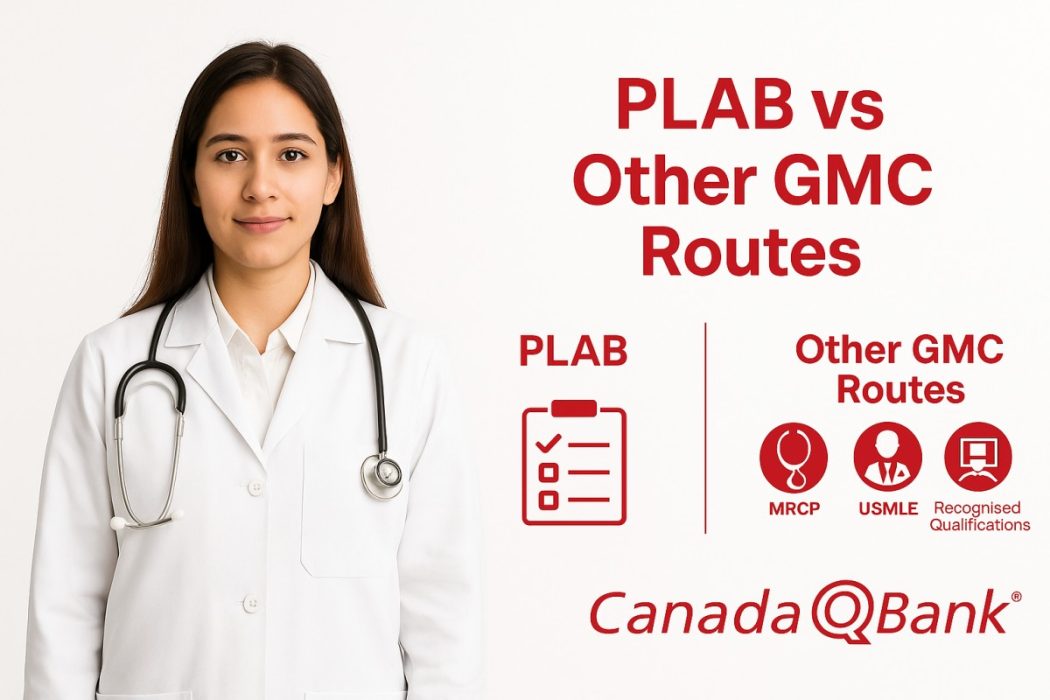

What is the Difference Between PLAB and Other Routes to GMC Registration?

What is the Difference Between PLAB and Other Routes to GMC Registration?

For aspiring doctors seeking to migrate and practice medicine in the United Kingdom, the Professional and Linguistic Assessment Board (PLAB) exam is the first route most people think of. However, it is not the only way to gain permission to practice medicine in the UK. In this guide, we will explain all the alternative paths (plus a short breakdown of PLAB) that can lead you to gaining licensure as a GMC-certified doctor in the U.K.

Overview of the UK Medical System

NHS (National Health Service)

The UK is served by a publicly funded healthcare system that provides care free of charge at the point of use. In England, care is delivered by NHS Trusts (hospital trusts, foundation trusts, ambulance trusts, etc.) and Integrated Care Systems, all overseen by NHS England and the Department of Health. Hospitals, community clinics, and general practices employ doctors in these organisations.

Doctor Career Grades

UK medical careers typically start with a 2-year Foundation Programme (FY1, FY2). On completing FY1, doctors gain full GMC registration. After FY2, doctors enter speciality training (e.g. Internal Medicine, Surgery, etc.), with grades like Speciality Trainee (ST1, ST2…) or Speciality Registrar (SpR). General Practice (GP) training is a parallel 3-year path (GPST1–3). Senior doctors are Consultants (hospital specialists on the GMC Specialist Register) or GPs on the GP Register.

The GMC

The General Medical Council (GMC) is the statutory regulator for doctors and is responsible for the UK medical register. Its primary duty is to “protect, promote and maintain the health and safety of the public” by controlling who is licensed to practise medicine.

All doctors—whether NHS or private, UK- or overseas-trained—must hold a valid GMC registration with a licence to practise to treat patients.

There are three types of GMC registration depending on a doctor’s training and qualifications:

  • Provisional registration: for doctors in their first year of training
  • Full registration: for doctors who complete their first year and can practise unsupervised
  • Specialist or GP registration: for those practising as specialists or general practitioners in the UK

Routes to GMC Registration

Before anyone can legally practice medicine on any person in the United Kingdom, they must be registered with the GMC. Thankfully, depending on your qualifications, there may be more than one way to gain certification.

PLAB Exam Route

This route is for IMGs without UK postgraduate qualifications who have an acceptable primary medical degree.

  • First, verify your primary medical qualification with the GMC.
  • Next, demonstrate English proficiency (IELTS/OET), and register on the GMC’s online portal to book exams.
  • Then, pass the two-part PLAB exam to demonstrate equivalence to a UK doctor at the start of FY2.

PLAB Part 1 is a 3-hour multiple-choice test (180 questions) held internationally.
PLAB Part 2 is a practical OSCE with 16 stations held at a UK centre.

Both parts must be passed (usually within 2 years) to apply for full GMC registration. Preparing and scheduling both exams typically takes many months. After passing, you have 2 years to apply for GMC registration.

UK Medical Licensing Assessment (UKMLA)

From 2024, UK medical graduates must pass the UKMLA as the final step to obtaining their degree. To allow a standardised assessment for both UK-trained and international doctors, the GMC has aligned PLAB with MLA standards.

This means future PLAB exams will be compliant with the MLA framework, and both UK and international candidates will be tested on the same core topics.

Medical Training Initiative (MTI)

This 2-year sponsored training scheme is designed for qualified doctors from outside the UK, usually early-career or trainees. It fills NHS training needs while supporting the doctor’s education. Posts are often at registrar/fellow level with hands-on training under consultants.

Eligibility includes:

  • Recognised PMQ
  • At least 3 years of clinical experience post-graduation (including 1-year internship)
  • At least 3 of the last 5 years in medical practice
  • English proficiency (IELTS 7.5 or OET B in all parts)

MTI applicants do not take PLAB. Instead, they apply through the relevant Royal College or sponsor. Upon acceptance, doctors receive GMC registration sponsorship and a Tier 5 (Government Authorised Exchange) visa for up to 24 months.

After 2 years, doctors must return to their home country. However, many use the MTI experience to apply for UK speciality exams or secure NHS roles later via a Skilled Worker visa.

GMC Sponsorship Schemes (SRC)

Some UK hospitals and universities offer GMC-approved sponsored training or fellowship programs for IMGs. These allow doctors to register with the GMC without going through PLAB.

Requirements include:

  • At least 3 years of clinical work (including the most recent year)
  • Valid PMQ
  • High IELTS/OET score

To apply, search the GMC’s list of approved sponsors. Each sponsor has specific eligibility criteria. If selected, the sponsor applies to the GMC on your behalf. The GMC may then grant full or limited registration depending on your training role.

Specialist or GP Registration (CESR/CEGPR)

Experienced doctors trained outside the UK may apply directly to the Specialist or GP register via the Certificate of Eligibility route.

Two types are available:

  • CESR for speciality registration
  • CEGPR for General Practice registration

You must compile a portfolio of evidence (training records, logbooks, exams, references) proving your skills match the UK curriculum. The GMC assesses this against UK Certificate of Completion of Training (CCT) standards. It can take up to 2 years to gather and submit all documentation.

Recognised Postgraduate Qualifications

The GMC maintains a list of overseas postgraduate medical qualifications considered equivalent to UK specialist training. If your qualification is on this list, you may bypass PLAB.

Examples include:

  • FRACGP (Australia)
  • CCFP (Canada)
  • MRCPI (Ireland)
  • Fellowships from NZ, Canada, Europe

In such cases, you can register directly with the GMC based on your postgraduate qualification.

Academic or Fellowship Routes

Clinical Academic Posts

IMGs may pursue teaching or research careers via UK universities. These are usually 2–3 year roles that combine clinical work with research time. They often require a UK training post and visa sponsorship.

Fixed-term Fellowships

Hospitals often advertise 1–2 year clinical fellow posts. These are service roles (not part of national training) where IMGs can work under supervision and gain experience.

Visiting Fellowships/Scholarships

Some institutions offer fellowships for overseas doctors—such as WHO or NIHR research fellowships. These are valuable stepping stones toward UK clinical roles and usually require visa sponsorship.

Final Thoughts

While PLAB is the most popular route for GMC registration, it is not the only one. From MTI to GMC Sponsorship and postgraduate qualifications, the UK offers various pathways for international doctors to register and practice. The choice depends on your current qualifications, career goals, and level of experience.

If you’re preparing for PLAB or any other international medical licensing exam, CanadaQBank is your best resource for practice questions, exam simulation, and expert content. We offer detailed question banks and online tools tailored to help you succeed in PLAB, AMC, MCCQE, USMLE, and more.

How to Become a Doctor in the UK

How to Become a Doctor in the UK

Being a doctor is one of the more rewarding career choices open to people; not only do you work to save and improve the quality of life of your patients, but you get paid an attractive salary the more qualified you are. However, the road to becoming a doctor can be very difficult and long, taking an average of seven years to become fully registered.

The National Health Service (NHS) is the UK’s healthcare system, and it is widely regarded as one of the best in the world. Many people in Europe and around the world go the extra mile to gain employment in this system as it is both lucrative and provides opportunities to grow and improve their skills. However, before you begin this journey, it is very important that you understand the path ahead of you and decide if it is a journey you want to embark on.

In this article, we’ll go over the different pathways that potential doctors can take to enable them to work in the NHS.

The UK’s Medical Pathway

There are a few prerequisites to becoming a doctor in the UK. The first is that you must have a medical degree from a medical school recognized by the General Medical Council (GMC). The GMC is the UK’s regulatory body that screens, catalogs, and ensures that all medical practitioners in the UK are legitimate and meet the minimum standard required to treat citizens.

There are 130 UK universities, but only 37 of them have a medical program. So, it is no surprise that there is fierce competition for a position in those halls, and some schools have a 5% acceptance rate. While some universities have specific requirements, all of them typically expect a minimum of three A-levels or equivalent in Chemistry, Biology, and a third in another subject like Physics or Maths. Due to the heavy competition, some even ask for four A-levels. You will also need to prepare for the University Clinical Aptitude Test, which most medical schools use to test your attitude and aptitude by assessing if your behavioral attributes and mental abilities are the right fit for the job.

You should also prepare a personal statement that reflects your motivations and relevant experiences, such as volunteering or clinical placements, that shows why you’re suitable for medical school. This is crucial because, as mentioned before, medical school is a long and arduous journey, so you need to have more than academic chops; you need to have the right temperament. An interview will likely be held as well to assess you in person.

Once you get into the school of your choice, you have to stay committed for the next five years as you undergo lectures, practical classes, individual research, exams, and placements in local hospitals where you shadow doctors in different specialties. After you graduate, you enter a two-year foundational program where you begin to work in the medical fields you have the most zeal for to get more hands-on experience. A perk of this is that you start to receive a salary for the work you put in. At the end of the second year, you’ll emerge as a registered and licensed Junior doctor of the GMC. From here, you are free to choose the route you wish to follow, and you can decide to go into a nonclinical role like teaching or management or select a specialty and begin training. Depending on your choice of specialty, training could take anywhere from three years (GP) to eight years (pediatrics).

Alternative Paths

Some universities offer a graduate program for those who graduated with an undergraduate degree from a nonmedical field. People with a 2.1 or first-class degree can apply for accelerated training. This route is similar to the normal undergraduate route, except it lasts for four years instead of five. Doctors who finish this route will continue into the two-year foundation program.

International Doctors

New International Medical Graduates (IMGs) and doctors trained outside the UK who wish to practice in the country have to undergo some additional tests to ensure their qualifications hold up to the standards the NHS expects from its doctors. First, your medical degree must come from a school recognized by the GMC. The next step for these doctors is to register for the Professional and Linguistic Assessments Board (PLAB) exam. It’s an exam designed to test if the doctors who want to work in the UK are trained and equipped to work with British patients and their unique characteristics. Doctors from countries like the US, Australia, South Africa, and Hong Kong are exempt from writing the PLAB exam; they may still be required to show their English proficiency by passing the IELTS or a similar exam.

The PLAB is a two-part exam that can be difficult to pass with flying colors. So many doctors undergo weeks of intense preparations to ensure they pass the exam with as many points as they can score. These potential doctors utilize textbooks, study guides, flashcards, and question banks like CanadaQbanks to best prepare for the exam. Another way is by gaining sponsorship through specific GMC sponsorship schemes or the Medical Training Initiative (MTI) or being a graduate of the European Economic Area or Switzerland. Alternatively, if you’ve obtained degrees such as MRCP (Membership of the Royal College of Physicians) or MRCS (Membership of the Royal College of Surgeons) – or similar postgraduate certificates – these can serve as evidence of your competence.

The GMC

The GMC stands as the final barrier to a career as a medical doctor, and in their drive to ensure that you are a good match, the GMC may review your past employer references and your documented fitness-to-practice. Think of it as the final background check, ensuring that any red flags—from disciplinary issues to unresolved complaints—are sorted out before you’re cleared to serve patients.

Working as a Doctor in the UK

Now that you’ve navigated your way through medical school and licensing, you step into the vibrant, challenging world of working as a doctor in the UK. Here, the journey doesn’t end at the door of the hospital—it morphs into a dynamic career with its own set of rewards and hurdles.

The pay structure in the UK is laid out in clear NHS pay bands, which determine how much you earn based on your role and experience.

During your first year in the foundation program, you might earn around £28,000 to £32,000 a year, which then increases modestly in year two. As you move into core and specialty training, salaries gradually rise. By the time you become a registrar, earnings can be in the region of £40,000 to £50,000 per year. Once you reach consultant status, salaries typically range from £80,000 to over £100,000 a year, depending on your specialty and experience.

Yet, while these figures sound promising, keep in mind that a significant portion of your income goes toward taxes. The UK’s progressive tax system ensures that while you’re earning a respectable wage, your take-home pay might be less than expected. However, the beauty of a medical career in the UK is that there’s always room for further growth and specialization.

As you progress, you’ll take further examinations (e.g., MRCP for internal medicine, MRCS for surgery) that mark your journey toward becoming a specialist. These milestones are stepping stones that lead to greater responsibility and higher earning potential. Once you reach the consultant level, there’s room to specialize further. Whether it’s focusing on a niche area within surgery or delving into research and teaching, the opportunities are vast. For example, an IMG from South Asia might use their unique background and experiences to contribute to culturally sensitive care, bridging gaps between diverse patient populations. Finally, Continuous Professional Development (CPD) is built into the system to ensure that doctors continue to update their knowledge and skills, reflecting the latest advances in medicine. It’s a commitment to lifelong learning—a promise that each doctor will always strive to be better.