If you are an internationally trained physician planning to work in the UK, you have almost certainly encountered both terms — PLAB and UKMLA — and wondered what the relationship between them actually is. Conflicting information in online forums, outdated guides, and the rapid pace of GMC policy changes have made this one of the most commonly misunderstood topics in UK medical licensing.
This guide gives you a clear, accurate, and up-to-date answer to the question: how is the UKMLA different from PLAB?
The Short Answer
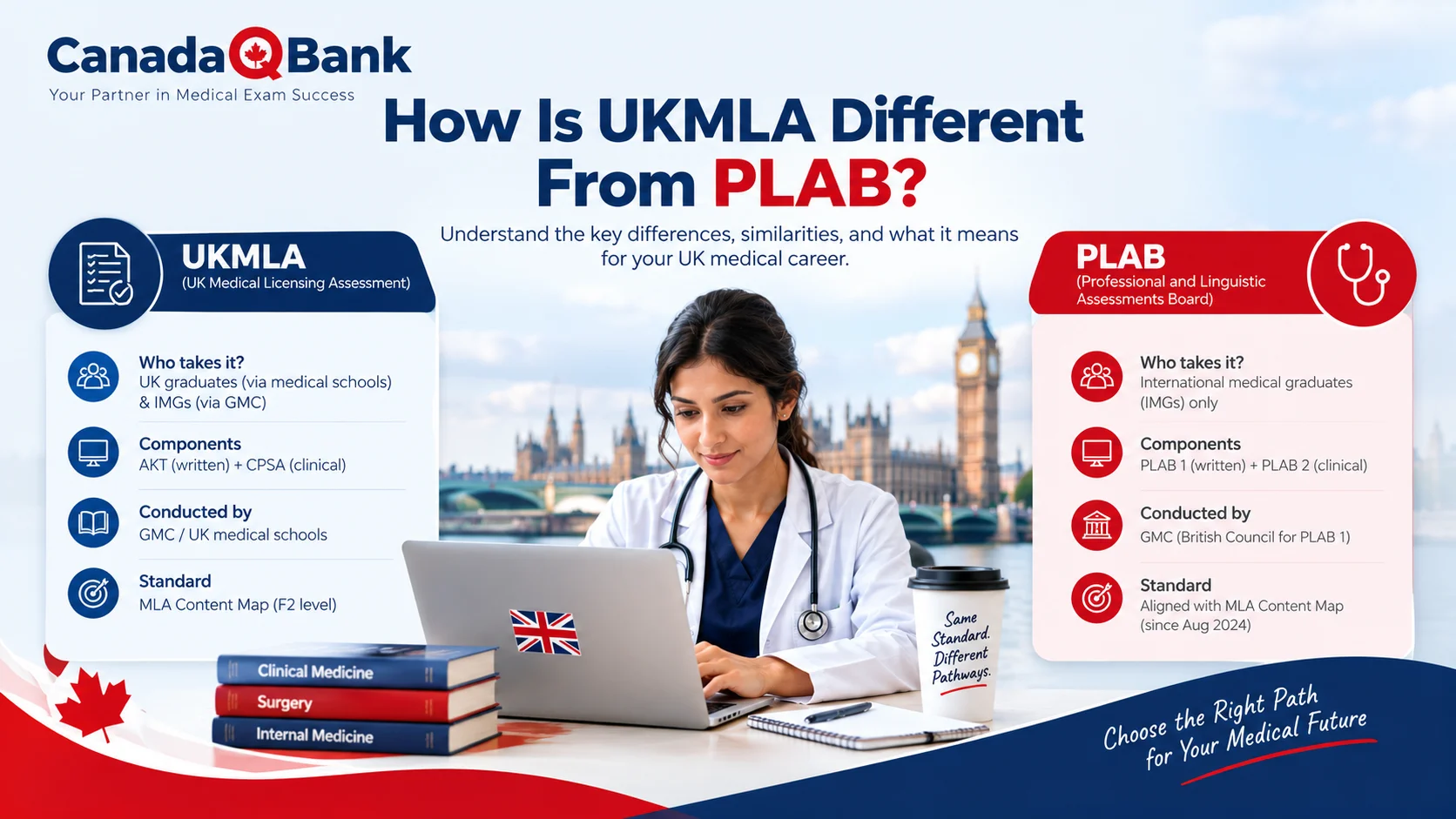
PLAB has not been replaced by the UKMLA. Both exist. But since August 2024, PLAB 1 and the UKMLA Applied Knowledge Test (AKT) test the same clinical knowledge to the same standard using the same content map.
In practical terms:
- UK medical graduates sit the UKMLA through their medical schools
- International medical graduates (IMGs) continue to sit PLAB through the GMC
- Both groups are now assessed against the same standard — the MLA Content Map — and both exams operate at the level expected of a doctor entering the UK Foundation Programme
The name is different. The booking process is different. The brand is different. The clinical knowledge standard is the same.
Background: What Is the UKMLA?
The UK Medical Licensing Assessment (UKMLA) — also referred to as the MLA — is the most significant change to UK medical licensing in decades. Introduced by the GMC, it was designed to create a single, uniform standard of competence for every doctor entering medical practice in the UK — regardless of where they trained.
Before the UKMLA, UK medical graduates sat their own medical school finals, which varied between institutions. IMGs sat PLAB. There was no single shared standard.
The UKMLA changed this. It created a unified framework — the MLA Content Map — that defines the clinical knowledge, skills, and professional behaviours expected of every doctor entering the UK Foundation Programme. UK graduates now sit the UKMLA as part of their final year assessment. IMGs sit PLAB, which has been aligned to the same MLA Content Map.
The UKMLA consists of two components:
1. Applied Knowledge Test (AKT) A computer-based, single best answer (SBA) examination of 180 questions completed in 3 hours. It tests clinical knowledge and reasoning at the standard expected of a doctor beginning Foundation training in the UK. Available at British Council centres worldwide for IMGs; administered through UK medical schools for UK graduates.
2. Clinical and Professional Skills Assessment (CPSA) An OSCE-style clinical assessment held at the GMC’s centre in Manchester. It consists of 18 stations of 8 minutes each and assesses clinical and communication skills in a simulated patient setting. IMGs sit the CPSA through the PLAB 2 pathway; UK graduates sit it through their medical school.
Background: What Is PLAB?
PLAB (Professional and Linguistic Assessments Board) is the GMC’s licensing pathway specifically for international medical graduates. It consists of two parts:
PLAB 1 — a written examination of 180 single best answer questions completed in 3 hours. Held at British Council test centres worldwide, four times per year (typically February, May, August, and November).
PLAB 2 — a clinical OSCE held exclusively at the GMC’s assessment centre in Manchester. It consists of 16 stations (14 active + 2 rest stations) of 8 minutes each. It assesses clinical and communication skills through actor-patient interactions.
Passing both PLAB 1 and PLAB 2 is required for GMC registration as an international medical graduate.
How PLAB Relates to the UKMLA: The Alignment
Since August 2024, PLAB 1 exams have been fully aligned to the MLA Content Map — the same blueprint that underpins the UKMLA AKT taken by UK graduates. This alignment was confirmed by the GMC and represents the most significant change to PLAB content in the examination’s history.
What this means in practice:
- PLAB 1 and the UKMLA AKT now test the same clinical knowledge to the same standard
- A PLAB 1 pass satisfies the AKT component of the MLA
- A PLAB 2 pass satisfies the CPSA component of the MLA
- The standard for both is the level expected of a doctor entering Year 2 of the UK Foundation Programme (F2 level)
The GMC has confirmed that pre-August 2024 PLAB 1 passes remain valid within their standard validity period. If you passed PLAB 1 before the alignment, your pass is accepted for GMC registration — nothing changes retroactively.
A further update to the MLA Content Map is planned for September 2026. Candidates sitting PLAB 1 after that date should ensure their preparation resources reflect the updated content map.
The Key Differences Between PLAB and UKMLA
Despite the content alignment, several important practical differences remain between PLAB and the UKMLA. Understanding these prevents confusion during your application process.
1. Who Takes Each Exam
| PLAB | UKMLA | |
|---|---|---|
| Who sits it | International medical graduates (IMGs) only | UK medical graduates (through medical schools) AND IMGs (through GMC) |
| Booking | Through GMC Online account | UK graduates: through their medical school; IMGs: through GMC |
| Branding | PLAB 1 and PLAB 2 | AKT (Applied Knowledge Test) and CPSA (Clinical and Professional Skills Assessment) |
2. Exam Format
| Feature | PLAB 1 / UKMLA AKT | PLAB 2 / UKMLA CPSA |
|---|---|---|
| Questions | 180 SBAs | 16 stations (PLAB 2) / 18 stations (CPSA) |
| Duration | 3 hours | Approximately 3 hours |
| Location | British Council centres worldwide | Manchester only (GMC centre) |
| Format | Computer-based SBA | OSCE live stations |
The most notable structural difference is in the clinical assessment component. PLAB 2 has 16 stations (14 active + 2 rest) while the UKMLA CPSA has 18 stations — reflecting the fact that the UK graduate version is delivered through their medical schools with a slightly different administrative structure. Both assess the same clinical and communication competencies.
3. Content Standard
Both PLAB 1 and the UKMLA AKT are now assessed against the same MLA Content Map. The content map is based on:
- The GMC’s Outcomes for Graduates — what newly qualified UK medical graduates must know and be able to do
- The GMC’s Generic Professional Capabilities framework
- Clinical situations typically encountered by doctors in the UK Foundation Programme
This means that since August 2024, the clinical knowledge required to pass PLAB 1 and the UKMLA AKT is the same. UK-specific guidelines — NICE, BNF, CKS (Clinical Knowledge Summaries), and GMC Good Medical Practice — remain the foundation of both examinations.
4. Validity and Registration
| Feature | PLAB | UKMLA |
|---|---|---|
| PLAB 1 validity for PLAB 2 entry | 3 years | — |
| Pre-August 2024 passes | Valid within validity period | — |
| Both parts required for GMC registration | Yes (PLAB 1 + PLAB 2) | Yes (AKT + CPSA) |
5. Retake Limits
PLAB allows candidates to retake each part up to four times. The specific retake limits for the UKMLA pathway for IMGs who may access it directly are subject to ongoing GMC policy development — always verify current rules on the GMC website.
Is the UKMLA Harder Than PLAB?
This is one of the most frequently asked questions — and the answer is clear.
The standard is the same. The GMC has explicitly confirmed that the UKMLA is not intended to be harder than PLAB. It is a unified standard applied consistently. PLAB 1 and the UKMLA AKT are calibrated to the same difficulty level — F2 standard — using the same content map.
In practice, some UK graduates report finding the UKMLA more demanding than their previous medical school finals (which historically varied in difficulty between institutions). Some IMGs report finding post-alignment PLAB 1 different in feel from older question banks that predate the MLA alignment. But the official standard — and the passing threshold — is the same for both.
The practical implication for preparation is clear: use current, MLA-aligned preparation resources. Question banks and study materials written before August 2024 may not fully reflect the MLA Content Map that PLAB 1 now tests.
Will PLAB Eventually Be Replaced by the UKMLA?
This is a question the GMC has addressed directly. The current position is that PLAB continues as the IMG pathway to GMC registration, aligned to the MLA standard. The GMC has not announced a timeline for replacing the PLAB name or booking process with UKMLA branding for IMGs.
What has happened is alignment — the same standard, different administrative routes. Whether IMGs will eventually sit something formally branded as the UKMLA rather than PLAB remains a question of policy development.
For candidates preparing now: sit PLAB 1 and PLAB 2 through the existing GMC process. The content you need to master is the MLA Content Map. The examination you register for and sit is PLAB.
What This Means for Your PLAB Preparation in 2026
The MLA alignment has practical implications for how you prepare.
Use MLA-aligned resources. Question banks, study guides, and preparation courses developed or updated after August 2024 reflect the MLA Content Map. Resources that predate this alignment may still be clinically useful but may not reflect the specific emphasis and presentation of content in the current PLAB 1.
UK-specific guidelines remain essential. The MLA Content Map is grounded in UK clinical practice. NICE guidelines, BNF prescribing standards, CKS summaries, and GMC Good Medical Practice principles are the authoritative sources for the clinical decisions the examination tests. International or American guidelines are not the correct reference for PLAB preparation.
The F2 standard is your benchmark. Every question you encounter in PLAB 1 preparation should be approached through the lens of: what would a safe, competent Foundation Year 2 doctor do in this clinical situation, according to current UK guidelines?
PLAB 2 communication emphasis is unchanged. The MLA alignment primarily affects PLAB 1 content. PLAB 2 continues to assess clinical communication, consultation skills, and professional behaviour through its OSCE format — and preparation for PLAB 2 requires live practice with a partner, not content review alone.
September 2026 content map update. The GMC has indicated that the MLA Content Map will be updated in September 2026. If you are sitting PLAB 1 after this date, ensure your preparation materials reflect the updated map. Check the GMC website for the current published content map before beginning preparation.
Summary: UKMLA vs PLAB at a Glance
| Question | Answer |
|---|---|
| Has PLAB been replaced by the UKMLA? | No. PLAB continues for IMGs |
| Do PLAB and UKMLA test the same content? | Yes, since August 2024 — both use the MLA Content Map |
| Is PLAB 1 the same as the UKMLA AKT? | Same content and standard; different name, booking, and branding |
| Is PLAB 2 the same as the UKMLA CPSA? | Same competencies assessed; PLAB 2 has 16 stations, CPSA has 18 |
| Is the UKMLA harder than PLAB? | No — same standard (F2 level) |
| Are pre-2024 PLAB passes still valid? | Yes, within their validity period |
| Who books PLAB? | IMGs through GMC Online |
| Who books the UKMLA AKT? | UK graduates through their medical school |
| Do I need both parts for GMC registration? | Yes — PLAB 1 + PLAB 2 (or AKT + CPSA) |
How CanadaQBank Supports Your PLAB Preparation
At CanadaQBank.com, our PLAB 1 question bank is built around the MLA Content Map — the same blueprint that has underpinned PLAB 1 since August 2024.
Our platform provides:
- PLAB 1 SBA question bank aligned to the current MLA Content Map — 180-question format, UK clinical guidelines, NICE, BNF, and GMC Good Medical Practice
- Clinical reasoning development through detailed explanations grounded in UK clinical practice — building the applied knowledge the MLA standard requires
- UK-specific guideline content throughout — every correct answer reflects current UK clinical practice, not international or American standards
- Timed practice modes building the 3-hour exam pacing the PLAB 1 format demands
- Domain performance analytics identifying your weakest clinical areas so every study session is precisely targeted
- Updated content reflecting the post-August 2024 MLA alignment — not pre-alignment question banks that no longer fully match the current examination
Visit CanadaQBank.com today and prepare for PLAB 1 with a question bank built around the standard the examination actually tests.