SMLE vs USMLE: Key Differences for International Doctors

SMLE vs USMLE: Key Differences for International Doctors

For international medical graduates (IMGs), choosing the right licensing examination is one of the most important decisions in their medical career. Two of the most recognized licensing exams are the Saudi Medical Licensing Examination (SMLE) and the United States Medical Licensing Examination (USMLE). Both exams are designed to assess a physician’s competence and readiness for clinical practice, but they serve different healthcare systems, licensing pathways, and career goals.

If you’re considering practicing medicine in Saudi Arabia or the United States, understanding the differences between SMLE vs USMLE can help you make an informed decision and prepare effectively for your future.

In this comprehensive guide, we’ll compare the SMLE and USMLE in terms of eligibility, exam structure, difficulty, costs, career opportunities, preparation strategies, and more.

What Is the SMLE?

The Saudi Medical Licensing Examination (SMLE) is administered by the Saudi Commission for Health Specialties (SCFHS) and is required for physicians who wish to practice medicine in Saudi Arabia.

The exam evaluates whether candidates possess the medical knowledge and clinical judgment necessary to provide safe patient care within the Saudi healthcare system.

The SMLE is commonly taken by:

  • Saudi medical graduates
  • International medical graduates seeking employment in Saudi Arabia
  • Physicians applying for residency training programs in Saudi Arabia

Passing the SMLE is a mandatory requirement for obtaining a professional license to practice medicine in the Kingdom of Saudi Arabia.

What Is the USMLE?

The United States Medical Licensing Examination (USMLE) is a three-step examination program used to assess a physician’s ability to practice medicine in the United States.

The exam is jointly sponsored by:

  • Federation of State Medical Boards (FSMB)
  • National Board of Medical Examiners (NBME)

The USMLE pathway is required for:

  • U.S. medical graduates
  • International medical graduates pursuing residency in the United States
  • Physicians seeking medical licensure in the U.S.

The USMLE evaluates a physician’s understanding of medical sciences, clinical knowledge, patient care, and readiness for independent medical practice.

SMLE vs USMLE: Quick Comparison

FeatureSMLEUSMLE
CountrySaudi ArabiaUnited States
Governing BodySCFHSFSMB & NBME
Number of ExamsOne main licensing examThree-step examination system
Main PurposeMedical licensure in Saudi ArabiaMedical licensure in the U.S.
Exam FormatMultiple-choice questionsStep 1, Step 2 CK, Step 3
Residency RequirementBased on Saudi programsRequired for U.S. residency matching
Clinical Skills ExamNot currently separateClinical skills integrated into assessments
International RecognitionPrimarily Saudi ArabiaWidely recognized internationally

Eligibility Requirements

SMLE Eligibility

Candidates must generally:

  • Hold a recognized medical degree
  • Complete internship requirements
  • Meet SCFHS credentialing requirements

International medical graduates may need additional document verification through the SCFHS registration process.

USMLE Eligibility

To sit for the USMLE, candidates must:

  • Be enrolled in or graduated from a recognized medical school
  • Meet ECFMG requirements (for international graduates)
  • Complete application procedures through the official USMLE system

International candidates must obtain ECFMG certification before entering U.S. residency training programs.

Exam Structure: SMLE vs USMLE

SMLE Format

The SMLE consists of a computer-based examination featuring multiple-choice questions that assess:

  • Internal medicine
  • Surgery
  • Pediatrics
  • Obstetrics and gynecology
  • Emergency medicine
  • Family medicine
  • Ethics and professionalism

Questions focus on clinical application and practical decision-making.

The exam is designed to evaluate competencies expected from a newly qualified physician.

USMLE Format

Step 1

Step 1 assesses foundational medical sciences including:

  • Anatomy
  • Physiology
  • Biochemistry
  • Pharmacology
  • Pathology
  • Microbiology

The exam is now reported as Pass/Fail.

Step 2 CK

Step 2 Clinical Knowledge evaluates:

  • Internal medicine
  • Surgery
  • Pediatrics
  • Obstetrics and gynecology
  • Psychiatry
  • Preventive medicine

Candidates receive a numerical score.

Step 3

Step 3 focuses on:

  • Independent patient management
  • Clinical decision-making
  • Emergency care
  • Preventive medicine

Step 3 is usually taken during residency training.

Which Exam Is More Difficult?

Difficulty is subjective and depends on a candidate’s background, preparation, and career goals.

Why Some Candidates Find USMLE More Challenging

The USMLE pathway is longer and more comprehensive.

Candidates must:

  • Pass multiple examinations
  • Compete for residency positions
  • Achieve strong Step 2 CK scores
  • Demonstrate research and clinical experience

The competitive nature of U.S. residency matching adds another layer of difficulty.

Why Some Candidates Find SMLE Challenging

Although SMLE involves a single licensing examination, it still covers a broad medical curriculum.

Challenges include:

  • Large content volume
  • Time management
  • Clinical reasoning requirements
  • Competition for residency positions in Saudi Arabia

Candidates who underestimate the exam often struggle despite its shorter licensing pathway.

Exam Costs

SMLE Costs

SMLE costs are generally lower than the total expenses associated with the USMLE pathway.

Candidates typically pay for:

  • Examination fees
  • SCFHS registration
  • Credential verification

The overall financial investment is relatively affordable compared to U.S. licensing.

USMLE Costs

The USMLE pathway can be expensive, particularly for international medical graduates.

Costs may include:

  • Step 1 registration
  • Step 2 CK registration
  • ECFMG certification
  • Travel expenses
  • Residency applications
  • Interview costs

The total investment often reaches several thousand dollars.

Residency Opportunities

Residency in Saudi Arabia

After passing the SMLE, candidates may apply for residency programs administered through the Saudi Commission for Health Specialties.

Popular specialties include:

  • Internal medicine
  • Surgery
  • Pediatrics
  • Family medicine
  • Emergency medicine

Residency positions are competitive, particularly in major cities.

Residency in the United States

Passing USMLE exams allows candidates to participate in the National Resident Matching Program (NRMP).

The U.S. offers:

  • Extensive specialty options
  • Advanced training opportunities
  • Research-focused programs
  • Internationally respected residency training

However, residency matching can be highly competitive, especially for international graduates.

Career Opportunities After SMLE

Physicians who successfully pass the SMLE can pursue a variety of career opportunities within Saudi Arabia’s healthcare sector, including:

Government Hospitals

Saudi Arabia’s public healthcare system employs thousands of physicians across primary, secondary, and tertiary care facilities.

Private Hospitals

Major private healthcare networks continue to expand throughout the Kingdom, creating strong demand for qualified medical professionals.

Specialized Medical Centers

Physicians can work in advanced specialty and tertiary-care centers that provide highly specialized medical services.

Academic Institutions

Qualified physicians may pursue careers in medical education, research, and academic leadership at universities and teaching hospitals.

Career Opportunities After USMLE

Passing the USMLE provides access to career opportunities within one of the world’s largest and most advanced healthcare systems.

Clinical Practice

Practice as a licensed physician across a wide range of medical and surgical specialties after completing residency training.

Academic Medicine

Contribute to medical education, clinical research, and innovation through university-affiliated hospitals and academic institutions.

Subspecialty Fellowships

Pursue advanced fellowship training in highly specialized areas of medicine and surgery.

International Career Mobility

U.S. residency training and clinical experience are widely respected and can enhance career opportunities in many countries around the world.

Which Exam Should International Doctors Choose?

The answer depends on your long-term career goals.

Choose SMLE If:

  • You plan to practice in Saudi Arabia.
  • You want a shorter licensing pathway.
  • You are interested in Middle Eastern healthcare opportunities.
  • You prefer a more direct route to licensure.

Choose USMLE If:

  • You want to practice in the United States.
  • You seek access to highly competitive residency programs.
  • You are interested in advanced research opportunities.
  • You want broader international recognition.

Neither exam is inherently better. The right choice depends entirely on where you envision your future medical career.

Best Preparation Strategies for SMLE and USMLE

Regardless of which exam you choose, success requires a structured preparation plan.

Focus on High-Yield Topics

Prioritize commonly tested areas such as:

  • Internal medicine
  • Emergency medicine
  • Pediatrics
  • Pharmacology
  • Ethics

High-yield topics frequently appear on both exams.

Practice Questions Daily

Question-based learning remains one of the most effective preparation methods.

Benefits include:

  • Improved clinical reasoning
  • Better time management
  • Identification of weak areas
  • Increased confidence

Take Mock Exams

Practice exams simulate real testing conditions and help candidates assess readiness.

Regular self-assessment allows you to adjust your study strategy before exam day.

Use Reliable Study Resources

Choosing quality resources is essential.

A well-designed question bank can significantly improve retention and performance by exposing candidates to realistic exam scenarios.

How CanadaQBank Can Help

Whether you’re preparing for the SMLE, USMLE, MCCQE1, PLAB, or other international medical licensing exams, effective question practice is critical for success.

CanadaQBank provides comprehensive exam preparation resources that help candidates:

  • Master high-yield concepts
  • Improve clinical decision-making
  • Build exam confidence
  • Track performance and progress
  • Practice with realistic exam-style questions

By combining structured study with extensive question practice, candidates can improve their chances of passing on the first attempt and achieving their professional goals.

Conclusion

When comparing SMLE vs USMLE, it’s important to understand that each examination serves a different purpose and healthcare system. The SMLE provides a pathway to medical practice in Saudi Arabia, while the USMLE is the gateway to residency training and licensure in the United States.

The USMLE pathway is generally longer, more expensive, and more competitive, but it offers extensive career opportunities and international recognition. The SMLE provides a more streamlined route to practicing medicine in one of the Middle East’s fastest-growing healthcare sectors.

Ultimately, your decision should align with your long-term career objectives, preferred practice location, and professional aspirations. With proper planning, consistent preparation, and the right study resources, success in either examination is entirely achievable.

Average Doctor Salary in Canada 2026: A Comprehensive Guide

Average Doctor Salary in Canada 2026

If you’re considering a medical career in Canada or are already a practicing physician, understanding the average doctor salary in Canada for 2026 is crucial. Salaries for doctors vary widely based on specialization, experience, location, and employment type. In this blog, we’ll break down the expected earnings for physicians across different fields, provinces, and practice settings while also exploring factors that influence income.

By the end of this guide, you’ll have a clear picture of what doctors can expect to earn in 2026 and how to maximize your earning potential. Plus, if you’re preparing for medical licensing exams, CanadaQBank offers premium question banks and study resources to help you succeed!

Overview of Doctor Salaries in Canada

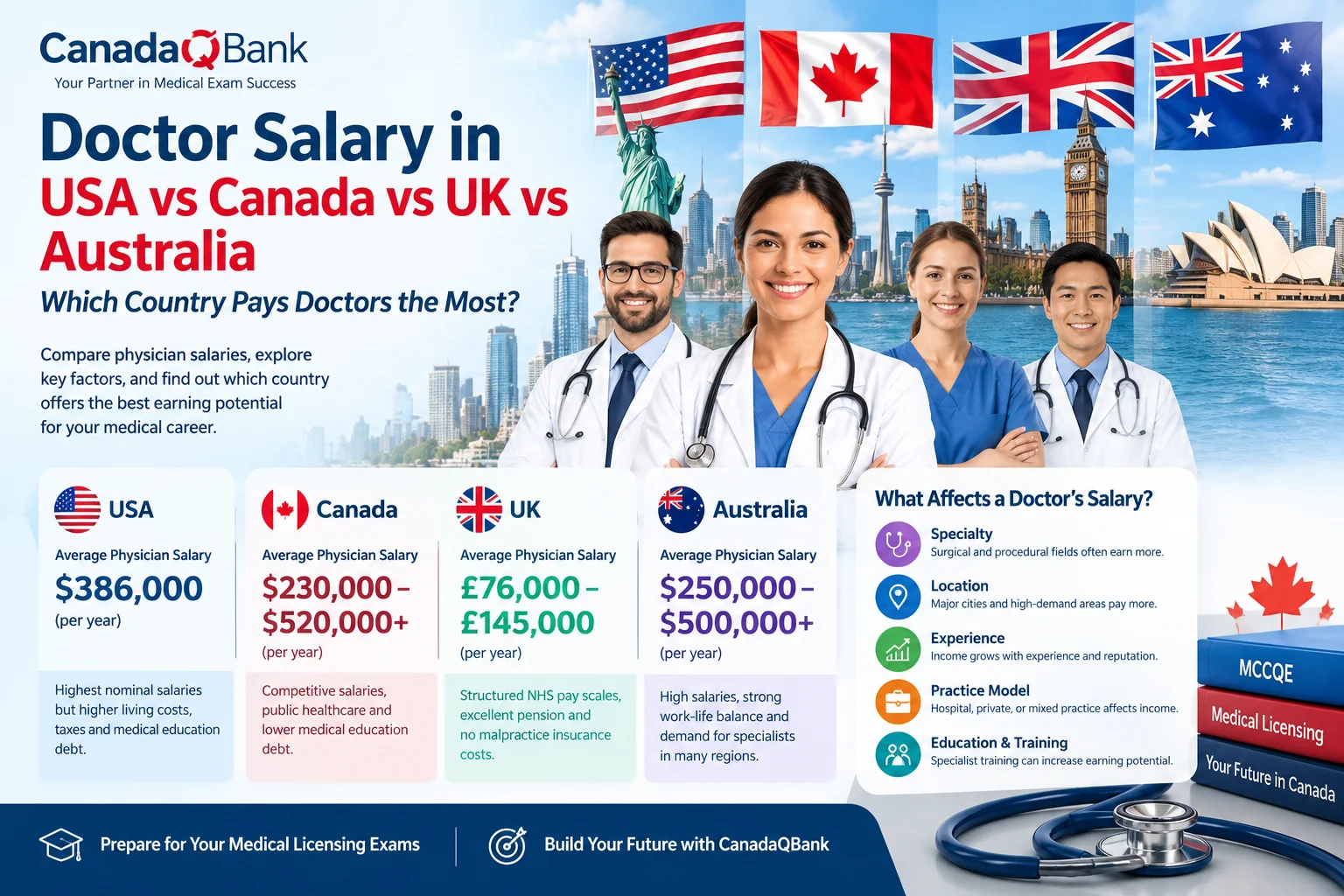
Doctors in Canada are among the highest-paid professionals, reflecting the extensive education, training, and responsibility required in the field. According to recent projections, the average doctor salary in Canada in 2026 is expected to range between $230,000 and $520,000+ per year, depending on specialization and other factors.

Key Factors Affecting Doctor Salaries:

  1. Specialization – Surgeons and specialists typically earn more than general practitioners.
  2. Experience – Senior doctors with years of practice command higher fees.
  3. Location – Urban vs. rural practice and provincial fee structures impact earnings.
  4. Employment Type – Self-employed physicians often earn more than salaried hospital doctors.
  5. Billing Model – Fee-for-service vs. salary-based roles influence income.

Now, let’s dive into the specifics.

Average Doctor Salary in Canada by Specialty (2026)

1. Family Physicians (General Practitioners)

Family doctors are the backbone of Canada’s healthcare system. In 2026, the average salary for a family physician is projected to be between $230,000 – $320,000 annually. Those in rural or underserved areas may earn higher due to incentives.

2. Medical Specialists

Specialists such as cardiologists, neurologists, and gastroenterologists earn significantly more. Expected salaries in 2026:

  • Cardiologists: $420,000 – $650,000
  • Neurologists: $320,000 – $470,000
  • Gastroenterologists: $370,000 – $520,000

3. Surgeons

Surgeons are among the highest-paid doctors in Canada. Projected 2026 earnings:

  • General Surgeons: $370,000 – $520,000
  • Neurosurgeons: $550,000 – $850,000+
  • Orthopedic Surgeons: $480,000 – $750,000

4. Emergency Medicine Physicians

ER doctors handle critical cases and can expect an average salary of $320,000 – $470,000 in 2026, with variations based on shift differentials and location.

5. Psychiatrists

With increasing demand for mental health services, psychiatrists are projected to earn $270,000 – $420,000 annually.

6. Pediatricians

Pediatricians earn between $210,000 – $360,000, depending on whether they work in private practice or hospitals.

Provincial Breakdown of Doctor Salaries in Canada

Salaries vary by province due to different healthcare budgets and fee schedules. Here’s a comparison for 2026:

ProvinceAverage Salary Range (2026)
Ontario$260,000 – $580,000
British Columbia$270,000 – $620,000
Alberta$250,000 – $520,000
Quebec$230,000 – $470,000
Nova Scotia$210,000 – $420,000
Manitoba$240,000 – $500,000

Alberta and Ontario tend to offer the highest salaries, while Atlantic provinces may have lower averages but often include incentives for rural practice.

How Do Canadian Doctor Salaries Compare to Other Countries?

  • USA: Doctors earn significantly more ($320,000 – $750,000+) but face higher malpractice costs.
  • UK: Lower salaries (£65,000 – £160,000) but with public healthcare benefits.
  • Australia: Comparable to Canada (AU$210,000 – $520,000).

Canada offers a balanced mix of high earnings, good work-life balance, and universal healthcare benefits.

Ways to Increase Your Earnings as a Doctor in Canada

  1. Choose a High-Demand Specialty – Surgeons and specialists earn more.
  2. Work in Rural Areas – Many provinces offer bonuses for rural practice.
  3. Take On Additional Roles – Teaching, research, or administrative duties can add income.
  4. Optimize Billing Practices – Efficient fee-for-service billing maximizes earnings.
  5. Open a Private Clinic – Self-employed doctors often earn more than hospital employees.

Future Trends Affecting Doctor Salaries in Canada

  • Increased Demand for Specialists – Aging population boosts need for surgeons and geriatric care.
  • Telemedicine Growth – Virtual care may open new revenue streams.
  • Government Funding Changes – Fee structure reforms could impact earnings.

Conclusion

The average doctor salary in Canada in 2026 remains highly competitive, with specialists and surgeons leading in earnings. Location, experience, and practice type all play crucial roles in determining income. Whether you’re a medical student, resident, or practicing physician, understanding these trends helps in career planning.

Boost Your Medical Career with CanadaQBank!

Preparing for medical licensing exams like the MCCQE, USMLE, or PLABCanadaQBank offers the most comprehensive question banks, detailed explanations, and simulated exams to help you succeed. With our high-yield resources, you’ll be one step closer to securing a high-paying medical career in Canada.

Visit CanadaQBank.com today and ace your exams!

CanadaQbank and How It Can Transform Your Studies

CanadaQBank is a highly regarded online test preparation platform that has assisted numerous medical students and physicians in passing their medical licensing exams.

CanadaQBank features a vast array of questions that have been carefully curated to accurately simulate the actual questions and cases encountered on the licensing exams. This makes it an essential tool for anyone seeking to pass their medical licensing exams confidently and easily.

CanadaQBank was founded on the foundation of research to help students streamline their learning process and maximize their study time. The goal was to provide a platform that would allow students to focus their efforts on high-yield topics and test-taking strategies rather than spending countless hours on low-yield information that would not be as useful on the licensing exams.

By doing so, CanadaQBank helps students save valuable time and energy while preparing for their exams, leading to a more effective and efficient study process.

How Does CanadaQBank help You Study better?

CanadaQBank offers a one-stop solution for all your learning needs, providing multiple ways to make your study process more effective. With abundant information available in the medical field, it can be challenging to keep track of the most important learning points and recall them later. To overcome this challenge, CanadaQBank has created an innovative feature that allows you to keep all your notes, selected questions, and topics in one central location.

Each multiple-choice question on CanadaQBank has built-in tools that enable you to personalize your learning experience by highlighting important points, taking notes, and categorizing the questions according to your preferences. These tools are easily accessible from the “My Questions” page, which is a single source for all your selected questions and notes.

Offers Question Organization for Easy Revision

The “My Questions” feature enables you to organize and store your selected questions for future reference and revision. This feature provides a convenient and organized way to review your most important topics and ensures that you retain the most valuable information from your study process. With CanadaQBank, you can maximize your learning potential and pass your medical licensing exams with ease.

Seamless User-Interface

At CanadaQBank, we understand the importance of efficiency and convenience in test preparation. That’s why we have made the process of starting a test as seamless and effortless as possible. With just a single click, you can be on your way to mastering the medical licensing exam.

As soon as you land on the CanadaQBank.com webpage, your login information will be automatically filled in, eliminating the need to enter your name and password repeatedly. Once you are logged in, you will be taken directly to the test page, where all the popular test parameters have been preset for you. This means you don’t have to waste time and energy configuring the test every time you start it.

All you need to do is click the “Create test” button, and your test will be launched immediately. This streamlined process is just one of the many ways that CanadaQBank is dedicated to helping you achieve your learning goals and pass your medical licensing exam easily.

Improves your Focus during exam preparation

CanadaQBank stands apart from its competitors due to its unique “Study Topic” feature, specifically designed to make the learning experience more effective and efficient. The “Study Topic” feature allows students to focus on mastering one topic at a time, making studying and understanding complex medical concepts easier.

Once the students have a solid understanding of the high-yield topics and feel confident in their knowledge, they can take a timed test to reinforce their learning and drive the medical facts into their deep memory. This organized approach to learning ensures that students are better prepared and more confident when it comes time to take the medical licensing exam.

Helps you take Notes for better revision

You can add your own notes inside each MCQ and review them later. This makes the learning process more interesting and allows you to review your notes during revisions.

Multiple Difficulty Levels to help you test yourself

No matter what stage of your medical career, CanadaQBank has you covered. If you’re just starting out as a medical student or a seasoned physician who needs a refresher, you can select the difficulty level that best suits your needs. Start with the “Easy” level questions and gradually work your way up to the “Medium” and “Hard” difficulty levels. This allows you to learn and grow at your own pace, ensuring that you are prepared for the medical licensing exam.

Wide Range of Question Options

CanadaQBank offers students traditional MCQs and multimedia questions that include video explanations. These instructional tutorial videos are available on our YouTube channel and provide an alternate way for students to learn and understand high-yield topics. This allows students to use video to supplement traditional text-based learning, offering a more diverse and engaging learning experience.

Makes learning easy and faster

Everyone’s learning style is different, and sometimes, a change in pace is necessary. The “Topics Mode” allows you to focus on mastering one topic at a time rather than taking a traditional test. This feature is designed to accommodate varying learning moods and styles and helps you move forward and make progress in your studies, no matter what your preferred method of learning may be.

Helps you monitor your performance in real-time

Knowing your performance is crucial in the medical field and CanadaQBank understands this. That’s why it has included an intuitive and easy-to-use performance tracking tool. The standard deviation graph helps students monitor their progress and provides a visual representation of where they stand compared to others. With each performance, students will see their percentile ranking improve, allowing them to track their progress easily.

Conclusion

It is no secret that the medical field is an incredibly vast and complex field, encompassing countless specialties, subspecialties, and areas of study. It takes years of education, experience, and continuous learning to begin to master a single area of medicine.

CanadaQBank is a platform that has been meticulously designed to deliver the best multiple-choice questions and case studies, with the ultimate goal of providing maximum results for students. The platform’s creators have put in extensive time and effort to develop a comprehensive set of QBanks that are proven to produce outstanding results.