


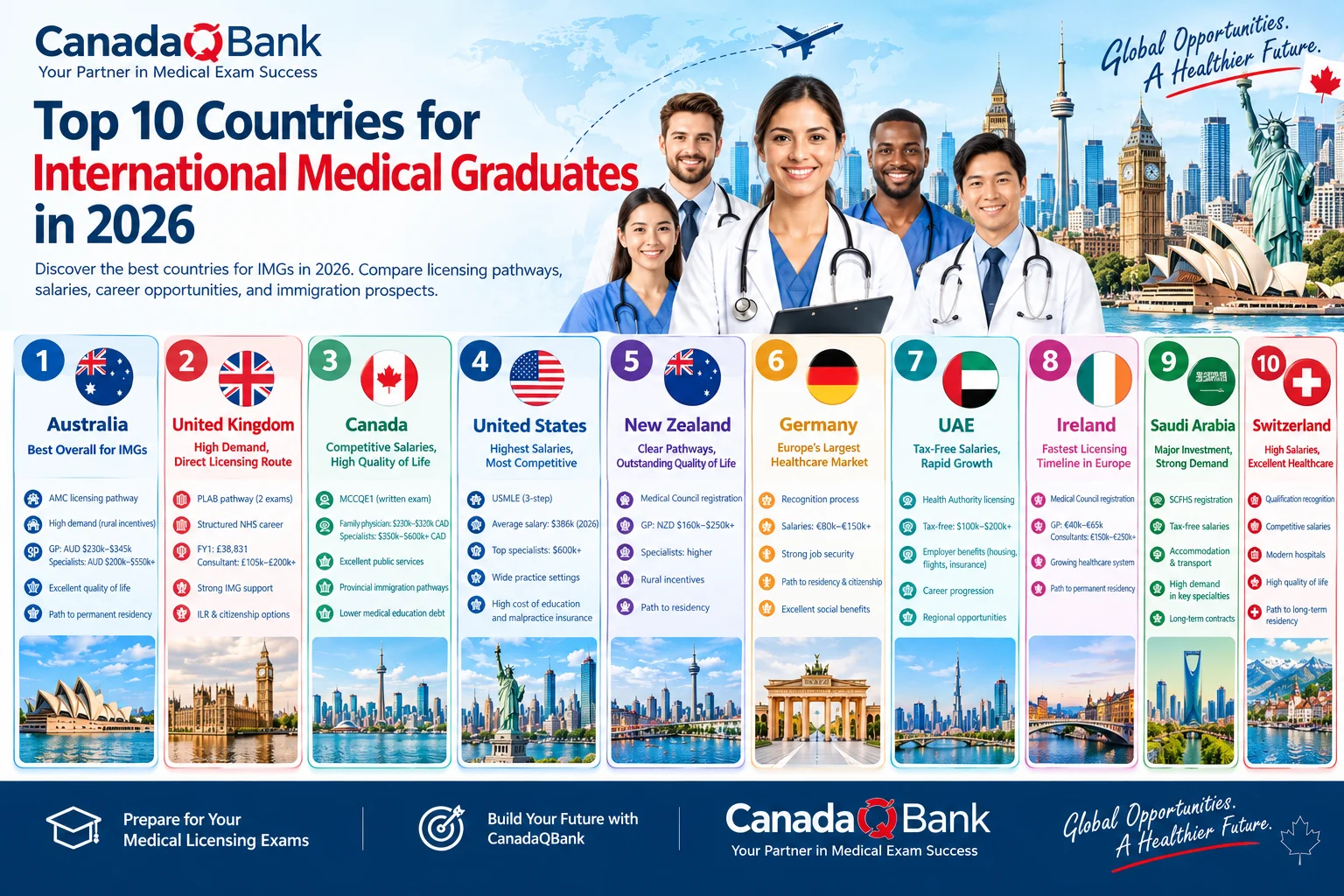
The world is facing a significant and growing shortage of doctors. Developed healthcare systems across North America, Europe, and the Asia-Pacific region are competing for qualified physicians — and internationally trained medical graduates are increasingly central to filling that gap.
For IMGs, this creates genuine opportunity. Countries that once imposed near-impossible barriers to foreign physician practice are now streamlining licensing pathways, creating dedicated immigration routes, and offering financial incentives to attract medical talent from abroad. In 2026, the question for many IMGs is not whether opportunities exist — it is which country offers the right combination of licensing accessibility, career prospects, salary, quality of life, and long-term immigration security.
This guide ranks the top ten countries for IMGs in 2026, based on licensing pathway structure, demand for foreign physicians, salary, quality of life, and immigration prospects.
1. Australia — Best Overall for IMGs in 2026
Australia consistently ranks as the top destination for international medical graduates, and 2026 is no exception. Approximately 30% of Australia’s practising doctors are internationally trained — a figure that reflects both the country’s genuine openness to IMGs and its structural reliance on overseas-trained physicians to staff its healthcare system, particularly in rural and regional areas.
Why it ranks first:
- Clear, structured licensing pathway through the Australian Medical Council (AMC)
- Strong demand across all specialties, with critical shortages in rural areas commanding additional financial incentives
- High physician salaries — GP earns AUD $230,000–$345,000; specialists AUD $200,000–$550,000+
- Excellent quality of life, strong public services, and a well-regarded immigration system
- Employer superannuation contributions of 12% add meaningfully to total compensation
- Permanent residency pathways available through skilled migration, with medicine consistently on the skills shortage list
Licensing pathway: AMC Part 1 (MCQ examination) → AMC Part 2 (clinical examination) → supervised practice period → fellowship training in chosen specialty. Some IMGs with specialist qualifications may qualify for a shortened pathway through specialist recognition.
Language requirement: English. IELTS or OET required for non-native speakers.
2. United Kingdom — High Demand, Direct Licensing Route
Over 40% of doctors entering the UK medical register each year are international graduates — making the UK one of the most accessible and IMG-friendly healthcare systems in the world. The NHS faces chronic workforce shortages across virtually every specialty and region, and actively recruits from abroad.
Why it ranks second:
- The PLAB (Professional and Linguistic Assessments Board) pathway is one of the most straightforward licensing routes globally — two examinations and a supervised practice period
- Structured NHS career progression from Foundation to Consultant with defined pay scales
- Significant IMG community and support networks
- Route to indefinite leave to remain (ILR) and British citizenship available
- NHS defined-benefit pension scheme is a substantial long-term benefit
Licensing pathway: PLAB 1 (written SBA examination, 180 questions, 3 hours) → PLAB 2 (OSCE, 16 stations in Manchester) → GMC registration → Foundation Programme or equivalent → specialty training or specialty and associate specialist (SAS) roles.
Salary: FY1 £38,831 basic; consultant £105,504–£139,882 NHS basic, £150,000–£300,000+ with private practice.
Language requirement: English. IELTS or OET required.
3. Canada — Competitive Salaries, High Quality of Life
Canada has one of the highest physician shortages per capita among developed nations, with family medicine and primary care facing a particular crisis across most provinces. This shortage creates genuine opportunities for IMGs — though the residency match pathway remains competitive.
Why it ranks third:
- MCCQE1 is a single written examination that opens the door to Canadian medical licensing
- High physician salaries — family physicians $230,000–$320,000 CAD; specialists $350,000–$600,000+ CAD
- Excellent quality of life, strong public services, and welcoming immigration policies
- Provincial nominee programs and express entry pathways support permanent residency for physicians
- Lower cost of medical education than the US means graduates enter without crippling debt
Licensing pathway: MCCQE1 (230 MCQ examination) → residency match (CaRMS) → specialty training → MCCQE2 (OSCE) or CFPC/RCPSC fellowship examinations → licensure.
Challenge for IMGs: Canadian residency positions are limited and competitive. Many IMGs who pass the MCCQE1 face difficulty securing a residency position through CaRMS. Provincial Practice-Ready Assessment (PRA) programs offer an alternative route for experienced family physicians in some provinces.
Language requirement: English or French depending on province.
4. United States — Highest Salaries, Most Competitive Pathway
The United States offers the highest physician salaries in the world — an average of $386,000 (2026 Medscape Report), with top surgical specialists exceeding $600,000. For IMGs willing to navigate the demanding USMLE pathway and residency match, the financial and professional rewards are unmatched.
Why it ranks fourth:
- Highest nominal physician salaries globally
- IMGs make up approximately 25% of the US physician workforce — a substantial and established presence
- Wide variety of practice settings — academic, private practice, hospital-employed, locum tenens
- Significant IMG-friendly residency programs, particularly in internal medicine, pathology, and neurology
Licensing pathway: USMLE Step 1 → USMLE Step 2 CK → ECFMG certification → residency match (NRMP) → USMLE Step 3 → state medical licensure. Total timeline from medical degree to independent practice: typically 7–10 years including residency and fellowship.
Challenges for IMGs: The residency match is highly competitive. USMLE scores carry significant weight. Visa requirements (J-1 or H-1B) add complexity. Medical malpractice insurance, educational debt (for US medical graduates), and administrative burden are higher than in other countries.
Language requirement: English. USMLE examinations are in English.
5. New Zealand — Clear Pathways, Outstanding Quality of Life
New Zealand is an increasingly attractive destination for IMGs in 2026 — offering structured licensing pathways, physician shortages across most specialties and regions, and one of the highest quality-of-life rankings in the world.
Why it ranks fifth:
- The Medical Council of New Zealand has a well-defined pathway for overseas-trained physicians
- Active recruitment of IMGs, particularly for rural and regional positions
- Average GP salary NZD $160,000–$250,000; specialists higher
- New Zealand’s skilled migrant category actively favours health professionals
- Strong community, outdoor lifestyle, and proximity to Australia for career flexibility
Licensing pathway: Application to the Medical Council of New Zealand → competence assessment (which may include supervised practice) → vocational registration for specialists or general registration for GPs → annual practising certificate.
Language requirement: English.
6. Germany — Europe’s Largest Healthcare Market, Growing IMG Pathway
Germany faces one of the most severe physician shortages in Europe, with an estimated shortfall of tens of thousands of doctors projected over the coming decade. The country has actively streamlined its recognition of foreign medical qualifications, and the process — while still requiring German language proficiency — has become more accessible.
Why it ranks sixth:
- Europe’s largest economy and healthcare system, with strong job security and benefits
- Growing demand for IMGs across hospital and outpatient settings
- Competitive salaries by European standards — specialist physicians earning €80,000–€150,000+
- Pathway to permanent residency and EU citizenship available
- Strong social security system, generous annual leave, and structured working hours
Licensing pathway: Foreign degree recognition (Approbation or Berufserlaubnis) through state medical chambers → language examination → equivalency assessment → supervised practice if required → full licensure (Approbation).
Challenge: German language proficiency (typically B2 to C1 level) is required. This is the primary barrier for most non-German-speaking IMGs. Dedicated language preparation programs exist specifically for physicians.
7. United Arab Emirates — Tax-Free Salaries, Rapid Growth
The UAE’s healthcare sector has undergone rapid expansion over the past decade, with significant investment in both public and private healthcare infrastructure across Dubai, Abu Dhabi, and the wider Emirates. The country recruits actively from abroad and offers tax-free salaries that are competitive globally.
Why it ranks seventh:
- Tax-free physician salaries — specialists typically earn USD $100,000–$200,000+ with no income tax
- Rapid career progression opportunities in a growing healthcare market
- Strong expat community and English widely spoken in clinical settings
- Employer-provided accommodation, health insurance, and flights are frequently included in packages
- Gateway to broader Gulf Cooperation Council (GCC) opportunities
Licensing pathway: Health Authority Abu Dhabi (HAAD) or Dubai Health Authority (DHA) licensing examination and credential verification → employment offer → residency visa. The licensing process is employer-facilitated in most cases.
Considerations: Contracts are typically 2–3 years with renewal. Permanent residency pathways are limited compared to Western countries. Career trajectory beyond a certain seniority level can be more restricted than in traditional healthcare systems.
8. Ireland — Fastest Licensing Timeline in Europe
Ireland offers one of the fastest licensing timelines for IMGs in the world — in some cases as short as 3 months from application to practice. The Irish Medical Council has a streamlined recognition process, and Ireland’s healthcare system actively recruits from abroad.
Why it ranks eighth:
- Rapid licensing pathway relative to other countries
- English-language healthcare system — no language examination for most IMGs
- Gateway to working throughout the European Union with Irish registration
- Growing economy and improving physician salaries
- Strong quality of life and a welcoming culture for international professionals
Licensing pathway: Application to the Medical Council of Ireland → primary source verification → internship (if required) → registration. Specialists may require recognition through the relevant postgraduate training body.
Salary: Junior doctors earn €40,000–€65,000; consultants €150,000–€250,000+ in public and private combined.
9. Saudi Arabia — Major Investment, Strong Demand
Saudi Arabia’s Vision 2030 initiative has driven enormous investment in healthcare infrastructure, and the country’s demand for internationally trained physicians remains strong. Saudi Arabia actively recruits IMGs for both public hospital and private sector positions.
Why it ranks ninth:
- Tax-free salaries with comprehensive benefits packages
- Active government investment in healthcare expansion creating sustained physician demand
- Accommodation, transportation, and health insurance typically provided
- Competitive salaries for specialists in high-demand fields — cardiology, oncology, orthopaedics, radiology
Licensing pathway: Saudi Commission for Health Specialties (SCFHS) registration → credential verification → licensing examination (for some specialties) → employment contract → visa.
Considerations: Cultural adaptation is a meaningful factor. Working conditions and personal freedoms differ significantly from Western countries. Contracts are fixed-term and permanent residency is not routinely available.
10. Switzerland — High Salaries, Excellent Healthcare System
Switzerland is an attractive destination for internationally trained medical graduates seeking competitive salaries, advanced healthcare facilities, and a high standard of living. Its healthcare system is well developed, with modern hospitals, strong clinical standards, and opportunities for doctors across different specialties.
However, Switzerland can be challenging for IMGs because medical qualification recognition, language proficiency, and work authorisation requirements depend on the candidate’s background and circumstances.
Why it ranks tenth:
- High physician earning potential compared with many European countries
- Advanced hospitals and modern medical technology
- Strong healthcare infrastructure and high standards of patient care
- Excellent quality of life, public services, and safety
- Opportunities in hospital medicine and specialist practice for eligible candidates
Licensing pathway: Apply for recognition of your medical qualification through the relevant Swiss authority, including the Swiss Federal Office of Public Health (FOPH) where applicable. Candidates must meet the applicable registration, language, and postgraduate training requirements before practising. Recognition rules differ according to where the medical qualification was obtained.
Language requirement: German, French, or Italian, depending on the canton and workplace. Proficiency in the relevant language is an important requirement for clinical practice.
Salary: Doctors in Switzerland can earn competitive salaries, with earnings varying by specialty, experience, hospital, and seniority. Confirm current salary figures from reliable Swiss employment or healthcare sources before publishing specific amounts.
Considerations: Switzerland is not necessarily the easiest route for IMGs. Recognition of qualifications from outside the EU/EFTA can be particularly complex, and language requirements may require substantial preparation. Candidates should check official eligibility requirements before committing to this pathway.
How to Choose the Right Country for You
Every IMG’s situation is different. The right country depends on a combination of factors unique to your circumstances:
Licensing complexity and timeline. If speed to independent practice matters most, Ireland, the UK, and Australia offer the most direct routes. The US requires the longest commitment.
Salary priorities. The US offers the highest gross salaries. Australia and Canada offer competitive compensation with better work-life balance. The UAE and Saudi Arabia offer tax-free packages that can be compelling for shorter-term placements.
Immigration and long-term settlement. Australia, Canada, New Zealand, and the UK all offer clear pathways to permanent residency and citizenship. The Gulf states generally do not.
Language. English-speaking destinations — Australia, Canada, UK, USA, New Zealand, Ireland — require no additional language preparation. Germany requires German; the Gulf states are predominantly English in clinical settings but Arabic is advantageous.
Specialty recognition. Some countries offer direct specialist recognition for certain qualifications; others require full re-training regardless of experience. Research the specific pathway for your specialty before committing to any destination.
How CanadaQBank Prepares IMGs for the Licensing Examinations That Open These Doors
Whatever country you are targeting, a licensing examination is the gateway. At CanadaQBank.com, we provide comprehensive preparation resources for the examinations that open the doors to the world’s top IMG destinations.
Our platform covers:
- MCCQE1 — for Canada, the world’s most comprehensive medical licensing exam preparation
- USMLE Step 1 and Step 2 CK — for the United States pathway
- PLAB 1 — for GMC registration and NHS practice in the United Kingdom
- AMC MCQ — for Australian Medical Council registration and medical practice in Australia
All question banks are built around the specific clinical guidelines, healthcare systems, and examination standards of their respective countries — not generic question sets repurposed from another exam.
Visit CanadaQBank.com today and start preparing for the examination that opens the door to your chosen destination. The opportunity is real — the preparation starts here.