Every international medical graduate (IMG) eventually asks the same question: which country’s licensing pathway is the right one for me?
The honest answer is that the four most popular destinations — Canada, the United Kingdom, Australia, and the United States — are not variations on one process. Each has a different gatekeeper, a different set of exams, a different relationship with residency training, and a different bottleneck that decides how long you will actually wait. A pathway that is quick for one candidate can be effectively closed to another.
This guide compares the four pathways side by side so you can see what each one demands, where each one slows candidates down, and which type of candidate each one suits best.
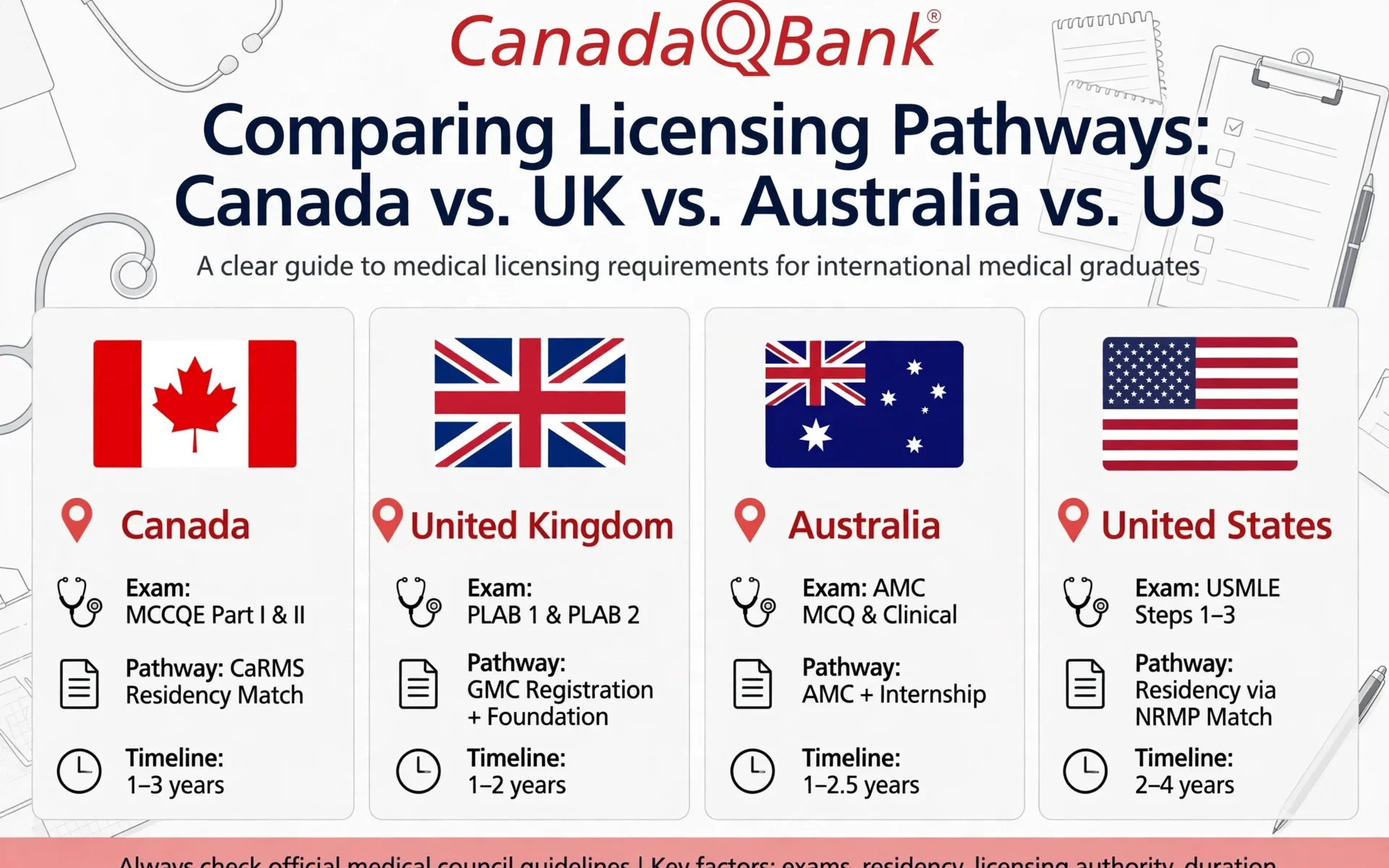
The Four Pathways at a Glance
| Canada | United Kingdom | Australia | United States | |
|---|---|---|---|---|
| Core exams | MCCQE (230 MCQs); NAC Examination (OSCE) for the residency match | PLAB 1 (180 SBAs) and PLAB 2 (OSCE) | AMC CAT MCQ (150 questions), then AMC Clinical Exam or Workplace-Based Assessment | USMLE Step 1 and Step 2 CK; Step 3 during residency |
| Main gatekeepers | Medical Council of Canada (MCC), provincial colleges, CaRMS | General Medical Council (GMC) | Australian Medical Council (AMC), Medical Board of Australia, AHPRA | ECFMG, NRMP, state medical boards |
| Training required after exams? | Usually yes — residency through CaRMS, or a provincial Practice-Ready Assessment (PRA) for eligible physicians | No national match, but you must secure a supervised job | 12 months of supervised practice before general registration | Yes — US residency (3 to 7 years), with limited state-level exceptions |
| Typical time | Dominated by residency length | About 4 to 9 months from starting preparation to GMC registration | Roughly 2 to 3 years to general registration | About 4 to 6 years (family medicine) to 7 to 10+ years (surgical specialties) |
| Main bottleneck | Residency seats | Exam seat availability; later competition for training posts | Clinical exam places; employer sponsorship | The residency match |
Timelines are approximate and assume first-attempt exam passes. Re-sits, credential verification delays, and failed matches all add time.
Canada: A Streamlined Exam Stage, a Competitive Training Stage
The pathway
1. Source verification. You verify your medical degree through the Medical Council of Canada via Physicians Apply. This runs independently of your exams and can take several months, so it should start early.
2. The MCCQE. The Medical Council of Canada Qualifying Examination — renamed from “MCCQE Part I” in April 2026 — is a 230-question multiple-choice examination delivered in two sections of 115 questions. It is based on the MCC Examination Objectives, and the correct answer is always the Canadian clinical answer.
3. The LMCC. Since January 26, 2026, the Licentiate of the Medical Council of Canada no longer requires 12 months of postgraduate training. You now need a pass on the MCCQE and successful source verification of your degree. This lets candidates hold the LMCC much earlier than before.
4. The NAC Examination. IMGs applying to the CaRMS residency match must also pass the NAC Examination, an OSCE assessing clinical and communication skills.
5. Residency through CaRMS, or an alternative route. This is the stage that defines the Canadian pathway. Most IMGs enter practice by matching to a Canadian residency through CaRMS, which has a dedicated IMG stream and province-specific eligibility rules. Experienced family physicians in several provinces may instead qualify for a Practice-Ready Assessment, which assesses them in practice rather than requiring them to repeat residency.
6. Provincial licensure and certification. Licensing is provincial, so requirements vary. Family physicians then pursue CCFP certification through the College of Family Physicians of Canada; other specialists pursue Royal College certification.
Strengths and limitations
Canada’s exam stage is short — essentially one major written exam plus the NAC. The LMCC reform also removed a long-standing barrier. The limitation is the number of residency positions available to IMGs: passing the MCCQE makes you eligible, not guaranteed.
United Kingdom: The Fastest Route to Registration
The pathway
1. PLAB 1. A written examination of 180 single best answer questions in three hours, held several times a year. Since August 2024 it has been aligned to the same MLA content map used for UK medical graduates, and it tests knowledge at the level expected of a doctor starting the second year of the UK Foundation Programme.
2. PLAB 2. A clinical OSCE held at the GMC’s assessment centre in Manchester. It has 16 stations — 14 active and two rest stations — each lasting eight minutes. You are scored on data gathering, clinical management, and interpersonal skills.
3. GMC registration. After passing PLAB 2, you apply for registration with a licence to practise. Your PLAB 1 pass is valid for three years to complete PLAB 2, and your registration application needs to be approved within two years of passing PLAB 2.
4. Securing a post. There is no national residency match to obtain registration, but registration is not a job. IMGs typically enter NHS posts at foundation or senior-house-officer level, or through specialty and associate specialist (SAS) roles, and entry into specialty training programs is competitive.
Strengths and limitations
For a well-prepared candidate, the UK is the quickest route from starting exams to holding a licence — often 4 to 9 months. The limitation is practical rather than regulatory: exam seats can fill quickly, and the GMC has announced that from 2027 several international PLAB 1 locations will no longer run the exam and the February 2027 sitting will be available only in the UK and EU. Candidates planning to sit internationally should check current locations before choosing a sitting.
Australia: Several Pathways, So Choose the Right One First
Australia is the only one of the four countries where the very first decision is which pathway applies to you. The Medical Board of Australia operates distinct routes, and starting the wrong one costs months.
The three main routes
Standard pathway. For IMGs who are not eligible for the Competent Authority or Specialist pathways. It runs through the AMC:
- AMC CAT MCQ — a computer-adaptive exam of 150 multiple-choice questions in 3.5 hours, delivered by Pearson VUE. You cannot return to a question once you have answered it, and there is no negative marking.
- AMC Clinical Examination or Workplace-Based Assessment — an OSCE, or an assessment completed in a workplace under limited registration.
- AMC Certificate, followed by provisional registration with the Medical Board through AHPRA.
- Supervised practice — the equivalent of an internship year.
- General registration.
Competent Authority pathway. For IMGs who have been assessed by a Board-approved competent authority and have practised in a competent authority country. It can lead to general registration without sitting the AMC exams.
Specialist and Expedited Specialist pathways. For IMGs holding an international specialist qualification. The Expedited Specialist pathway lets specialists whose qualifications appear on the Board’s accepted list apply directly for specialist registration. It covers only certain specialties and qualifications, and the Board has been expanding the list gradually.
The Medical Board consulted in mid-2026 on formalising the Competent Authority pathway and reviewing the Standard pathway, including a possible change of name, so check the Board’s website for current terminology before you plan.
Strengths and limitations
Australia offers real routes for experienced specialists and for doctors from competent authority countries, and the Standard pathway has no match lottery. The bottlenecks are Clinical Examination places, which the AMC allocates through scheduling rounds, and finding an employer willing to sponsor you for the supervised period. Australia also tends to be the longest of the three non-US pathways for candidates on the Standard route: roughly two to three years to general registration.
United States: The Longest Route, the Most Rigid Gate
The pathway
1. ECFMG certification. IMGs must be certified by the Educational Commission for Foreign Medical Graduates, which requires verified medical school credentials and passing both Step 1 and Step 2 CK.
2. USMLE Step 1. 280 questions. Step 1 is reported pass/fail only, so passing is required but does not differentiate applicants.
3. USMLE Step 2 CK. Up to 318 items across 16 blocks of 30 minutes. Step 2 CK still produces a numeric score, and in the pass/fail era it is the main exam score programs use to compare IMG applicants.
4. The residency match. Applications go through ERAS and the NRMP match. IMGs make up roughly one in four US physicians, but the match is competitive, and US clinical experience and US reference letters strengthen an application considerably.
5. Residency, Step 3, and state licensure. Residency lasts from three years for family and internal medicine to five or more for surgical specialties. Step 3 is typically taken during residency, and each state medical board issues the licence.
The emerging alternative
A growing number of US states have passed laws creating alternative licensure pathways for experienced internationally trained physicians who have completed postgraduate training abroad. According to the World Education Services policy tracking, as of May 2026, 27 states and two territories had passed such laws, with 13 fully implemented and accepting applications. Tennessee was the first.
These pathways typically offer a provisional licence tied to an employer, require prior foreign licensure and substantial experience, and may not transfer to other states. Requirements differ sharply from state to state, and implementation is still maturing, so treat them as an option to research carefully, not a replacement for planning around the match.
Visas
Most IMGs training in the US use a J-1 (sponsored through ECFMG) or an H-1B visa. The J-1 carries a home-country presence requirement unless a waiver is obtained, which affects long-term plans.
Strengths and limitations
The US pathway offers the broadest range of specialties and practice settings, with the highest physician earnings of the four countries. Its limitation is the length and uncertainty of the process: a failed match adds a full year.
Head-to-Head Comparison
Exam burden
| Country | Exams to reach licensure |
|---|---|
| UK | Two — PLAB 1 and PLAB 2 |
| Australia | Two on the Standard pathway — AMC MCQ plus Clinical Exam or WBA; fewer or none on the Competent Authority pathway |
| Canada | MCCQE and NAC to enter residency, then certification exams during or after residency |
| USA | Step 1 and Step 2 CK to enter the match, Step 3 during residency, then board certification |
Format: written and clinical
Every pathway tests clinical reasoning, but the formats differ. The UK’s PLAB 1 is a 180-question SBA paper, Canada’s MCCQE a 230-question MCQ paper, and Australia’s AMC MCQ a computer-adaptive 150-question exam that does not let you go back. The US exams are the longest, with Step 2 CK running a full day. For the clinical component, the UK’s PLAB 2 and the AMC Clinical Examination are both OSCE-style assessments, while Canada’s NAC and the US pathway’s residency interviews test communication and clinical skills in different ways.
The residency question
The most important structural difference is whether the pathway makes you repeat training. In the UK and Australia, passing the exams followed by supervised practice leads to registration. In Canada and the US, most IMGs must secure a residency position in a competitive match, with Practice-Ready Assessment and state alternative pathways serving as the main exceptions.
Recognition of prior experience
Experienced specialists have the most options in Australia, where the Specialist and Expedited Specialist pathways exist, and increasingly in the US, where some states now recognise foreign postgraduate training. Experienced family physicians in Canada can look at PRA programs and, depending on their certification, the CFPC Jurisdictional Route. In the UK, registration is relatively quick, but progression into specialty training remains competitive.
Which Pathway Fits Which Candidate?
If speed to a licence matters most: The UK, where a well-prepared candidate can reach registration in under a year. Australia’s Competent Authority pathway can also be fast for eligible doctors.
If you want the widest specialty choice and are prepared for a long, competitive process: The United States, ideally with a strong Step 2 CK score and US clinical experience.
If you are an experienced family physician: Canada’s PRA programs and the CFPC Jurisdictional Route deserve serious research, as does Australia’s general practice pathway.
If you are an experienced specialist: Check Australia’s Expedited Specialist list first, then the US state alternative pathways, before assuming you must repeat training.
If you want a clear exam sequence without a match: Australia and the UK both avoid a national match, though both still require you to find a supervised post.
If you are early in your career and want to train in the country you will practise in: Canada and the US both offer full residency training, but expect to compete for it.
Common Mistakes When Choosing a Pathway
Choosing by salary alone. Earnings matter, but the pathway that pays the most may also take the longest and carry the highest risk of not matching.
Starting the wrong Australian pathway. Confirm whether you are eligible for the Competent Authority or Specialist route before beginning Standard pathway preparation.
Ignoring validity windows. A PLAB 1 pass is valid for three years, and English-language evidence and credentials expire. Plan your timeline backward from these deadlines.
Underestimating the bottleneck. Every pathway has one: residency seats in Canada, the match in the US, clinical exam places in Australia, and exam seat availability in the UK. Plan around the bottleneck, not just the exam.
Studying from the wrong country’s guidelines. The MCCQE tests Canadian practice, PLAB tests UK practice, the AMC tests Australian practice, and USMLE tests US practice. Resources written for one pathway can mislead you on another.
Not checking your medical school’s recognition. Most regulators check your school against the World Directory of Medical Schools, so confirm eligibility before you invest in preparation.
How CanadaQBank Supports Each Pathway
At CanadaQBank.com, we provide question banks aligned to the exams on all four pathways:
- MCCQE — Canadian clinical guidelines and the MCC Examination Objectives
- PLAB 1 — UK clinical practice, NICE guidance, and the MLA content framework
- AMC MCQ — Australian clinical practice and the AMC blueprint
- USMLE Step 1 and Step 2 CK — US clinical practice and the current exam formats
Each bank is built around the clinical standards of its own country, with detailed explanations that teach the reasoning behind every answer, timed and tutor modes, and performance tracking by subject so you can see where to study next.
Visit CanadaQBank.com to start preparing for the exam on the pathway you choose.