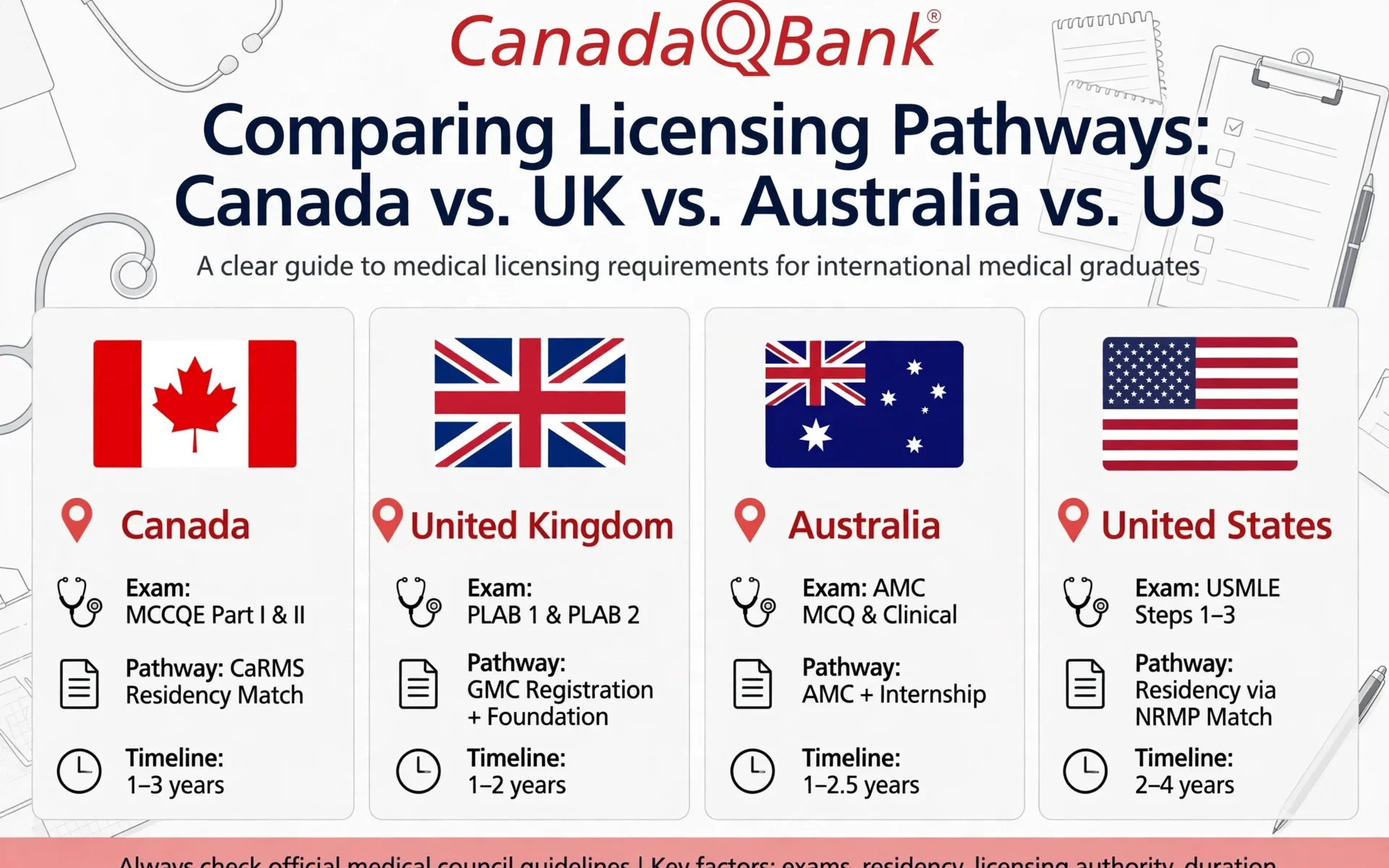
Comparing Licensing Pathways: Canada vs. UK vs. Australia vs. US

Comparing Licensing Pathways: Canada vs. UK vs. Australia vs. US

Every international medical graduate (IMG) eventually asks the same question: which country’s licensing pathway is the right one for me?

The honest answer is that the four most popular destinations — Canada, the United Kingdom, Australia, and the United States — are not variations on one process. Each has a different gatekeeper, a different set of exams, a different relationship with residency training, and a different bottleneck that decides how long you will actually wait. A pathway that is quick for one candidate can be effectively closed to another.

This guide compares the four pathways side by side so you can see what each one demands, where each one slows candidates down, and which type of candidate each one suits best.

The Four Pathways at a Glance

CanadaUnited KingdomAustraliaUnited States
Core examsMCCQE (230 MCQs); NAC Examination (OSCE) for the residency matchPLAB 1 (180 SBAs) and PLAB 2 (OSCE)AMC CAT MCQ (150 questions), then AMC Clinical Exam or Workplace-Based AssessmentUSMLE Step 1 and Step 2 CK; Step 3 during residency
Main gatekeepersMedical Council of Canada (MCC), provincial colleges, CaRMSGeneral Medical Council (GMC)Australian Medical Council (AMC), Medical Board of Australia, AHPRAECFMG, NRMP, state medical boards
Training required after exams?Usually yes — residency through CaRMS, or a provincial Practice-Ready Assessment (PRA) for eligible physiciansNo national match, but you must secure a supervised job12 months of supervised practice before general registrationYes — US residency (3 to 7 years), with limited state-level exceptions
Typical timeDominated by residency lengthAbout 4 to 9 months from starting preparation to GMC registrationRoughly 2 to 3 years to general registrationAbout 4 to 6 years (family medicine) to 7 to 10+ years (surgical specialties)
Main bottleneckResidency seatsExam seat availability; later competition for training postsClinical exam places; employer sponsorshipThe residency match

Timelines are approximate and assume first-attempt exam passes. Re-sits, credential verification delays, and failed matches all add time.

Canada: A Streamlined Exam Stage, a Competitive Training Stage

The pathway

1. Source verification. You verify your medical degree through the Medical Council of Canada via Physicians Apply. This runs independently of your exams and can take several months, so it should start early.

2. The MCCQE. The Medical Council of Canada Qualifying Examination — renamed from “MCCQE Part I” in April 2026 — is a 230-question multiple-choice examination delivered in two sections of 115 questions. It is based on the MCC Examination Objectives, and the correct answer is always the Canadian clinical answer.

3. The LMCC. Since January 26, 2026, the Licentiate of the Medical Council of Canada no longer requires 12 months of postgraduate training. You now need a pass on the MCCQE and successful source verification of your degree. This lets candidates hold the LMCC much earlier than before.

4. The NAC Examination. IMGs applying to the CaRMS residency match must also pass the NAC Examination, an OSCE assessing clinical and communication skills.

5. Residency through CaRMS, or an alternative route. This is the stage that defines the Canadian pathway. Most IMGs enter practice by matching to a Canadian residency through CaRMS, which has a dedicated IMG stream and province-specific eligibility rules. Experienced family physicians in several provinces may instead qualify for a Practice-Ready Assessment, which assesses them in practice rather than requiring them to repeat residency.

6. Provincial licensure and certification. Licensing is provincial, so requirements vary. Family physicians then pursue CCFP certification through the College of Family Physicians of Canada; other specialists pursue Royal College certification.

Strengths and limitations

Canada’s exam stage is short — essentially one major written exam plus the NAC. The LMCC reform also removed a long-standing barrier. The limitation is the number of residency positions available to IMGs: passing the MCCQE makes you eligible, not guaranteed.

United Kingdom: The Fastest Route to Registration

The pathway

1. PLAB 1. A written examination of 180 single best answer questions in three hours, held several times a year. Since August 2024 it has been aligned to the same MLA content map used for UK medical graduates, and it tests knowledge at the level expected of a doctor starting the second year of the UK Foundation Programme.

2. PLAB 2. A clinical OSCE held at the GMC’s assessment centre in Manchester. It has 16 stations — 14 active and two rest stations — each lasting eight minutes. You are scored on data gathering, clinical management, and interpersonal skills.

3. GMC registration. After passing PLAB 2, you apply for registration with a licence to practise. Your PLAB 1 pass is valid for three years to complete PLAB 2, and your registration application needs to be approved within two years of passing PLAB 2.

4. Securing a post. There is no national residency match to obtain registration, but registration is not a job. IMGs typically enter NHS posts at foundation or senior-house-officer level, or through specialty and associate specialist (SAS) roles, and entry into specialty training programs is competitive.

Strengths and limitations

For a well-prepared candidate, the UK is the quickest route from starting exams to holding a licence — often 4 to 9 months. The limitation is practical rather than regulatory: exam seats can fill quickly, and the GMC has announced that from 2027 several international PLAB 1 locations will no longer run the exam and the February 2027 sitting will be available only in the UK and EU. Candidates planning to sit internationally should check current locations before choosing a sitting.

Australia: Several Pathways, So Choose the Right One First

Australia is the only one of the four countries where the very first decision is which pathway applies to you. The Medical Board of Australia operates distinct routes, and starting the wrong one costs months.

The three main routes

Standard pathway. For IMGs who are not eligible for the Competent Authority or Specialist pathways. It runs through the AMC:

  1. AMC CAT MCQ — a computer-adaptive exam of 150 multiple-choice questions in 3.5 hours, delivered by Pearson VUE. You cannot return to a question once you have answered it, and there is no negative marking.
  2. AMC Clinical Examination or Workplace-Based Assessment — an OSCE, or an assessment completed in a workplace under limited registration.
  3. AMC Certificate, followed by provisional registration with the Medical Board through AHPRA.
  4. Supervised practice — the equivalent of an internship year.
  5. General registration.

Competent Authority pathway. For IMGs who have been assessed by a Board-approved competent authority and have practised in a competent authority country. It can lead to general registration without sitting the AMC exams.

Specialist and Expedited Specialist pathways. For IMGs holding an international specialist qualification. The Expedited Specialist pathway lets specialists whose qualifications appear on the Board’s accepted list apply directly for specialist registration. It covers only certain specialties and qualifications, and the Board has been expanding the list gradually.

The Medical Board consulted in mid-2026 on formalising the Competent Authority pathway and reviewing the Standard pathway, including a possible change of name, so check the Board’s website for current terminology before you plan.

Strengths and limitations

Australia offers real routes for experienced specialists and for doctors from competent authority countries, and the Standard pathway has no match lottery. The bottlenecks are Clinical Examination places, which the AMC allocates through scheduling rounds, and finding an employer willing to sponsor you for the supervised period. Australia also tends to be the longest of the three non-US pathways for candidates on the Standard route: roughly two to three years to general registration.

United States: The Longest Route, the Most Rigid Gate

The pathway

1. ECFMG certification. IMGs must be certified by the Educational Commission for Foreign Medical Graduates, which requires verified medical school credentials and passing both Step 1 and Step 2 CK.

2. USMLE Step 1. 280 questions. Step 1 is reported pass/fail only, so passing is required but does not differentiate applicants.

3. USMLE Step 2 CK. Up to 318 items across 16 blocks of 30 minutes. Step 2 CK still produces a numeric score, and in the pass/fail era it is the main exam score programs use to compare IMG applicants.

4. The residency match. Applications go through ERAS and the NRMP match. IMGs make up roughly one in four US physicians, but the match is competitive, and US clinical experience and US reference letters strengthen an application considerably.

5. Residency, Step 3, and state licensure. Residency lasts from three years for family and internal medicine to five or more for surgical specialties. Step 3 is typically taken during residency, and each state medical board issues the licence.

The emerging alternative

A growing number of US states have passed laws creating alternative licensure pathways for experienced internationally trained physicians who have completed postgraduate training abroad. According to the World Education Services policy tracking, as of May 2026, 27 states and two territories had passed such laws, with 13 fully implemented and accepting applications. Tennessee was the first.

These pathways typically offer a provisional licence tied to an employer, require prior foreign licensure and substantial experience, and may not transfer to other states. Requirements differ sharply from state to state, and implementation is still maturing, so treat them as an option to research carefully, not a replacement for planning around the match.

Visas

Most IMGs training in the US use a J-1 (sponsored through ECFMG) or an H-1B visa. The J-1 carries a home-country presence requirement unless a waiver is obtained, which affects long-term plans.

Strengths and limitations

The US pathway offers the broadest range of specialties and practice settings, with the highest physician earnings of the four countries. Its limitation is the length and uncertainty of the process: a failed match adds a full year.

Head-to-Head Comparison

Exam burden

CountryExams to reach licensure
UKTwo — PLAB 1 and PLAB 2
AustraliaTwo on the Standard pathway — AMC MCQ plus Clinical Exam or WBA; fewer or none on the Competent Authority pathway
CanadaMCCQE and NAC to enter residency, then certification exams during or after residency
USAStep 1 and Step 2 CK to enter the match, Step 3 during residency, then board certification

Format: written and clinical

Every pathway tests clinical reasoning, but the formats differ. The UK’s PLAB 1 is a 180-question SBA paper, Canada’s MCCQE a 230-question MCQ paper, and Australia’s AMC MCQ a computer-adaptive 150-question exam that does not let you go back. The US exams are the longest, with Step 2 CK running a full day. For the clinical component, the UK’s PLAB 2 and the AMC Clinical Examination are both OSCE-style assessments, while Canada’s NAC and the US pathway’s residency interviews test communication and clinical skills in different ways.

The residency question

The most important structural difference is whether the pathway makes you repeat training. In the UK and Australia, passing the exams followed by supervised practice leads to registration. In Canada and the US, most IMGs must secure a residency position in a competitive match, with Practice-Ready Assessment and state alternative pathways serving as the main exceptions.

Recognition of prior experience

Experienced specialists have the most options in Australia, where the Specialist and Expedited Specialist pathways exist, and increasingly in the US, where some states now recognise foreign postgraduate training. Experienced family physicians in Canada can look at PRA programs and, depending on their certification, the CFPC Jurisdictional Route. In the UK, registration is relatively quick, but progression into specialty training remains competitive.

Which Pathway Fits Which Candidate?

If speed to a licence matters most: The UK, where a well-prepared candidate can reach registration in under a year. Australia’s Competent Authority pathway can also be fast for eligible doctors.

If you want the widest specialty choice and are prepared for a long, competitive process: The United States, ideally with a strong Step 2 CK score and US clinical experience.

If you are an experienced family physician: Canada’s PRA programs and the CFPC Jurisdictional Route deserve serious research, as does Australia’s general practice pathway.

If you are an experienced specialist: Check Australia’s Expedited Specialist list first, then the US state alternative pathways, before assuming you must repeat training.

If you want a clear exam sequence without a match: Australia and the UK both avoid a national match, though both still require you to find a supervised post.

If you are early in your career and want to train in the country you will practise in: Canada and the US both offer full residency training, but expect to compete for it.

Common Mistakes When Choosing a Pathway

Choosing by salary alone. Earnings matter, but the pathway that pays the most may also take the longest and carry the highest risk of not matching.

Starting the wrong Australian pathway. Confirm whether you are eligible for the Competent Authority or Specialist route before beginning Standard pathway preparation.

Ignoring validity windows. A PLAB 1 pass is valid for three years, and English-language evidence and credentials expire. Plan your timeline backward from these deadlines.

Underestimating the bottleneck. Every pathway has one: residency seats in Canada, the match in the US, clinical exam places in Australia, and exam seat availability in the UK. Plan around the bottleneck, not just the exam.

Studying from the wrong country’s guidelines. The MCCQE tests Canadian practice, PLAB tests UK practice, the AMC tests Australian practice, and USMLE tests US practice. Resources written for one pathway can mislead you on another.

Not checking your medical school’s recognition. Most regulators check your school against the World Directory of Medical Schools, so confirm eligibility before you invest in preparation.

How CanadaQBank Supports Each Pathway

At CanadaQBank.com, we provide question banks aligned to the exams on all four pathways:

  • MCCQE — Canadian clinical guidelines and the MCC Examination Objectives
  • PLAB 1 — UK clinical practice, NICE guidance, and the MLA content framework
  • AMC MCQ — Australian clinical practice and the AMC blueprint
  • USMLE Step 1 and Step 2 CK — US clinical practice and the current exam formats

Each bank is built around the clinical standards of its own country, with detailed explanations that teach the reasoning behind every answer, timed and tutor modes, and performance tracking by subject so you can see where to study next.

Visit CanadaQBank.com to start preparing for the exam on the pathway you choose.
SMLE vs USMLE: Key Differences for International Doctors

SMLE vs USMLE: Key Differences for International Doctors

For international medical graduates (IMGs), choosing the right licensing examination is one of the most important decisions in their medical career. Two of the most recognized licensing exams are the Saudi Medical Licensing Examination (SMLE) and the United States Medical Licensing Examination (USMLE). Both exams are designed to assess a physician’s competence and readiness for clinical practice, but they serve different healthcare systems, licensing pathways, and career goals.

If you’re considering practicing medicine in Saudi Arabia or the United States, understanding the differences between SMLE vs USMLE can help you make an informed decision and prepare effectively for your future.

In this comprehensive guide, we’ll compare the SMLE and USMLE in terms of eligibility, exam structure, difficulty, costs, career opportunities, preparation strategies, and more.

What Is the SMLE?

The Saudi Medical Licensing Examination (SMLE) is administered by the Saudi Commission for Health Specialties (SCFHS) and is required for physicians who wish to practice medicine in Saudi Arabia.

The exam evaluates whether candidates possess the medical knowledge and clinical judgment necessary to provide safe patient care within the Saudi healthcare system.

The SMLE is commonly taken by:

  • Saudi medical graduates
  • International medical graduates seeking employment in Saudi Arabia
  • Physicians applying for residency training programs in Saudi Arabia

Passing the SMLE is a mandatory requirement for obtaining a professional license to practice medicine in the Kingdom of Saudi Arabia.

What Is the USMLE?

The United States Medical Licensing Examination (USMLE) is a three-step examination program used to assess a physician’s ability to practice medicine in the United States.

The exam is jointly sponsored by:

  • Federation of State Medical Boards (FSMB)
  • National Board of Medical Examiners (NBME)

The USMLE pathway is required for:

  • U.S. medical graduates
  • International medical graduates pursuing residency in the United States
  • Physicians seeking medical licensure in the U.S.

The USMLE evaluates a physician’s understanding of medical sciences, clinical knowledge, patient care, and readiness for independent medical practice.

SMLE vs USMLE: Quick Comparison

FeatureSMLEUSMLE
CountrySaudi ArabiaUnited States
Governing BodySCFHSFSMB & NBME
Number of ExamsOne main licensing examThree-step examination system
Main PurposeMedical licensure in Saudi ArabiaMedical licensure in the U.S.
Exam FormatMultiple-choice questionsStep 1, Step 2 CK, Step 3
Residency RequirementBased on Saudi programsRequired for U.S. residency matching
Clinical Skills ExamNot currently separateClinical skills integrated into assessments
International RecognitionPrimarily Saudi ArabiaWidely recognized internationally

Eligibility Requirements

SMLE Eligibility

Candidates must generally:

  • Hold a recognized medical degree
  • Complete internship requirements
  • Meet SCFHS credentialing requirements

International medical graduates may need additional document verification through the SCFHS registration process.

USMLE Eligibility

To sit for the USMLE, candidates must:

  • Be enrolled in or graduated from a recognized medical school
  • Meet ECFMG requirements (for international graduates)
  • Complete application procedures through the official USMLE system

International candidates must obtain ECFMG certification before entering U.S. residency training programs.

Exam Structure: SMLE vs USMLE

SMLE Format

The SMLE consists of a computer-based examination featuring multiple-choice questions that assess:

  • Internal medicine
  • Surgery
  • Pediatrics
  • Obstetrics and gynecology
  • Emergency medicine
  • Family medicine
  • Ethics and professionalism

Questions focus on clinical application and practical decision-making.

The exam is designed to evaluate competencies expected from a newly qualified physician.

USMLE Format

Step 1

Step 1 assesses foundational medical sciences including:

  • Anatomy
  • Physiology
  • Biochemistry
  • Pharmacology
  • Pathology
  • Microbiology

The exam is now reported as Pass/Fail.

Step 2 CK

Step 2 Clinical Knowledge evaluates:

  • Internal medicine
  • Surgery
  • Pediatrics
  • Obstetrics and gynecology
  • Psychiatry
  • Preventive medicine

Candidates receive a numerical score.

Step 3

Step 3 focuses on:

  • Independent patient management
  • Clinical decision-making
  • Emergency care
  • Preventive medicine

Step 3 is usually taken during residency training.

Which Exam Is More Difficult?

Difficulty is subjective and depends on a candidate’s background, preparation, and career goals.

Why Some Candidates Find USMLE More Challenging

The USMLE pathway is longer and more comprehensive.

Candidates must:

  • Pass multiple examinations
  • Compete for residency positions
  • Achieve strong Step 2 CK scores
  • Demonstrate research and clinical experience

The competitive nature of U.S. residency matching adds another layer of difficulty.

Why Some Candidates Find SMLE Challenging

Although SMLE involves a single licensing examination, it still covers a broad medical curriculum.

Challenges include:

  • Large content volume
  • Time management
  • Clinical reasoning requirements
  • Competition for residency positions in Saudi Arabia

Candidates who underestimate the exam often struggle despite its shorter licensing pathway.

Exam Costs

SMLE Costs

SMLE costs are generally lower than the total expenses associated with the USMLE pathway.

Candidates typically pay for:

  • Examination fees
  • SCFHS registration
  • Credential verification

The overall financial investment is relatively affordable compared to U.S. licensing.

USMLE Costs

The USMLE pathway can be expensive, particularly for international medical graduates.

Costs may include:

  • Step 1 registration
  • Step 2 CK registration
  • ECFMG certification
  • Travel expenses
  • Residency applications
  • Interview costs

The total investment often reaches several thousand dollars.

Residency Opportunities

Residency in Saudi Arabia

After passing the SMLE, candidates may apply for residency programs administered through the Saudi Commission for Health Specialties.

Popular specialties include:

  • Internal medicine
  • Surgery
  • Pediatrics
  • Family medicine
  • Emergency medicine

Residency positions are competitive, particularly in major cities.

Residency in the United States

Passing USMLE exams allows candidates to participate in the National Resident Matching Program (NRMP).

The U.S. offers:

  • Extensive specialty options
  • Advanced training opportunities
  • Research-focused programs
  • Internationally respected residency training

However, residency matching can be highly competitive, especially for international graduates.

Career Opportunities After SMLE

Physicians who successfully pass the SMLE can pursue a variety of career opportunities within Saudi Arabia’s healthcare sector, including:

Government Hospitals

Saudi Arabia’s public healthcare system employs thousands of physicians across primary, secondary, and tertiary care facilities.

Private Hospitals

Major private healthcare networks continue to expand throughout the Kingdom, creating strong demand for qualified medical professionals.

Specialized Medical Centers

Physicians can work in advanced specialty and tertiary-care centers that provide highly specialized medical services.

Academic Institutions

Qualified physicians may pursue careers in medical education, research, and academic leadership at universities and teaching hospitals.

Career Opportunities After USMLE

Passing the USMLE provides access to career opportunities within one of the world’s largest and most advanced healthcare systems.

Clinical Practice

Practice as a licensed physician across a wide range of medical and surgical specialties after completing residency training.

Academic Medicine

Contribute to medical education, clinical research, and innovation through university-affiliated hospitals and academic institutions.

Subspecialty Fellowships

Pursue advanced fellowship training in highly specialized areas of medicine and surgery.

International Career Mobility

U.S. residency training and clinical experience are widely respected and can enhance career opportunities in many countries around the world.

Which Exam Should International Doctors Choose?

The answer depends on your long-term career goals.

Choose SMLE If:

  • You plan to practice in Saudi Arabia.
  • You want a shorter licensing pathway.
  • You are interested in Middle Eastern healthcare opportunities.
  • You prefer a more direct route to licensure.

Choose USMLE If:

  • You want to practice in the United States.
  • You seek access to highly competitive residency programs.
  • You are interested in advanced research opportunities.
  • You want broader international recognition.

Neither exam is inherently better. The right choice depends entirely on where you envision your future medical career.

Best Preparation Strategies for SMLE and USMLE

Regardless of which exam you choose, success requires a structured preparation plan.

Focus on High-Yield Topics

Prioritize commonly tested areas such as:

  • Internal medicine
  • Emergency medicine
  • Pediatrics
  • Pharmacology
  • Ethics

High-yield topics frequently appear on both exams.

Practice Questions Daily

Question-based learning remains one of the most effective preparation methods.

Benefits include:

  • Improved clinical reasoning
  • Better time management
  • Identification of weak areas
  • Increased confidence

Take Mock Exams

Practice exams simulate real testing conditions and help candidates assess readiness.

Regular self-assessment allows you to adjust your study strategy before exam day.

Use Reliable Study Resources

Choosing quality resources is essential.

A well-designed question bank can significantly improve retention and performance by exposing candidates to realistic exam scenarios.

How CanadaQBank Can Help

Whether you’re preparing for the SMLE, USMLE, MCCQE1, PLAB, or other international medical licensing exams, effective question practice is critical for success.

CanadaQBank provides comprehensive exam preparation resources that help candidates:

  • Master high-yield concepts
  • Improve clinical decision-making
  • Build exam confidence
  • Track performance and progress
  • Practice with realistic exam-style questions

By combining structured study with extensive question practice, candidates can improve their chances of passing on the first attempt and achieving their professional goals.

Conclusion

When comparing SMLE vs USMLE, it’s important to understand that each examination serves a different purpose and healthcare system. The SMLE provides a pathway to medical practice in Saudi Arabia, while the USMLE is the gateway to residency training and licensure in the United States.

The USMLE pathway is generally longer, more expensive, and more competitive, but it offers extensive career opportunities and international recognition. The SMLE provides a more streamlined route to practicing medicine in one of the Middle East’s fastest-growing healthcare sectors.

Ultimately, your decision should align with your long-term career objectives, preferred practice location, and professional aspirations. With proper planning, consistent preparation, and the right study resources, success in either examination is entirely achievable.

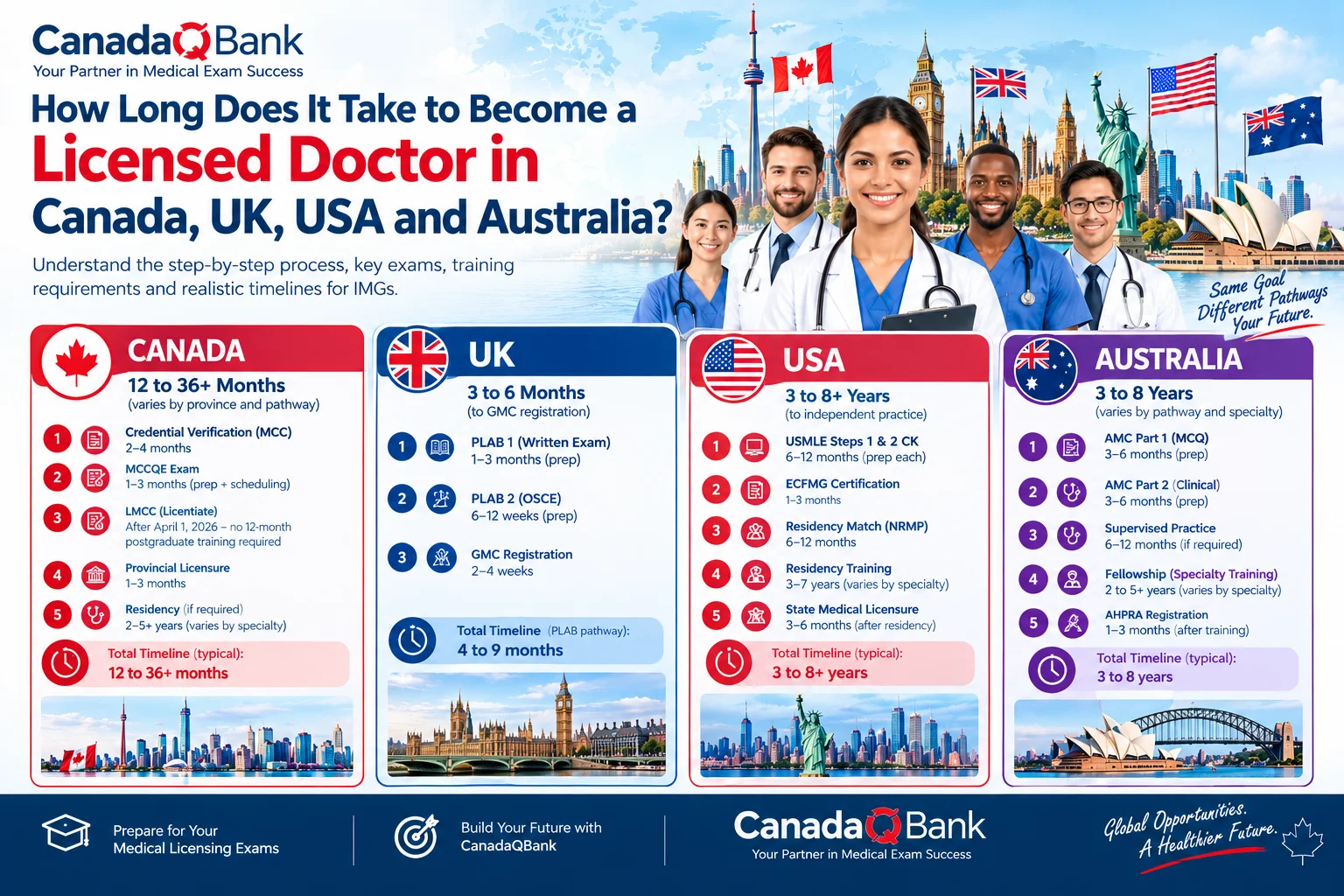
How Long Does It Take to Become a Licensed Doctor in Canada, UK, USA, and Australia?

For international medical graduates (IMGs), earning a medical degree is only the first step towards practising in another country. Before you can work as a doctor, you may need to verify your qualifications, pass licensing examinations, demonstrate English-language proficiency, complete postgraduate training, and obtain registration from the relevant medical regulator.

So, how long does it take to become a licensed doctor in Canada, the United Kingdom, the United States, or Australia?

The answer depends on your medical qualifications, previous clinical experience, chosen specialty, examination results, and eligibility for the licensing pathway available to you. Some doctors may qualify for a relatively direct registration route, while others must compete for residency positions or complete additional supervised training.

This guide explains the main licensing routes for international medical graduates, the stages that take the most time, and the factors to consider when choosing where to practise.

Important: The timelines in this article are planning estimates, not guaranteed processing times or official promises. Licensing rules can change, and the medical regulator in your intended country—and, where relevant, state or province—should be your final source for current eligibility requirements.

At a Glance: Medical Licensing Timelines

The four countries do not use identical licensing systems. The following table gives broad planning estimates for common IMG pathways rather than a single timeline that applies to every doctor.

CountryMain examination or assessment routeWhat affects the timeline most?
CanadaMedical Council of Canada examinations and an eligible provincial or territorial licensing pathwayResidency access, provincial rules, and eligibility for alternative pathways
United KingdomPLAB or another GMC-accepted registration routeExam availability, English-language requirements, documentation, and the type of registration sought
United StatesUSMLE Steps and ECFMG certification, followed by residency for most IMGsResidency matching, examination completion, visa eligibility, and specialty choice
AustraliaAMC Standard Pathway assessments or another eligible pathwayAssessment route, supervised practice opportunities, registration requirements, and specialist recognition

It is useful to separate three milestones when comparing countries:

  • Registration or initial licensure: Permission from the regulator to practise within the scope of the registration granted.
  • Completion of postgraduate training: Residency, supervised practice, or other required training.
  • Specialist recognition: Approval to practise as a recognised specialist, which may require additional training or assessment.

These milestones are not interchangeable. A doctor may obtain registration without yet being qualified as a specialist, and passing an examination alone does not automatically grant permission to practise.

1. Canada: How Long Does Medical Licensing Take?

Canada can be a challenging destination for international medical graduates because the licensing process involves national credential and examination requirements as well as provincial or territorial regulation. The route depends heavily on your training history and the type of medical practice you intend to enter.

There is no single Canadian timeline that applies to all IMGs.

Step 1: Verify Your Medical Credentials

International medical graduates generally need to have their medical credentials verified through the appropriate Medical Council of Canada (MCC) process.

This involves confirming that the medical qualification was issued by the institution listed in the application. You may need to submit identity documents, degree certificates, and other records according to the applicable instructions.

Start credential verification early. Delays can occur when documents are incomplete, institutions take time to respond, or additional information is required.

Step 2: Complete the Required Examinations

The MCC examination requirements depend on the pathway you are pursuing. The MCC Qualifying Examination (MCCQE) is an important assessment for many IMGs seeking Canadian licensure.

Candidates should confirm the current examination name, eligibility criteria, format, application deadlines, and result arrangements directly with the MCC. Do not rely on an old exam guide because examination policies and formats may change.

Passing an examination is an important milestone, but it does not, by itself, guarantee a residency position or a licence to practise.

Step 3: Determine Whether You Need Canadian Residency

For many IMGs, the main challenge is securing a postgraduate training position through the Canadian Resident Matching Service (CaRMS) or another eligible route.

The residency route is particularly important for doctors who need Canadian postgraduate training to meet the requirements for their intended licence or specialty.

Competition can be substantial, and eligibility may depend on citizenship or immigration status, examination results, language proficiency, previous training, and the rules of the specific program.

Training length varies by specialty. Family medicine programs commonly take about two years, while many other specialties require longer training. Some specialties also require additional fellowship training.

Step 4: Explore Practice-Ready Assessment Pathways

Experienced international family physicians may be eligible for a Practice-Ready Assessment (PRA) pathway in certain provinces or territories.

These programs assess whether a physician with relevant postgraduate training and clinical experience can practise safely in the local healthcare system. Eligibility criteria, assessment arrangements, return-of-service obligations, and licensing conditions vary.

PRA is not a universal shortcut for all IMGs. You should check the requirements of the specific province or program before planning around this route.

Step 5: Apply for Provincial or Territorial Licensure

Medical regulators in Canada’s provinces and territories issue licences. The requirements can differ according to the licence category, training history, examination results, and intended scope of practice.

Depending on your route, you may need to provide evidence of credentials, postgraduate training, professional standing, language proficiency, or other required documentation.

How Long Does Canada Take?

For an IMG pursuing an examination-and-registration route, the process can take many months and may extend beyond a year. If you must secure a residency position and complete postgraduate training, the overall journey can take several years.

A realistic plan should account for credential verification, exam preparation, examination dates, the residency application cycle, training duration, and the time needed for provincial registration.

Key takeaway: Before investing in examinations, identify the exact Canadian licensing pathway for which you may qualify. Your province, previous training, and eligibility for residency or PRA can make a substantial difference to your timeline.

2. United Kingdom: How Long Does It Take to Obtain GMC Registration?

The United Kingdom has a structured registration system administered by the General Medical Council (GMC). Many international medical graduates use the PLAB route, although PLAB is not the only possible route to registration.

For a candidate who already has an acceptable medical qualification, meets the relevant English-language requirements, passes the required assessments, and submits complete documentation, the process may be completed in months. However, examination availability, preparation time, and individual circumstances can extend the timeline.

Step 1: Check Your Eligibility for GMC Registration

Before booking an examination, confirm that your primary medical qualification is acceptable to the GMC and that you meet the current requirements for the registration route you intend to use.

You may also need to demonstrate English-language proficiency and provide evidence of identity, internship or clinical experience where applicable, and other required documentation.

The exact requirements depend on your qualification and circumstances. Some applicants may qualify through routes other than PLAB, such as an accepted postgraduate qualification or another recognised registration pathway.

Step 2: Prepare for PLAB 1

PLAB 1 is a written examination designed to assess whether a doctor has the knowledge and skills expected at the relevant stage of entry into UK medical practice.

Preparation time varies. Some candidates need a few months of structured study, while others need longer depending on their clinical knowledge, familiarity with UK guidance, and available study time.

Candidates should check the GMC’s current examination information for the format, dates, fees, eligibility rules, and booking availability.

Step 3: Pass PLAB 2

PLAB 2 is a practical clinical assessment conducted in person at the GMC assessment centre in Manchester. It evaluates clinical and communication skills through structured stations.

Candidates should allow time for practice with clinical scenarios, communication, history-taking, examination techniques, and management decisions. Passing PLAB 1 does not guarantee an immediate PLAB 2 appointment, so availability can affect the overall schedule.

Step 4: Apply for GMC Registration With a Licence to Practise

After completing the required assessments and meeting the other criteria, eligible candidates can apply for the appropriate GMC registration.

The GMC must assess the application and supporting documents. Missing or inconsistent information can delay the decision.

A successful registration application is not the same as securing an NHS job. Employment, immigration permission, employer checks, and any role-specific requirements are separate considerations.

How Long Does the UK Pathway Take?

A well-prepared candidate may be able to complete the PLAB and registration stages within several months, but there is no guaranteed three-, six-, or nine-month deadline. Exam availability, preparation needs, application processing, and document verification all matter.

Obtaining GMC registration also does not make a doctor a consultant. Doctors seeking specialist or general-practice recognition may need to complete approved training or meet the relevant specialist registration requirements.

What About the UKMLA?

The UK Medical Licensing Assessment (UKMLA) framework applies to UK medical graduates and informs the assessment standards for doctors entering UK practice. International graduates should follow the GMC’s current guidance on PLAB and any applicable changes to assessment requirements.

Do not assume that PLAB will automatically be replaced for all international applicants in a particular year. Confirm the current rules with the GMC before booking an examination.

Key takeaway: The UK may offer a comparatively direct registration route for eligible IMGs, but registration, employment, postgraduate training, and specialist recognition are separate steps.

3. United States: How Long Does It Take to Become a Licensed Doctor?

The United States has a multi-stage pathway for most international medical graduates. Candidates typically need to complete the relevant United States Medical Licensing Examination (USMLE) requirements, obtain Educational Commission for Foreign Medical Graduates (ECFMG) certification, and secure a residency position before progressing through postgraduate training.

The process can be lengthy because examination success does not guarantee a residency match.

Step 1: Complete USMLE Step 1

USMLE Step 1 assesses the foundations of medical science and their application to health, disease, and clinical practice.

Step 1 is reported as pass or fail; it does not currently provide a three-digit numerical score. Candidates should therefore avoid study resources or articles claiming that Step 1 produces a numerical score under the current scoring system.

Preparation time depends on your medical background, familiarity with the examination, and daily study schedule. Some candidates prepare over several months, but there is no universally appropriate preparation period.

Step 2: Pass USMLE Step 2 CK

USMLE Step 2 Clinical Knowledge (CK) assesses the application of clinical knowledge in patient care. It is scored numerically and can be an important part of a residency application.

Candidates should build their preparation around the current USMLE content outline and official examination guidance. A strong performance can support an application, but it cannot guarantee a residency position.

Step 3: Meet ECFMG Certification Requirements

Most international medical graduates entering US residency through the standard route need ECFMG certification.

Requirements include verification of the medical school’s eligibility and the candidate’s credentials, successful completion of the required USMLE examinations, and satisfaction of the applicable clinical and communication skills requirements or approved pathways in force at the time of application.

The exact requirements can change. Candidates should check the ECFMG website for their graduation year, medical school, and intended application cycle rather than relying on a fixed checklist from an older article.

Step 4: Apply for Residency and Participate in the Match

For most IMGs, residency is the most consequential stage of the US pathway.

Applicants typically submit applications to residency programs and may be invited to interviews. Many programs participate in the National Resident Matching Program (NRMP) Main Residency Match, although the applicable process depends on the program and specialty.

A candidate who does not match may need to strengthen the application and apply again in a later cycle. That can add a year or more to the overall journey.

Residency competitiveness varies by specialty and program. It is not accurate to label an entire specialty or state as guaranteed to be IMG-friendly. Applicants should evaluate current program eligibility, visa sponsorship, selection criteria, and published match data.

Step 5: Complete Residency Training

Residency length depends on the specialty. Examples of common training lengths include:

  • Family medicine: typically three years.
  • Internal medicine: typically three years.
  • General surgery: typically five years.
  • Neurology: commonly four years, depending on the training structure.
  • Other specialties: duration varies according to the relevant training pathway.

Some doctors then pursue fellowship training, which adds further time.

Step 6: Complete USMLE Step 3 and Meet State Licensing Requirements

USMLE Step 3 is generally taken after the candidate meets the examination’s eligibility requirements, which for IMGs normally include ECFMG certification. It is often completed during residency.

A state medical licence is issued by the relevant state medical board, not by USMLE or ECFMG. Requirements can include examination completion, postgraduate training, credential verification, background checks, and other state-specific conditions.

Passing Step 3 does not automatically grant a state licence.

How Long Does the US Pathway Take?

For an IMG who secures a residency position, completes the required examinations and certification steps, and follows a standard training route, the journey from beginning the licensing process to completing residency can take several years.

As a broad planning guide, the pre-residency examination and application stages may take one or more years, depending on preparation and match timing. Residency then commonly adds three to five years or longer, depending on specialty. Additional fellowships, repeat examinations, unsuccessful match attempts, or visa issues may extend the timeline.

Key takeaway: In the United States, planning for residency is just as important as planning for USMLE examinations. Candidates should evaluate the entire pathway rather than treating exam completion as the finish line.

4. Australia: How Long Does Medical Registration Take?

Australia offers several pathways for international medical graduates. The appropriate route depends on whether you are seeking general registration, applying through a recognised competent-authority route, or pursuing recognition as a specialist.

The Australian Medical Council (AMC) assesses many IMGs, while registration is handled by the Medical Board of Australia through the Australian Health Practitioner Regulation Agency (AHPRA).

Step 1: Identify the Correct Registration Pathway

Before booking an examination, determine which pathway applies to your qualifications and experience.

Common routes include:

  • Standard Pathway: Commonly used by IMGs who need to demonstrate that their medical knowledge and clinical skills meet Australian standards.
  • Competent Authority Pathway: Available to eligible applicants who have completed specified assessments or training in recognised jurisdictions.
  • Specialist Pathway: For doctors with specialist qualifications who are seeking assessment for specialist recognition in Australia.

These routes have different eligibility criteria. Completing the AMC examinations is not necessarily required for every IMG, and the specialist pathway should not be confused with the standard route to general registration.

Step 2: Complete the Required AMC Assessments if Applicable

Under the Standard Pathway, candidates generally need to pass the AMC CAT Multiple-Choice Question (MCQ) examination and then demonstrate clinical competence through an accepted route.

Depending on the pathway and current rules, the clinical component may involve the AMC Clinical Examination or an approved workplace-based assessment (WBA) program.

Candidates should check the AMC’s current guidance for exam eligibility, format, assessment availability, fees, and the requirements for progressing to the next stage.

Step 3: Apply for Registration Through AHPRA

Passing the required AMC assessments is not the same as receiving medical registration. Applicants must satisfy the Medical Board of Australia’s registration requirements and submit the necessary evidence.

This may include verification of qualifications, proof of identity, English-language proficiency, professional history, and other checks required for the relevant registration category.

The Medical Board determines the conditions under which an applicant can practise. AHPRA administers the registration process on the Board’s behalf.

Step 4: Complete Supervised Practice if Required

Depending on the registration pathway and the applicant’s background, supervised practice or other approved clinical requirements may be necessary before general registration is granted.

The exact arrangement is not identical for every IMG. Requirements can depend on the registration category, previous internship or postgraduate experience, and the Board’s decision.

Candidates should not assume that everyone must complete the same internship, or that passing both AMC examinations automatically grants unrestricted general registration.

Step 5: Pursue Specialist Recognition if Needed

Doctors seeking recognition as specialists must follow the relevant specialist assessment pathway. The appropriate specialist medical college assesses overseas qualifications and experience and determines whether additional training, assessment, or supervised practice is required.

For example, the requirements for recognition in general practice differ from those for surgery or internal medicine. Specialist recognition may add several years, particularly when additional Australian training is required.

How Long Does Australia Take?

The timeline varies considerably by pathway. Candidates following the Standard Pathway may need months for exam preparation and assessment, followed by registration and any required supervised practice. The complete process may take multiple years.

Applicants who qualify for a different pathway may have a different timeline, while those seeking specialist recognition may need additional assessment or training.

Key takeaway: Confirm your registration pathway before estimating the time or cost of moving to Australia. The AMC assessment route, competent-authority eligibility, and specialist recognition route are not interchangeable.

5. Canada vs the UK vs the USA vs Australia

Which country is fastest? There is no reliable answer for every IMG because each country measures different milestones and applicants enter with different qualifications.

FactorCanadaUnited KingdomUnited StatesAustralia
Main regulator or assessment bodiesMCC and provincial/territorial medical regulatorsGMCECFMG, USMLE, and state medical boardsAMC, Medical Board of Australia, and AHPRA
Common assessment routeMCC examinations, where requiredPLAB or another accepted routeUSMLE and ECFMG certification for most IMGsAMC Standard Pathway assessments, where required
Is passing an exam enough to practise?NoNoNoNo
Is postgraduate training relevant?Yes; requirements depend on the licence and routeYes, for many training and specialist routesResidency is central to the standard IMG routeSupervised practice or further training may be required
Main planning challengeFinding an eligible route and, where needed, residencyExam access, registration requirements, and employmentResidency matching and completing trainingChoosing the correct pathway and meeting registration requirements

The most useful comparison is not simply the number of months to pass an exam. It is the time, cost, and eligibility requirements from your current position to the level of practice you want to achieve.

6. What Can Make the Licensing Process Take Longer?

Several factors can change your timeline in any of these countries.

Your Medical School and Graduation Details

Regulators and certification bodies may need to confirm that your medical school and qualification meet their requirements. Graduates from different institutions or graduation years may face different verification or eligibility rules.

Your Previous Internship and Postgraduate Training

Previous clinical experience can affect which routes are open to you. It may be relevant to registration, residency eligibility, supervised practice, or specialist assessment.

However, experience is not automatically accepted as equivalent to local training. The regulator or assessment body makes that determination under its current rules.

Examination Preparation and Availability

Candidates need time to prepare, obtain an examination appointment, sit the exam, and receive the result. A failed attempt may require additional preparation and a later sitting.

Booking availability can also affect progress even when a candidate is ready to take the exam.

Residency or Supervised Practice Opportunities

In the United States and Canada, obtaining a suitable residency position can be a major factor in the overall timeline. In Australia and other pathways, access to an approved supervised practice or assessment position can also matter.

Passing examinations does not guarantee that a training position will be available immediately.

Documents, English-Language Evidence, and Background Checks

Missing documents, inconsistencies in professional history, delayed credential verification, and outstanding language requirements can hold up an application.

Prepare these requirements early and use the current checklist from the relevant regulator or certification body.

Your Intended Specialty

A doctor seeking general registration may have a different timeline from one seeking specialist recognition. Surgical and other specialist training routes can require several additional years beyond initial registration.

For this reason, always estimate the time to your specific goal: initial registration, completion of residency, general registration, or specialist qualification.

7. How to Plan Your Licensing Journey

A practical plan begins with your eligibility, not with an examination booking.

  1. Choose your target country and intended level of practice. Decide whether you want initial registration, residency training, general registration, or specialist recognition.
  2. Check the official pathway. Use the relevant medical regulator’s current guidance to determine your eligibility and required assessments.
  3. Verify your credentials early. Find out which documents must be verified and how long the process may take.
  4. Build an examination plan. Set realistic preparation targets and account for examination dates, result schedules, and possible resits.
  5. Research training and employment requirements. Check residency eligibility, supervised practice requirements, job availability, visa conditions, and any return-of-service obligations.
  6. Budget for the full process. Include examination fees, credential verification, preparation resources, travel where required, application fees, and living expenses.
  7. Recheck official guidance before each major step. Requirements and examination policies can change, so use current official information when making decisions.

This approach helps you avoid spending time and money on an examination or pathway that does not lead to your intended registration outcome.

8. How CanadaQBank Can Support Your Exam Preparation

Preparing for licensing examinations takes more than memorising facts. Candidates need to apply clinical knowledge, recognise common presentations, interpret investigations, and make decisions in the style expected by the examination.

CanadaQBank offers question-bank resources for several medical examination pathways, including MCCQE, USMLE, PLAB, and AMC preparation. Depending on the product, candidates can use practice questions, explanations, timed study sessions, and performance review tools to identify weaker areas.

A structured question-bank routine can help you:

  • Identify gaps in clinical knowledge.
  • Practise applying concepts to patient scenarios.
  • Review explanations and understand why answers are correct or incorrect.
  • Track performance by subject or category where those tools are available.
  • Build familiarity with question-based examinations.

A question bank is a preparation resource, not a guarantee of passing an examination, obtaining registration, or securing a residency position. Combine practice with the official examination blueprint, relevant clinical guidance, and a study schedule suited to your background.

Explore the available preparation resources at CanadaQBank.com and choose the question bank that matches the examination you intend to take.

Conclusion

Becoming a licensed doctor in Canada, the UK, the USA, or Australia can take months to several years, depending on your qualifications, the pathway available to you, and whether further postgraduate training is required.

The UK may offer a relatively direct route to GMC registration for eligible candidates. Canada’s timeline often depends on the applicable provincial pathway and, for many doctors, access to postgraduate training. In the United States, residency matching and training are major components of the journey. In Australia, the timeline depends on whether the Standard, Competent Authority, or Specialist Pathway applies and whether supervised practice or further training is required.

The most important first step is to identify the correct licensing pathway for your own qualifications. Then confirm the current requirements with the relevant official body, plan for examinations and documents, and allow for the possibility of delays.

With realistic expectations and structured preparation, you can make better-informed decisions about where to pursue your medical career.

Frequently Asked Questions

Which country is the fastest for an international medical graduate to get licensed?

There is no single fastest country for every IMG. The answer depends on your qualifications, previous training, eligibility for the available registration route, exam availability, and the level of practice you want to achieve. Compare the requirements that apply to your own situation rather than relying on a universal ranking.

Can I work as a doctor immediately after passing PLAB?

No. Passing the required PLAB assessments does not automatically grant GMC registration or a job. You must meet the GMC’s other registration requirements and obtain the appropriate registration with a licence to practise. Employment and immigration requirements are separate.

Does passing USMLE Step 1 and Step 2 CK guarantee a US residency position?

No. Most IMGs pursuing the standard US route also need to meet ECFMG certification requirements and apply for residency. Selection depends on each program’s criteria and the competitiveness of the application cycle.

Do all international doctors need to take the AMC examinations in Australia?

No. The required route depends on the applicant’s qualifications and eligibility. The Standard Pathway commonly involves AMC assessments, while other eligible applicants may qualify for a Competent Authority or Specialist Pathway.

Does medical registration mean I am a specialist?

Not necessarily. Registration or licensure permits practice under the relevant conditions, but specialist recognition may require further postgraduate training, assessment, or approval by the appropriate authority.

What should I do before choosing a country?

Check the current official requirements for your medical qualification, examination eligibility, postgraduate training, language evidence, registration category, immigration status, and intended specialty. These details are more useful for estimating your timeline than a general country-level average.