Top 3 Tips for MCCQE1 Exam Preparation in 2026

Top 3 Tips for MCCQE1 Exam Preparation in 2026

Preparing for the Medical Council of Canada Qualifying Examination Part 1 (MCCQE1) can feel overwhelming at first. The exam tests not only your medical knowledge but also your ability to apply clinical reasoning, prioritize patient safety, and make decisions under pressure. With the updated MCCQE1 format now focused entirely on multiple-choice questions (MCQs), students must approach preparation differently than in previous years.

The good news is that passing the MCCQE1 is absolutely achievable with the right strategy. Most candidates who struggle are not lacking intelligence or medical knowledge — they simply use inefficient study methods, poor resources, or inconsistent practice habits.

If you are preparing for the MCCQE1 in 2026, these are the three most important tips that can dramatically improve your performance and increase your chances of success.

Why the MCCQE1 Requires a Different Study Approach

Before diving into the tips, it’s important to understand what makes the MCCQE1 unique.

The exam is designed to assess whether you are ready to enter supervised clinical practice in Canada. It evaluates:

  • Clinical reasoning
  • Diagnostic skills
  • Evidence-based management
  • Preventive medicine
  • Ethics and professionalism
  • Patient-centered care

Unlike traditional university exams, the MCCQE1 is not about memorizing textbooks word-for-word. It focuses on how well you can apply knowledge in realistic clinical scenarios.

Because of this, your preparation should focus heavily on:

  • Question-based learning
  • Clinical decision-making
  • Time management
  • Pattern recognition
  • Active recall

Now let’s discuss the three best preparation tips that consistently help candidates succeed.

Tip #1: Focus on Question-Based Learning Early

One of the biggest mistakes candidates make is spending months reading textbooks before attempting practice questions.

For the MCCQE1, this approach is ineffective.

The exam is heavily application-based, meaning you must train your brain to think clinically under timed conditions. The earlier you begin solving MCCQE1-style questions, the better your performance will become.

Why Practice Questions Matter

High-quality practice questions help you:

  • Understand the MCCQE1 exam style
  • Learn clinical reasoning
  • Identify weak areas
  • Improve retention
  • Build speed and accuracy
  • Develop test-taking confidence

Every question you solve teaches you how the MCC thinks.

Instead of memorizing isolated facts, you begin recognizing patterns in:

  • Diagnosis
  • Investigations
  • Management plans
  • Emergency care
  • Preventive medicine

This is exactly what the real exam tests.

Use a High-Quality MCCQE1 Question Bank

Your question bank is arguably the most important resource during preparation.

A good QBank should include:

  • Realistic clinical scenarios
  • Detailed explanations
  • Updated Canadian guidelines
  • Performance analytics
  • Timed and tutor modes
  • Large question volume

Why CanadaQBank Is Highly Recommended

CanadaQBank remains one of the most trusted resources for MCCQE1 preparation because it closely reflects the current exam style.

Some key advantages include:

  • Thousands of high-yield MCCQE1 MCQs
  • Questions aligned with Canadian clinical guidelines
  • Detailed explanations for every answer
  • Timed practice exams
  • Performance tracking by topic
  • Realistic exam simulations

The platform helps students transition from passive reading to active clinical reasoning — which is exactly what the MCCQE1 demands.

Practical Strategy for Question Practice

A smart approach is to divide your preparation into stages.

Early Preparation

  • Use tutor mode
  • Focus on understanding explanations
  • Practice slowly without time pressure

Mid Preparation

  • Increase question volume daily
  • Begin timed sessions
  • Mix different specialties

Final Preparation

  • Simulate full-length exams
  • Focus on weak areas
  • Improve speed and endurance

A candidate who consistently practices questions over several months will almost always outperform someone who only reads theory.

Tip #2: Master Time Management and Exam Strategy

The updated MCCQE1 format is shorter than before, but the time pressure remains significant.

Many students know the material but fail because they:

  • Spend too long on difficult questions
  • Panic during lengthy clinical scenarios
  • Overthink answers
  • Run out of time

Strong time management is essential.

Learn to Think Like the MCC

The MCCQE1 is designed around:

  • Patient safety
  • Evidence-based care
  • Canadian clinical standards

When answering questions, always ask yourself:

“What is the safest and most appropriate next step?”

Often, multiple answers may appear correct, but only one aligns best with Canadian guidelines and patient-centered care.

Use the “Last Sentence First” Technique

One highly effective strategy is reading the final sentence of the question before reading the entire case.

This helps you immediately identify:

  • What the question is asking
  • Whether it focuses on diagnosis, investigation, or management
  • Which clinical clues matter most

You then read the scenario with a clear purpose instead of getting overwhelmed by unnecessary details.

Don’t Get Stuck on Difficult Questions

A common mistake is spending 4–5 minutes trying to solve one difficult question.

This is dangerous.

Instead:

  • Answer confidently when possible
  • Flag difficult questions
  • Return later if time permits

Remember:
Every question carries value.

Missing easy questions because you spent too much time on a hard one can significantly hurt your final score.

Practice Under Real Exam Conditions

Timed practice is critical.

At least 6–8 weeks before your exam:

  • Start doing timed blocks daily
  • Simulate real testing conditions
  • Avoid distractions
  • Build mental endurance

The MCCQE1 is as much a mental stamina exam as it is a medical knowledge exam.

Practicing full-length sessions helps:

  • Reduce anxiety
  • Improve concentration
  • Increase speed
  • Build confidence

Tip #3: Prioritize Weak Areas and High-Yield Topics

Not all subjects contribute equally to exam success.

Some topics appear repeatedly and carry significant weight.

At the same time, ignoring weak subjects is one of the fastest ways to fail.

Successful candidates continuously identify and improve weak areas throughout preparation.

High-Yield MCCQE1 Topics in 2026

While the exam covers broad medical knowledge, some areas are consistently emphasized:

Internal Medicine

  • Cardiology
  • Endocrinology
  • Infectious disease
  • Respiratory medicine

Emergency Medicine

  • Shock
  • Chest pain
  • Stroke
  • Trauma
  • Sepsis

Pediatrics

  • Developmental milestones
  • Vaccinations
  • Pediatric emergencies

Obstetrics & Gynecology

  • Prenatal care
  • Contraception
  • Postpartum complications

Psychiatry

  • Depression
  • Anxiety
  • Suicide risk assessment
  • Substance use

Ethics & Professionalism

  • Consent
  • Capacity
  • Confidentiality
  • End-of-life care

Track Your Weaknesses

After every practice session, review:

  • Incorrect answers
  • Topics you guessed on
  • Areas where you lack confidence

Keep a notebook or digital document of:

  • Repeated mistakes
  • Important guidelines
  • Clinical pearls

This creates a personalized revision system focused on your weaknesses instead of wasting time reviewing material you already know.

Use Active Recall and Spaced Repetition

Passive reading is inefficient.

Instead, use:

  • Flashcards
  • Self-testing
  • Practice questions
  • Recall exercises

Spaced repetition helps move information into long-term memory, which is essential for retaining large amounts of medical knowledge.

Bonus Tip: Protect Your Mental and Physical Health

Burnout is extremely common during MCCQE1 preparation.

Many candidates underestimate how much:

  • Sleep
  • Exercise
  • Stress management
  • Nutrition

affect cognitive performance.

Studying 14 hours daily while exhausted is less effective than focused, high-quality study sessions with proper rest.

Healthy Habits That Improve Performance

Sleep Properly

Aim for 7–8 hours daily.

Sleep improves:

  • Memory consolidation
  • Focus
  • Clinical reasoning

Exercise Regularly

Even 20–30 minutes daily improves concentration and stress levels.

Take Breaks

Short breaks improve long-term productivity.

Avoid Comparing Yourself to Others

Every candidate progresses differently.

Focus on consistency instead of perfection.

Final Thoughts

Preparing for the MCCQE1 in 2026 requires more than just medical knowledge. Success depends on strategy, consistency, and smart preparation habits.

The three most important tips are simple but powerful:

  1. Start question-based learning early
  2. Master time management and exam strategy
  3. Continuously improve weak areas while focusing on high-yield topics

The candidates who succeed are usually not the ones who study the longest — they are the ones who study most effectively.

Using a trusted resource like CanadaQBank can significantly improve your preparation by giving you access to realistic MCCQE1-style questions, detailed explanations, performance tracking, and exam simulations tailored to the latest exam format.

With the right plan, disciplined practice, and the proper resources, passing the MCCQE1 on your first attempt is completely achievable.

5 Common Challenges International Students Face in MCCQE1 Exam Preparation

5 Common Challenges International Students Face in MCCQE1 Exam Preparation

Preparing for the Medical Council of Canada Qualifying Examination Part I (MCCQE1) is a demanding process for any candidate. For International Medical Graduates (IMGs), however, the journey often feels significantly more complex. The MCCQE1 is distinct from many other licensing exams because it blends core medical knowledge with Canadian-specific clinical guidelines, population health principles, ethics, and clinical decision-making that require precision and contextual understanding.

Many IMGs begin their preparation with a strong medical foundation, only to realize that the MCCQE1 tests far more than factual recall. As a result, international candidates frequently face unique academic, psychological, and logistical challenges. Understanding these obstacles is the first step toward overcoming them.

This article explores five of the most common challenges IMGs encounter during MCCQE1 preparation, why they occur, and how candidates can manage or mitigate them effectively.

1. Adapting to the Canadian Clinical Framework and Guidelines

One of the most significant hurdles for IMGs is adjusting to the Canadian approach to clinical practice, which can differ substantially from medical systems in Africa, Asia, the Middle East, Europe, and Latin America. The MCCQE1 does not simply test whether a candidate can identify a disease—it tests whether they can manage it according to Canadian standards.

In many healthcare systems, training emphasizes extensive investigations or specialist-driven care. In contrast, Canadian practice prioritizes primary care pathways, cost-effective diagnostics, patient safety, and stepwise evidence-based management. As a result, IMGs may select clinically reasonable options that are not considered the most appropriate within the Canadian context.

Additionally, the exam heavily references guidelines from organizations such as:

  • Canadian Cardiovascular Society (CCS)

  • Canadian Paediatric Society (CPS)

  • Society of Obstetricians and Gynaecologists of Canada (SOGC)

  • Public Health Agency of Canada (PHAC)

Candidates trained under UK NICE or US USPSTF frameworks often encounter subtle but critical differences in screening recommendations, management thresholds, and public health priorities.

This challenge becomes more pronounced in questions that integrate ethics, consent, vulnerable populations, and Indigenous health, areas that may receive limited coverage in many international curricula. Successfully adapting requires IMGs to learn not only medical content but also the clinical philosophy and values embedded within the Canadian healthcare system.

2. Difficulty Transitioning from Theoretical Learning to Clinical Reasoning

Many international medical schools emphasize theoretical knowledge, memorization, and discipline-based learning. The MCCQE1, however, focuses on integrated clinical reasoning, requiring candidates to synthesize information across specialties and apply it in practical, real-world scenarios.

IMGs commonly report difficulties such as:

  • Navigating long, complex clinical vignettes

  • Identifying the most appropriate “next step” in management

  • Managing uncertainty when multiple options appear plausible

  • Processing questions efficiently under time constraints

Rather than asking straightforward questions like “What is the diagnosis?”, the MCCQE1 often asks more nuanced questions such as:

  • “What is the most appropriate next investigation?”

  • “Which management option best ensures patient safety?”

  • “Which risk factor is most strongly associated?”

These questions require a clinical mindset, not just factual knowledge. For IMGs who have been away from clinical practice for several years or trained in environments with limited exposure to evidence-based reasoning, this transition can feel especially challenging.

Developing proficiency requires deliberate practice, learning to extract key clinical clues quickly, and resisting the urge to overanalyze. Over time, consistent exposure helps candidates recalibrate their thinking to match MCCQE1 expectations.

3. Limited Familiarity with Population Health, Ethics, and the Canadian Health System

A defining feature of the MCCQE1 is its strong emphasis on population health, public health ethics, and healthcare system knowledge. Many IMGs are surprised to discover how heavily these topics influence exam performance.

The MCCQE1 assumes familiarity with:

  • The structure of the Canadian healthcare system

  • Patient safety and quality improvement principles

  • Epidemiological concepts (e.g., NNT, sensitivity, specificity, bias)

  • Preventive care, screening programs, and immunization schedules

  • Ethical and legal responsibilities (confidentiality, reporting, consent)

  • Indigenous health and trauma-informed care

  • Social determinants of health and harm reduction strategies

While clinical topics like cardiology or obstetrics may feel familiar, these non-clinical domains often represent a significant knowledge gap. Even high-performing candidates can struggle if they underestimate the weight of public health and ethics on the exam.

Targeted practice and repeated exposure to Canada-specific content allow candidates to recognize recurring themes and improve confidence in these areas.

4. Managing Time Pressure and Mental Fatigue

The MCCQE1 is a mentally demanding exam that tests both knowledge and endurance. Candidates must answer 210 questions within a 4-hour time frame, requiring sustained concentration and efficient pacing.

IMGs frequently struggle with:

  • Spending too much time on early questions

  • Losing focus in the latter half of the exam

  • Feeling overwhelmed by lengthy clinical scenarios

  • Anxiety that disrupts timing and decision-making

Mental stamina is a critical yet often underestimated skill. Candidates who do not routinely practice full-length timed blocks may find themselves exhausted halfway through the exam. This challenge is compounded for IMGs who have been out of formal examination settings for years.

Regular practice with realistic, timed question banks—such as CanadaQBank—helps candidates build endurance, improve pacing, and reduce exam-day anxiety.

5. Isolation, Stress, and Logistical Challenges

Beyond academics, many IMGs face significant psychological and logistical barriers during MCCQE1 preparation. These challenges can be just as impactful as knowledge gaps.

Common stressors include:

  • Studying in isolation without a support network

  • Balancing exam preparation with work, family, or immigration processes

  • Financial pressure from exam fees and study resources

  • Anxiety related to eligibility, scoring, or residency timelines

  • Cultural and linguistic adjustments affecting reading speed

Preparing for the MCCQE1 often occurs during a period of personal and professional transition, making consistency difficult. Without structure or support, candidates may feel overwhelmed and demotivated.

Establishing a clear study plan, connecting with peer study groups, and engaging with online IMG communities can significantly reduce isolation and stress.

Conclusion

Preparing for the MCCQE1 as an international medical graduate involves far more than revising medical facts. Success requires a comprehensive transformation—academically, mentally, and strategically. IMGs must adapt to the Canadian clinical mindset, strengthen clinical reasoning skills, master unfamiliar public health concepts, develop exam endurance, and navigate emotional and logistical challenges.

These obstacles are real, but they are entirely surmountable. With structured preparation, consistent practice, and focused exposure to Canadian guidelines and exam-style questions, international candidates routinely succeed. The journey is demanding, but it also represents an opportunity to grow, adapt, and align with a healthcare system built on safety, evidence, and patient-centered care.

MCCQE1 Dates 2025 August | MCCQE1 Prep & Registration

MCCQE1 Dates 2025 August

The Medical Council of Canada Qualifying Examination (MCCQE) is a two-part exam designed to test whether applicants’ clinical skills and medical knowledge are at the level expected of an Australian final-year medical student. The exam is the national standard for medical schools across Canada, which is why it is administered at the end of schooling.

Obtaining a pass result on the MCCQE Part 1 is one of the eligibility criteria you must meet to apply for the Licentiate of the Medical Council of Canada (LMCC). Canadian medical regulatory authorities may require you to have the LMCC to apply for a medical licence within their province or territory.

Exam Format (2025 Update)

As of April 2025, the exam is a one-day, computer-based test consisting of 230 multiple-choice questions (MCQs) split into two sections of 115 questions each. Candidates have about 160 minutes per section, with one optional 45-minute break between sections.

The new 2025 format eliminates the Clinical Decision-Making cases, focusing solely on MCQs. It is delivered globally through Prometric test centres (in Canada and 70+ countries) or via secure remote proctoring.

The questions align with the MCC Examination Objectives based on the CanMEDS framework. The exam evaluates two broad categories – Dimensions of Care and Physician Activities – each with four domains (e.g., health promotion, acute and chronic care, communication, etc.). This ensures a balanced test of medical knowledge, decision-making, communication, and professional behaviour expected of a Canadian-trained physician.

Each correct MCQ scores 1 point, and there is no penalty for wrong answers. The total score is calculated using the questions’ individual scores and their difficulty level. Results are reported on a 100–400 scale. Passing is criterion-based: you pass if your score meets or exceeds the pass threshold, regardless of others’ performance. The current pass score is around 226, but a new pass score for the MCCQE Part 1 will be established through a standard-setting exercise that will take place in July 2025.

2025 MCCQE Part 1 Exam Schedule

For the 2025 exam sessions, the MCCQE Part 1 will be offered three times:

  • April 9–May 21
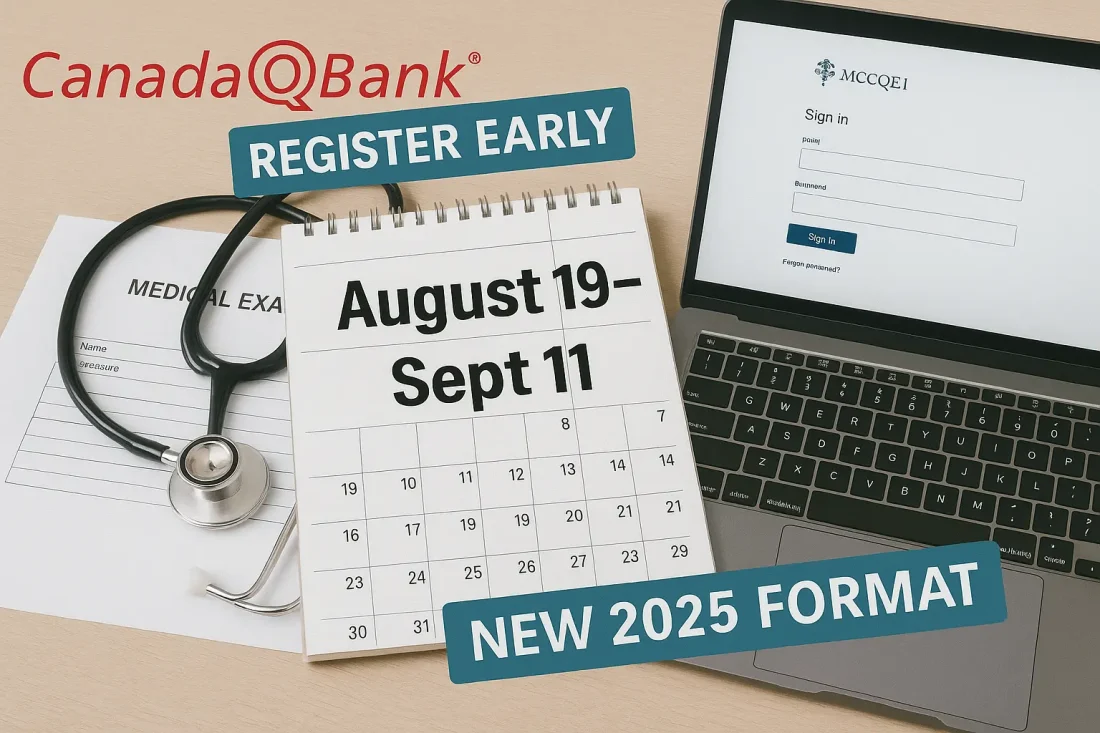
  • August 19–September 11
  • October 1–22

August 2025 Session

The August 19–September 11, 2025 session is a key window. Scheduling for each session opens 5 months before the start of the season. For example, scheduling for the August session opened in March 2025.

Candidates must apply and have their application approved before they can schedule a date in this window. Appointments are on a first-come, first-served basis via Prometric, so applicants should try to book early to secure their preferred centre and date. Once scheduling opens, you must visit the Prometric website to schedule an appointment.

If no seats are available at your preferred centre or time, you may need to choose another date or centre or use remote proctoring.

If you decide not to take a scheduled exam, ensure you cancel at least 120 hours (5 days) before the appointment to avoid forfeiture of your fee. Cancellations made more than 120 hours in advance allow you to withdraw via physiciansapply.ca and receive a partial refund (minus a $750 withdrawal fee). Cancellations within 30 days incur Prometric fees (CAD 85 + tax), and within 120 hours, you will forfeit the full exam fee.

You can extend your 12-month eligibility window by 12 more months for a $120 fee if you cannot write the exam within the original period.

The exam is available at Prometric centres across Canada and worldwide (70+ countries). There are centres in major cities for Canadian residents, while an international list is on Prometric’s MCCQE1 page. Remote proctoring is also offered (with stricter tech requirements). French-language proctors are available by appointment on limited days.

Results are released some weeks after each session. For April 2025 (a transition session), results take about 12 weeks due to standard-setting for the new pass score. For August and October 2025, results will be available approximately 4 weeks after the session’s last day. When scores are ready, the MCC will email you and post a notification in your physiciansapply.ca account.

MCCQE Part 1 Registration Process

To apply, you must be a current student or graduate of a qualifying medical school – either a CACMS-accredited Canadian MD program, a US MD/DO program, or a WDOMS-listed school with a Canada Sponsor Note. (Note: US MD graduates typically also need ECFMG certification, separate from the MCCQE registration.) The eligibility rules apply equally to CMGs and IMGs.

Application Steps

  1. Create an account at physiciansapply.ca (if you don’t have one) and log in.
  2. In the portal, go to Examinations → Apply for an exam → MCCQE Part 1.
  3. Upload certified ID documents (e.g., passport, driver’s licence) and any required medical credentials.
  4. IMG students must submit a Student Attestation form signed by their medical school.
  5. IMGs must submit a Source Verification Request (SVR) for their medical degree, which is done in the same portal before or along with the exam application. (Processing the SVR and verifying your degree is mandatory before MCC approves your exam application.)

Fees

  • MCCQE Part 1 application fee: CAD 1,500 (non-refundable)
  • SVR fee for IMGs: CAD 232
  • One-time account setup fee for all applicants: CAD 335

Fees are paid in CAD through the portal via credit card. All documents must be in English or French.

After submission, allow up to 4 weeks for MCC to review your application and documents. Once accepted, you will receive a notification in your physiciansapply account confirming eligibility. At that point, you can schedule your exam with Prometric.

Once your application is accepted, a 12-month eligibility window opens during which you can schedule and write the exam. If you cannot write within one year, you may extend this window by another 12 months (for $120). If you exceed your window without taking the exam (or withdrawing), the application will be cancelled and a partial refund issued.

Tips for the Exam

Prep Courses and Books

Several review courses and question banks cater to MCCQE1. CanadaQBank offers QBank subscriptions and timed mock exams. Toronto Notes and Preptest are commonly recommended books. Local medical schools sometimes run weekend review courses open to CMGs and IMGs. MCC itself sells preparatory exams (full-length MCC PEs) on its site.

Retakes

If you do not pass, you may register to retake the exam (following the same application steps and paying fees again). You have a 4-attempt limit. You cannot retake once you have passed. After a third attempt, a 1-year waiting period is required before your fourth and final attempt. Use any waiting period to strengthen your study plan.

Canadian Clinical Knowledge

The MCCQE1 tests medical facts and how well you understand Canadian healthcare practice. Clinical expectations like multidisciplinary teamwork, patient communication, and public health may differ from your training background. So, it is advisable to review sample Canadian patient cases and practice answering MCQs with a Canadian lens.

Navigating the MCCQE1: A Comprehensive Guide to Seamless Application and Triumph

Introduction

Embarking on the journey to secure a medical license in Canada involves overcoming the pivotal hurdle of the Medical Council of Canada Qualifying Examination (MCCQE) Part I. This examination stands as a critical milestone for both Canadian and international medical graduates, serving as a litmus test for a candidate’s clinical decision-making skills and core medical knowledge. Administered by the Medical Council of Canada (MCC), the MCCQE1 is offered in English and French, aligning with the MCC Objectives structured under the Canadian Medical Education Directions for Specialists (CanMEDS) roles.

Unraveling the MCCQE1

The MCCQE Part I is not just a regular examination; it’s a gateway to practicing medicine in Canada. This rigorous test evaluates the clinical knowledge of medical graduates, ensuring a robust foundation for residency training. It is a two-part examination, Section A comprises 210 Multiple-choice questions and Section B features 38 Clinical cases. What sets the MCCQE1 apart from the United States Medical Licensing Examination (USMLE) is its distinct clinical orientation.

Reasons Behind the Surge in MCCQE1 Applicants

The allure of practicing medicine in Canada has been steadily growing, attracting physicians from around the globe. Canada’s reputation as a welcoming hub for international medical graduates, coupled with its diverse and inclusive policies, adds to its appeal. The presence of world-renowned hospitals and research institutions further enhances the country’s charm.

The quality of residency and fellowship programs in Canada is another important factor in this surge as these programs not only provide excellent training but are often government-funded, making them more affordable than comparable programs in other countries. The recent easing of qualification requirements for International Medical Graduates (IMGs) has encouraged this influx, reinforcing Canada’s position as a sought-after destination for medical professionals.

The path to becoming a qualified physician in Canada, once labyrinthine, has now become more accessible. Simplified requirements, including an English language exam, MCCQE Part I, and NAC OSCE, make this an opportune moment to pursue the dream of practicing medicine in a country known for its freedom and quality healthcare.

Demystifying MCCQE1 Eligibility

Eligibility for the MCCQE1 is a stringent process overseen by the MCC. To partake in the exam, a candidate must hold a valid medical license from a recognized medical school. International and Canadian medical graduates certified by the MCC fall within the eligible bracket. Successfully navigating the MCCQE1 opens doors to applying for coveted residency positions across the country.

Navigating the MCCQE1 Application: A Stepwise Odyssey

While the prospect of the MCCQE1 application might seem daunting, a systematic approach can transform it into a more manageable journey. Let’s navigate through the application process step by step:

1. Account Creation:

Initiate the process by creating an account on physiciansapply.ca. Once the account is set up, log in to kickstart the application process.

2. Online Registration Form:

Access the online registration form, where vital personal information, educational background, and contact details are provided. Completion of the form marks the next step – submission of the application.

3. Verification of Medical Degree:

Await the verification of your medical degree. Once verified, you join the National Physician Database receiving an official registration confirmation.

4. Exam Schedule and Payment:

Delve into the exam schedule, pick a suitable date, and proceed with the payment process. An email confirmation from the MCC follows, laden with crucial details about the examination.

Pro Tips for a Seamless Registration Process

Effortless navigation through the MCCQE1 exam registration process demands attention to detail. Here are some pro tips to enhance your experience:

1. Medical School Eligibility Check:

Ensure your medical school boasts accreditation from the Committee on Accreditation of Canadian Medical Schools (CACMS) or is listed in the World Directory of Medical Schools.

2. MCCQE1 Eligibility Verification:

Confirm your eligibility, keeping in mind that the exam spans over eighty countries but mandates Canadian citizenship or permanent residency.

3. Understanding School Processes:

Familiarize yourself with your medical school’s processes for obtaining a medical degree to avoid any unwarranted delays.

4. Deadline Vigilance:

Stay vigilant about deadlines. Keeping a watchful eye on timelines ensures a smooth application process devoid of setbacks.

5. Leverage Support:

Amidst the complexities of the application process, remember you’re not alone. Seek assistance from MCC staff whenever questions arise – they are committed to supporting you on your journey.

Understanding Costs and the Elusive Eligibility Window

Cost of MCCQE1 Application:

Despite its pivotal role, the MCCQE1 comes with a reasonable price tag. Priced at $1375, this investment becomes a valuable stepping stone toward preparation for success. Keep in mind that withdrawals post-deadline result in the forfeiture of the fee.

MCCQE1 Eligibility Window:

Upon acceptance, applicants enter a twelve-month eligibility window to take the MCCQE Part I. Strategic planning is imperative to ensure readiness before this window expires. Extending the eligibility window incurs an additional cost of $110.

Number of Attempts:

Candidates are permitted a maximum of four attempts. Failing on the third attempt mandates a twelve-month waiting period before reattempting the exam.

The Day of the MCCQE1: Maneuvering the Exam Landscape

The day of the MCCQE1 can be laden with stress, but a comprehensive understanding of the logistics can alleviate uncertainties. Here’s a breakdown of what to anticipate on exam day:

1. Arrival at the Prometric Test Center:

Ensure you arrive at least 30 minutes before the scheduled testing time. Armed with the Scheduling Permit obtained during the application process and a valid identification, you’re set for the day.

2. Essential Identification:

Present a valid form of identification – be it a passport, driver’s license with a photograph, or Permanent Resident (PR) Card. Signing a test center log and securing personal belongings in an assigned locker follows.

3. Test Center Protocols:

Receive a marker and laminated writing surfaces during the test. Follow the instructions provided by Prometric Centre personnel, who will escort you to your testing station.

4. Tutorial and Exam Commencement:

Undergo a brief tutorial before commencing the exam. The Clinical Decision-Making (CDM) part is preceded by a 45-minute break, allowing a brief respite.

5. Break Management Strategies:

Manage break time judiciously, avoiding overextension. Returning promptly to the examination room ensures optimal utilization of your allotted time.

CanadaQBank: Your Ally in MCCQE1 Preparation

Preparation is the linchpin for success in the MCCQE1, and CanadaQBank emerges as a robust solution. With a repository of over 2000 high-yield questions, numerous Clinical Decision-Making (CDM) cases, and self-assessment tests, The CanadaQbank provides users with the opportunity and platform to practice stimulated exams created from previous exams.

MCCQE 1 Exam – 5 Tips for Preparation

The MCCQE (Medical Council of Canada Qualifying Examination) is an exam that assesses doctors trained outside of Canada but would like to practice in the country.

The MCC (Medical Council of Canada) uses this exam to check their level of clinical competence, knowledge, and judgment in actual clinical scenarios. The MCCQE has two parts- MCCQE 1 and MCCQE 2. However, we will only focus on MCCQE 1 in this article.

The MCCQE 1 has two sections: the MCQ and the CDM sections. The MCQ section has 210 questions and takes about 4 hours, after which there is a scheduled break for 45 minutes before the CDM section starts.

The CDM section is short for Clinical Decision Making.  It takes three and a half hours and comprises 38 cases with 1-4 questions each and specific instructions for each case. The passing score for the MCCQE 1 is 226.

Now that we have a general overview of the exam, what are the best tips and practices for MCCQE 1?

The MCCQE 1 is more than a test of factual knowledge. You must understand the intricacies of the test itself and be equipped with the right evidence-based clinical practices to ace this exam. Here are five tips to help you prepare for the exam very well.

1. Use proper resources

Using the right resources to prepare for the exams could potentially be what could push you over the finish line. Thus, to prepare for the MCCQE 1 exam make sure you use a board review book that works for you. These board review books help summarize the key concepts and objectives of the MCC to provide an efficient and easy way to digest all that you are required to know to pass your exam. You could then augment these board review books with textbooks to get more information. Remember to avoid using only textbooks as this could cause an overload of information making you lose what you need.

Furthermore, in choosing board review books always make sure to use one that works well for you. It would be foolhardy to use a book just because it is the best-reviewed on the internet. Thus, it is important to check the teaching style of each one, and you can do this by asking people who wrote the exams which ones they used.

2. Focus on those MCC objectives that you are not familiar with.

The MCCQE1 exam is based on the MCC guidelines. These guidelines are divided into different objectives, and some objectives may be harder to understand than others. So, it would be best to focus more on those objectives that are harder for you. This is to make sure you are not lacking in any area.

One of the ways to do this is to make sure you study them as often as you can because repetition enhances your memory. To ace this exam, you have to be as diligent and consistent as possible, so everything you need to know is just there, right at your fingertips.

3. Know the critical thresholds for the MCCQE 1

Many of the questions you will come across will be based on choosing the best possible answer for a treatment based on a given critical threshold value, e.g., ‘Mr. X has an apparent limb length discrepancy of Y cm; what could be the possible cause based on the history taken?’. To answer such questions, you will have to have the critical threshold value at your fingertips to choose the best possible action.

In many scenarios, you will be asked to choose the best patient management practices or routines based on the critical threshold values. If you have a good grasp of all these values, these questions will be a breeze.

These critical threshold values can sometimes slip your mind, so you should review them repeatedly to get familiar with them.

CanadaQBank can help you prepare with our simulated MCQ that mimics the exam situation.

4. Make Summary Notes

It is not just enough to read and understand. You should also make your study sessions as active as you can. You can do this by making summary notes of important points as you study to engage your mind. You do this to keep remembering the key points and digest information in such a way that you understand. The important thing is to make the information your own and not just read it repeatedly. When you do this, you attach a memory or an emotion to the information you process.

5. Use images to learn

Medicine is a visual and practical science, so media such as diagrams and graphics cannot be overemphasized. During the exam, you will see several clinical images and radiographs and will have to answer questions based on them. The MCC understands how central the use of visuals is for diagnosis and patient-centered management.

On CanadaQBank, there are many images to bring these clinical scenarios to life and help you prepare for the MCQ and CDM questions. We will also give you enough detailed information on these images so that when you are writing the exam, you will be able to answer any question with diagrams easily.

So, let’s run through all our tips

  • Use proper resources
  • Emphasize objectives you are not familiar with
  • Have the critical thresholds values on your fingertips
  • Make summaries of notes
  • Use images to learn

Do you need help with your preparation? Visit our website on CanadaQBank for more information and tips on accessing our question bank.