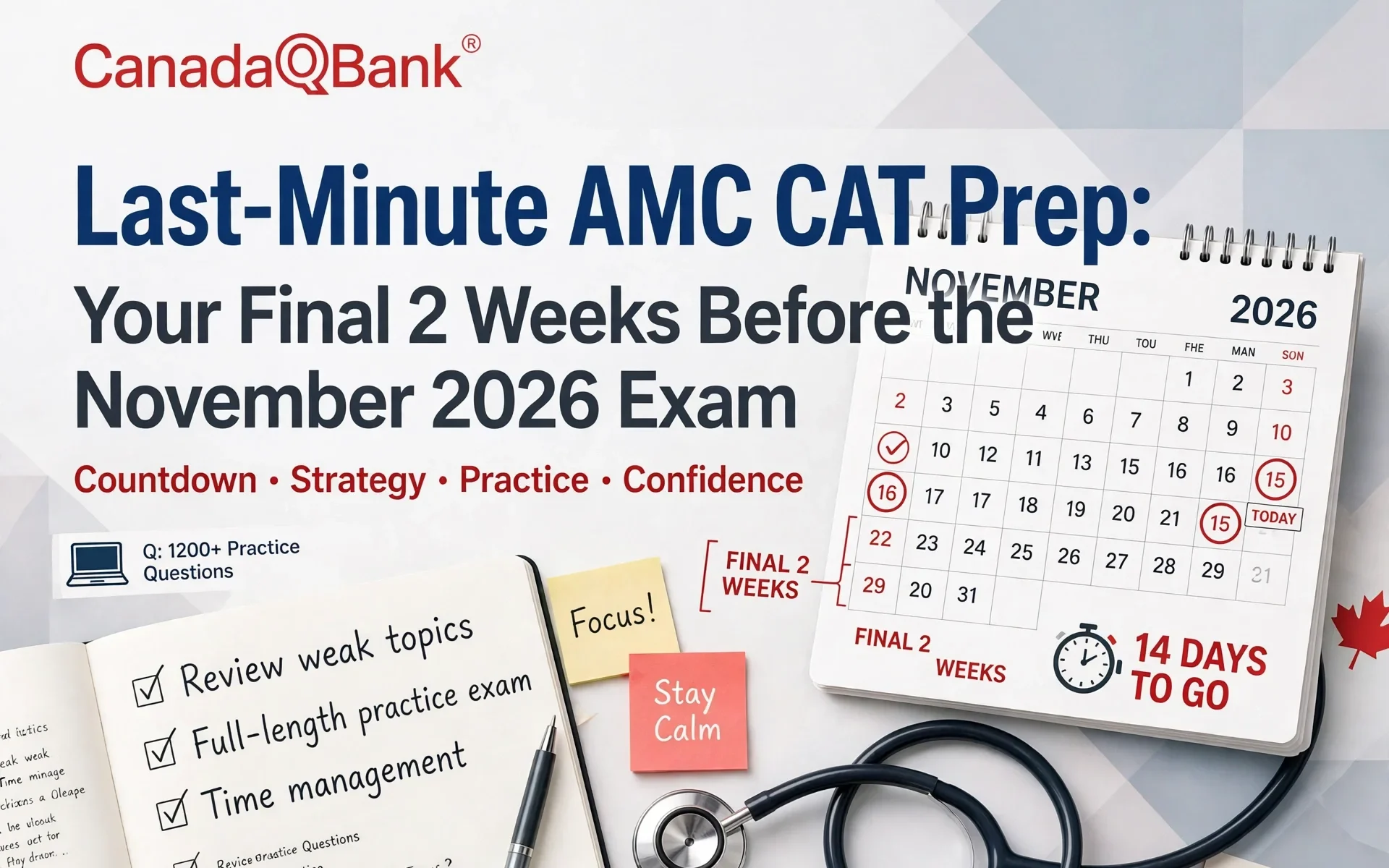
Last-Minute AMC CAT Prep: Your Final 2 Weeks Before the November 2026 Exam

Your Final 2 Weeks Before the November 2026 Exam

If you are reading this with your AMC CAT MCQ date somewhere in the November 2026 window (exam events run from November 16 to 21, with results due on December 17), you are in the part of preparation that decides more than most people expect. Two weeks is not enough time to learn medicine from scratch. It is, however, plenty of time to fix the specific things that cost candidates marks: weak topics you keep avoiding, poor pacing, and walking into the test centre exhausted.

This guide gives you a day-by-day plan for the final 14 days, the mistakes we see candidates repeat, and a few honest notes on what to leave alone. Please confirm your exact date, time and test centre rules on the official AMC website, since schedules and policies can change.

First, remember what you are actually sitting

The AMC CAT MCQ is computer-adaptive. You answer 150 questions, and the test adjusts as you go. A few practical consequences matter in the last two weeks:

  • You cannot go back. Once you submit an answer, it is final. Practising the habit of committing to a decision is a skill, and it needs rehearsal.
  • Difficulty will feel uneven. Some questions will feel strangely hard. That is normal for an adaptive format, so do not read your performance from how a single question felt.
  • Every question deserves roughly equal attention. Spending five minutes on one stem and rushing the last twenty questions is a classic way to lose marks you already earned.
  • You are being tested on safe, practical decisions. The exam rewards the next best step, the most likely diagnosis and the safest management, not obscure trivia.

Keep these four points in mind and your revision choices get a lot clearer.

The 14-day plan

Adjust the hours to your own life. If you work shifts, keep the order of the plan and shrink the volume.

Days 14 to 12: Find out where you really stand

The biggest mistake at this stage is revising what you already like. Everyone does it. Cardiology feels productive because you are good at it, so you keep going back.

Instead, spend these three days on honest diagnosis:

  1. Do mixed, timed blocks of questions across all systems. Do not choose topics.
  2. Record your score by subject area and by question type (diagnosis, investigation, management, ethics and communication).
  3. Write down your bottom five weak areas. Be specific. “Obstetrics” is too broad. “Hypertensive disorders in pregnancy and the drugs I mix up” is useful.

This is where performance analytics earn their keep. Inside CanadaQBank, your results are broken down by topic, so you can stop guessing and look at where the marks are actually leaking.

Days 11 to 8: Attack the weak areas, not the whole syllabus

Now you work through that bottom-five list. For each weak area:

  • Do a block of questions on that topic only.
  • Read the explanations for every question, including the ones you got right. A correct answer reached by a lucky guess is still a gap.
  • Write a two or three line summary of the rule you were missing, in your own words. Short notes you wrote yourself are far more useful in the final week than a textbook chapter.
  • Come back to the same topic two days later with fresh questions to see whether it stuck.

This is also a good time to use video explanations for topics that still do not click. Our YouTube channel has more than 500 tutorial videos on high-yield topics for the AMC and other licensing exams, which is handy when reading the same paragraph for the third time is getting you nowhere.

Days 7 to 5: Simulate the real thing

This is the most valuable stretch of the whole fortnight, so protect it.

  • Day 7: Sit a full-length, fully timed session. Same time of day as your real appointment if you can. Phone away, no notes, no pausing, no looking things up.
  • Day 6: Review the whole session. Sort every mistake into one of three buckets: did not know it, knew it but misread the question, or ran out of time and rushed. The second and third buckets are usually bigger than candidates expect, and they are the easiest to fix.
  • Day 5: Do shorter timed blocks that target the pattern you found. If you keep misreading stems, practise underlining the actual question before looking at the options. If you rush the end, practise a pacing check every 30 questions.

Do not take more than one or two full simulations in the final two weeks. They are tiring, and the learning comes from the review, not from the sitting.

Days 4 and 3: Consolidate, do not cram

By now, new material has very little payoff. What you want is retention of what you already know.

  • Go through your short personal notes from the weak-area work.
  • Redo questions you previously got wrong, from your saved or flagged set.
  • Do light mixed blocks (20 to 40 questions) to stay sharp without wearing yourself out.
  • Stop studying at a sensible hour. Sleep is part of your preparation.

Day 2: Logistics day

This is the day people forget about, and it prevents the kind of stress that wrecks a good exam.

  • Check your appointment time, test centre address and travel route. Plan to arrive early.
  • Prepare your identification documents exactly as the AMC and the test centre require. Check the official instructions rather than relying on a friend’s memory.
  • Lay out what you need for the morning and decide what you will eat.
  • Do a short, easy review session in the morning and then stop.

Day 1: Rest

Honestly, this is the hardest day. You will feel like you should be doing more. You should not.

  • Go for a walk. Eat properly. Talk to someone who is not an exam candidate.
  • If you must look at something, skim your one-page list of key rules for ten or fifteen minutes.
  • Go to bed at a normal time. Do not try to force an early night with some new routine, because that tends to backfire.

Exam day

Eat something you are used to. Arrive early. During the exam, take each question as a fresh start. If you notice yourself dwelling on the previous one, take a breath, reset and move on. You cannot go back anyway, so there is nothing to gain from carrying it with you.

Five mistakes that cost candidates marks in the final fortnight

1. Starting a new resource. Switching to a brand-new book or course two weeks out usually creates anxiety and confusion. Stick with what you know.

2. Avoiding weak topics. Comfort-revising is tempting. The marks are in the topics you dislike.

3. Doing questions without reading explanations. A question bank is a teaching tool, not a scoreboard. The explanation is where the learning happens.

4. Ignoring pacing. Strong candidates still lose marks by rushing the last stretch. Practise timing in the same conditions you will face on the day.

5. Sacrificing sleep. A tired brain misreads stems and second-guesses good answers. An extra late-night hour almost never pays back.

How CanadaQBank fits into your last two weeks

We built CanadaQBank for international medical graduates who are preparing around work, family and everything else life throws at them. For a final fortnight like this one, it helps in three ways:

  • Exam-style practice. Practise in timed and tutor modes so you can build speed and learn from detailed explanations in the same sitting.
  • Performance analytics. See your strong and weak areas by topic, so your last 14 days go to the places where marks are actually recoverable.
  • Video support. Our 500+ tutorial videos cover high-yield topics across the AMC and other licensing exams, for those moments when a concept just will not click in text.

If you have not started yet, there is still time to use the platform in a focused way. Take a diagnostic block today, find your five weak spots, and build your plan around them.

Ready to start your final two weeks properly? Visit CanadaQBank.com, choose your AMC plan and take your first timed block today.

Frequently asked questions

Is two weeks enough to prepare for the AMC CAT MCQ?

It is enough to improve, not to start from nothing. If you have already studied for a while, two weeks of targeted practice, review and pacing work can make a real difference. If you are just beginning, consider whether a later sitting is more realistic, and check the AMC scheduling options.

How many questions should I do per day in the final 14 days?

There is no magic number. Quality matters more than volume. A reasonable aim is a few focused blocks a day with proper review, rather than hundreds of questions with no reflection. Tailor it to your schedule and energy.

Should I take a full practice exam the day before the real one?

Most candidates are better off resting. A long simulation the day before mostly adds fatigue and anxiety. Do your last full-length session about a week out.

What if I feel I am not ready the week of the exam?

That feeling is common, even among people who go on to pass. Look at your recent practice data rather than your mood. If you genuinely need more time, check the AMC’s current rescheduling rules and fee policy before making a decision.

When are AMC CAT MCQ results released for the November sitting? Based on published schedules, results for the November 2026 events are due on December 17. Always confirm on the official AMC website.

Final thoughts

The last two weeks are not about heroic all-nighters. They are about finding the gaps, closing the ones you can, rehearsing the exam conditions and arriving rested. Do those four things and you will walk into the test centre far better prepared than someone who spent the fortnight rereading their favourite chapters.

We wish you the very best for your exam. When you are ready, start practising with CanadaQBank and make these final days count

Top 10 Mistakes to Avoid When Preparing for the AMC Exam

Top 10 Mistakes to Avoid When Preparing for the AMC Exam

The Australian Medical Council (AMC) Exam serves as the testing ground for doctors who wish to practice in Australia. It is a taxing but passable exam that checks your competency in medical knowledge and clinical skills to ensure they meet Australian standards for medical practice. It encompasses a broad range of domains, including, but not limited to, adult health, women’s health, child health, mental health, population health, and ethics.

The exam is divided into multiple-choice questions (MCQs) and a clinical skills exam or a workplace-based assessment program. However, the AMC exam is designed to be passable for newly qualified graduates of Australian medical schools who are about to begin their internship training.

Passing the AMC exam is a key step for many international medical graduates (IMGs) seeking to practise medicine in Australia. But knowing what not to do is just as important as knowing what to study. Many candidates struggle not from lack of intelligence, but from avoidable strategic errors. Drawing on lessons from seasoned tutors and AMC-prep educators, here are the top 10 mistakes IMG candidates commonly make and how to steer clear of them.

Building a Smarter Preparation Strategy

Avoiding mistakes requires more than being careful; it demands that you be strategic in your decisions. Successful AMC candidates plan their study timeline around three core pillars:

  1. Structured Content Review: Cover the Blueprint methodically, system by system, instead of jumping between random topics.
  2. Question-Based Practice: Reinforce learning through active recall using trusted platforms like CanadaQBank, which mirrors real AMC question patterns.
  3. Self-Evaluation and Adaptation: Continuously refine your focus based on feedback and results.

1. Ignoring the AMC Blueprint

One of the biggest errors candidates make is diving into preparation without first understanding what the exam truly assesses. The AMC Blueprint outlines the scope of topics, competencies, and professional standards expected of doctors in Australia. It’s a framework showing how clinical reasoning, communication, and patient safety are integrated into every question.

Failing to align your study plan with the Blueprint can render your preparation inefficient. Every topic, from cardiovascular disease to ethics, should be studied through the lens of Australian practice standards and patient-centred care.

Tip: Start your preparation by downloading the official AMC Handbook and mapping your resources and study time against the Blueprint. It helps you lock in on what topics and views actually matter.

2. Treating AMC Like a Memory Test

Many candidates come from systems where exams reward rote memorization. The AMC is not one of them. It’s a reasoning-based exam, emphasizing how you apply knowledge to patient problems, not how many facts you can recall.

Questions are often structured as evolving clinical scenarios where every line of the stem matters. Memorizing guidelines won’t help if you can’t prioritize, interpret data, or make safe management decisions.

Tip: Practice clinical reasoning daily. Ask yourself, “What’s the most likely diagnosis?”, “What’s the next best step?”, “What’s the safest option?” and always justify your reasoning.

3. Neglecting Practice under Exam Conditions

Knowing the material is one thing; performing under time pressure is another. The AMC Part 1 is a computer-based test (MCQ), which can be compared to a marathon of over 150 questions spread across several hours. Without timed practice, even strong candidates will find themselves running out of time or second-guessing easy questions.

Tip: Use mock exams and timed question blocks to simulate the pressure and pace of the real test. Tools like CanadaQBank, which replicates AMC-style clinical questions and timing, can help you build endurance and confidence while identifying weak areas early.

4. Ignoring Australian Context and Guidelines

Even if you’ve practised medicine elsewhere, the AMC expects you to answer questions based on Australian standards, not what you did in your home country. Management guidelines, first-line treatments, and ethical frameworks can differ substantially between countries.

For example, antibiotic stewardship, mental health pathways, and Indigenous health considerations hold significant weight in Australian medical practice. Failing to adapt your answers to these expectations can cost you marks even if your reasoning is sound.

Tip: Familiarize yourself with the Royal Australian College of General Practitioners and Therapeutic Guidelines (eTG). Incorporate these into your practice sessions so that your clinical reasoning reflects the Australian context.

5. Overloading with Too Many Resources

With so many books, courses, and question banks available, it’s tempting to use everything. But information overload leads to confusion and burnout. The best candidates know that depth beats breadth.

Tip: Choose one or two high-yield resources and stick with them. Combine the AMC Handbook, the AMC Qbank or CanadaQBank, and one clinical review text like John Murtagh’s General Practice. Repetition from reliable sources is more effective than skimming dozens of materials once.

6. Postponing Revision and Self-Assessment

Many study for weeks before realizing they never tested what they know. Without periodic self-assessment, you can’t track your progress or pinpoint weaknesses. Revision is crucial because it improves your ability to retrieve the varied information you’ve assimilated. You must be able to recall and apply knowledge quickly, especially under pressure.

Tip: While studying, have a note by your side where you write down your understanding of the topic you are reading. This will help you when revising or answering question banks. After every two weeks of study, take a mini mock or review your question bank analytics. Focus your next revision phase on weak systems or frequently missed question types. Self-evaluation keeps your preparation active and adaptive to your progress.

7. Underestimating Clinical Reasoning and Ethics

The AMC exam rewards candidates who think like safe, reflective practitioners. It tests your medical knowledge and your ethical judgment, professionalism, and communication in clinical settings. Neglecting these areas, especially ethics and doctor–patient interaction, will lead to missed opportunities for easy marks.

Tip: Read ethical guidelines from the Medical Board of Australia and review common clinical communication themes—practice questions that test what to do, and why and how you justify it. The safest, most ethical answer often earns full marks.

8. Failing to Build Exam Stamina and Focus

The AMC exam is long, mentally draining, and requires sustained focus. Going into the exam without preparing yourself for a marathon session would be setting yourself up for a tough time. Many candidates report that their performance drops in the second half due to fatigue, anxiety, or loss of concentration.

Tip: Build your stamina like you would for a physical challenge. Start by completing shorter, timed blocks, then progress to full-length simulated exams. During study breaks, train your focus with mindfulness or brief breathing techniques. Small habits, like avoiding caffeine spikes or improving sleep, can significantly impact cognitive endurance.

9. Ignoring Weak Areas Because They’re “Too Hard”

Everyone has topics they dislike, be it psychiatry, obstetrics, or biostatistics. But skipping these sections is one of the fastest ways to fail. The AMC tests integrated medicine, so weak areas inevitably appear in complex clinical vignettes.

Tip: Tackle your weakest subjects first. Use a “2+1” strategy; for every two strong-system study sessions, include one focused on a weaker area. Over time, discomfort decreases, and your confidence across the Blueprint becomes more balanced.

10. Letting Anxiety or Isolation Take Over

Preparing for the AMC can be lonely, especially for IMGs balancing work, relocation, or family life. The stress of studying in isolation or obsessing over scores can erode motivation and focus. Anxiety is another major hurdle, as it can cause you to waste time worrying over things you cannot immediately affect. Excessive anxiety directly impairs your recall and decision-making during the test.

Tip: Don’t prepare alone. Join study groups or online forums where IMGs share questions, motivation, and updates, as this sense of community will positively impact your preparation. Set healthy study hours, take rest days, and focus on consistency over intensity. A calm, rested mind always performs better than an exhausted one.

Bonus Tips

Putting Off Exam-Day Logistics

Neglecting test-day preparation is a silent trap. If you forget your IDs, don’t know the test center location, or fail to check remote exam requirements, you risk chaos that can cause you to miss your exam time.

Preempt these errors by confirming your exam center address or remote-testing software setup. Plan arrival times, transit logistics, meals, and rest breaks, and verify that your identification is accounted for.

Neglecting Health, Wellbeing, and Mental Resilience

Medical preparation is a marathon and ignoring wellness will undo your best efforts. Maintain healthy habits like getting 7–8 hours of sleep per night, keeping active, scheduling regular breaks into your study period, and managing stress by being mindful, journaling, or seeking peer/family support. Finally, monitor warning signs of burnout: memory lapses, irritability, fatigue.