


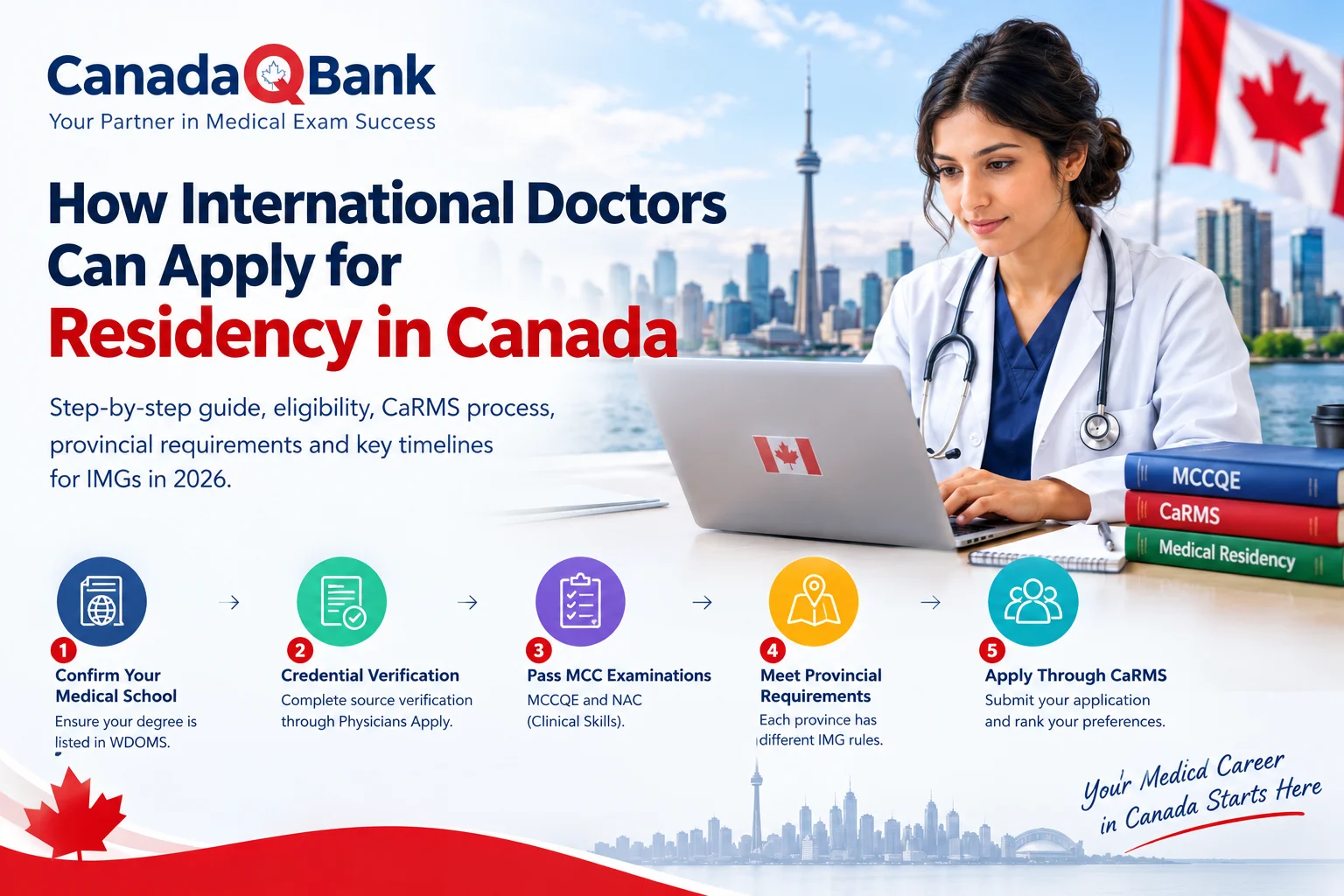
Canada needs doctors. The physician shortage — particularly in primary care, rural medicine, and several specialties — is well documented, and internationally trained physicians are a critical part of the solution. Yet for IMGs trying to navigate the Canadian residency application process, the pathway can feel opaque, competitive, and full of province-specific rules that change from year to year.
This guide gives you a clear, accurate, and current picture of how international doctors apply for residency in Canada in 2026 — the requirements, the process, the timelines, the provincial rules, and the alternative pathways available for experienced physicians.
What Is CaRMS and Why Does It Matter?
The Canadian Resident Matching Service (CaRMS) is the centralised system through which all residency positions in Canada are filled. Any physician — Canadian graduate or internationally trained — who wants to complete residency training in Canada must apply through CaRMS.
CaRMS operates an annual match process, the R-1 Main Residency Match, through which medical graduates apply to residency programs and programs rank applicants. A computer algorithm then matches applicants to programs based on ranked preferences from both sides.
For IMGs, CaRMS operates a dedicated IMG stream — a separate pool of residency positions specifically reserved for international medical graduates in most provinces. These positions are distinct from the positions reserved for Canadian medical graduates (CMGs), though the application system is the same.
Who Counts as an IMG in Canada in 2026?
The definition of an international medical graduate in the Canadian residency context changed significantly in 2026.
As of July 1, 2025, graduates of US allopathic and osteopathic medical schools are now classified as IMGs when applying to Canadian residency programs — a change from the previous arrangement where US graduates were treated similarly to Canadian graduates. This applies to anyone graduating from a US medical school on or after July 1, 2025.
In practice, this means the IMG category in the 2026 CaRMS match includes:
- Physicians who obtained their medical degree outside Canada and the United States
- Graduates of non-CACMS accredited schools in Canada on or after July 1, 2025
- Graduates of US medical schools (allopathic or osteopathic) on or after July 1, 2025
Step-by-Step: How IMGs Apply for Canadian Residency
Step 1 — Confirm Your Medical School Is Recognised
Your medical degree must be from a school listed in the World Directory of Medical Schools (WDOMS). If your institution is not listed, you will be ineligible for the CaRMS match. Verify this before investing time in any other step.
Step 2 — Source Verification Through Physicians Apply
All IMGs must verify their primary medical credentials through physiciansapply.ca — the Medical Council of Canada’s credential verification platform. This process confirms the authenticity of your medical degree, your identity, and your academic record.
Source verification is independent of CaRMS and must be initiated separately. The process can take several months depending on your country of graduation, so begin it as early as possible — ideally before you have passed your MCC examinations.
Within 20 months of graduation, register with the Medical Council of Canada through Physicians Apply.
Step 3 — Pass the Required MCC Examinations
IMGs applying to the CaRMS R-1 Main Residency Match must provide results for two MCC examinations:
1. The MCCQE (Medical Council of Canada Qualifying Examination) Formerly known as the MCCQE Part I, renamed as of April 1, 2026. This is a 230-question multiple-choice examination assessing clinical decision-making and medical knowledge across all major disciplines. It is offered multiple times per year at Prometric test centres worldwide.
2. The NAC Examination (National Assessment Collaboration Examination) The NAC is an OSCE — an Objective Structured Clinical Examination — assessing clinical and communication skills. It is held at assessment centres across Canada and at select international centres. IMGs must pass the NAC before being eligible for the CaRMS match.
Important timing note: File review for the CaRMS R-1 first iteration match begins in late November each year. To apply to the following year’s match, both the MCCQE and the NAC Examination must be completed during specific sessions earlier in the year. Check the MCC website for current deadlines — missing an examination session can delay your match eligibility by a full year.
Step 4 — Meet Provincial IMG Program Requirements
This is where the process becomes more complex — because IMG eligibility for the CaRMS match is not uniform across Canada. Each province sets its own rules about which IMGs are eligible for the positions it offers.
Alberta: IMGs must apply to and be assessed by the Alberta International Medical Graduate (AIMG) Program before they can apply to Alberta positions on CaRMS. The AIMG Program assesses eligibility and is a prerequisite for Alberta’s IMG-designated residency positions.
Ontario: Ontario has specific eligibility criteria for IMG positions in the first iteration of the match. For the 2026 R-1 first iteration, IMGs must either hold or be working on their medical degree from abroad and must have completed at least two years of high school in Ontario. IMGs who do not meet this criterion are ineligible for the first iteration but can apply to Ontario positions in the second iteration.
Quebec: The first iteration of the CaRMS match in Quebec is limited to graduates of accredited Canadian and US medical schools, and to IMGs who have completed the equivalence process of the Collège des médecins du Québec (CMQ). IMGs without CMQ equivalence can apply in the second iteration.
Other provinces: British Columbia, Saskatchewan, Manitoba, Nova Scotia, New Brunswick, Prince Edward Island, and Newfoundland each have their own IMG eligibility criteria, quota systems, and provincial assessment processes. Some provinces actively recruit IMGs and offer proportionally more IMG-designated positions relative to their total match quota.
Always check the current eligibility requirements directly on the CaRMS website and with the relevant provincial medical body before applying, as requirements change from cycle to cycle.
Step 5 — Build Your CaRMS Application
The CaRMS application opens in the autumn preceding the match year. For the 2026 match, file review began in late November 2025.
A complete CaRMS application for IMGs typically includes:
- Medical school transcript (uploaded by your medical school directly to CaRMS)
- Medical school diploma or degree certificate
- MCCQE result
- NAC Examination result
- Letters of reference (number and format specified by each program)
- Personal letter (a program-specific cover letter explaining your interest and suitability)
- Curriculum vitae
- Language proficiency evidence (where required)
- Provincial assessment results (where applicable — AIMG in Alberta, CMQ equivalence in Quebec)
Reference letters are among the most important components of an IMG’s CaRMS application. Most programs require three letters, and the weight placed on reference letters from Canadian supervisors — physicians who have observed your clinical work in Canada — is significant. If you have completed observerships, electives, or any supervised clinical experience in Canada, securing reference letters from those supervisors is strongly advisable.
Personal letters are program-specific and should address why you are applying to that program, what you bring to it, and your longer-term professional plans. Generic personal letters are easily identified by program directors and are a common weakness in IMG applications.
Step 6 — Apply to Programs and Attend Interviews
Once your application is submitted, programs review files and invite selected candidates to interview. For the 2026 cycle, all Canadian postgraduate admissions interviews are conducted virtually.
The interview is a critical differentiator in the CaRMS process. Programs use interviews to assess communication skills, professionalism, understanding of the Canadian healthcare system, and fit with the program’s culture and values. Preparation for CaRMS interviews should begin well before interview invitations are received.
Common interview formats include the Multiple Mini Interview (MMI) — a series of short, scenario-based stations — and the traditional panel interview. Some programs use both.
Step 7 — The Match
The CaRMS match takes place in March each year. Applicants rank programs in order of preference, and programs rank applicants. The CaRMS algorithm produces a stable matching that maximises alignment between applicant and program preferences.
Match results are released on a single day — Match Day — and represent a binding commitment. An applicant who matches to a program is committed to beginning that residency on the specified start date.
What Happens If You Do Not Match?
Not matching in the first iteration is a common experience for IMGs — and it is not the end of the road.
Second iteration: CaRMS runs a second iteration of the match using unfilled positions from the first round. IMGs can apply to available positions in the second iteration, including some positions in provinces that restrict IMG eligibility in the first iteration.
Re-applying the following year: IMGs who do not match can reapply to the following year’s match. A year between applications can be used productively — completing additional clinical experience in Canada, strengthening reference letters, publishing research, or completing additional training.
Alternate pathways: For experienced family physicians, the Practice-Ready Assessment (PRA) program offers an alternative to the residency match. Several provinces — including Alberta, Saskatchewan, Manitoba, Nova Scotia, and Prince Edward Island — operate PRA programs that allow experienced IMGs who have been in independent family medicine practice to undergo structured assessment and proceed to licensure without completing residency. Eligibility requirements vary by province.
Key Factors That Determine IMG Match Success
IMGs who match successfully share several common characteristics:
Strong MCCQE scores. While the MCCQE is a pass/fail prerequisite for the match, scores are visible to programs in some contexts and a strong performance signals clinical competence.
Canadian clinical experience. Observerships, clinical attachments, and supervised practice in Canada give IMGs exposure to the Canadian healthcare system — and, critically, the opportunity to obtain Canadian reference letters. This is one of the most significant differentiating factors in the IMG match.
Geographic flexibility. IMGs willing to consider positions outside major urban centres have access to a broader range of positions and face less competition. Rural and regional programs actively recruit IMGs and often have higher match rates for international candidates.
Specialty selection. Some specialties are significantly more accessible to IMGs than others. Family medicine consistently offers the most IMG-designated positions. Internal medicine, psychiatry, and laboratory medicine also have historically higher IMG match rates than competitive surgical specialties.
Communication skills and interview performance. Programs assess interpersonal skills, language proficiency, and cultural competency rigorously at interview. IMGs whose clinical knowledge is strong but whose communication style differs significantly from Canadian norms often perform below their academic level at interview.
The 2026 CaRMS Timeline for IMGs
| Milestone | Approximate Timing |
|---|---|
| MCCQE examination sessions eligible for 2026 match | April, August, or October 2025 |
| NAC Examination sessions eligible for 2026 match | May or September 2025 |
| CaRMS file review opens (first iteration) | Late November 2025 |
| Interview period | January to February 2026 |
| Rank order list submission deadline | February 2026 |
| Match Day | March 2026 |
| Residency start date | July 1, 2026 |
How CanadaQBank Prepares IMGs for the CaRMS Process
The foundation of every successful CaRMS application is passing the MCCQE and NAC Examination — and passing them well. At CanadaQBank.com, we provide the preparation resources IMGs need to meet the MCC examination requirements for CaRMS eligibility.
Our platform offers:
- Comprehensive MCCQE question bank aligned to the 2026 format — 230 MCQs, Canadian guidelines, MCC Examination Objectives — with domain-by-domain performance analytics that identify your weakest areas precisely
- Canadian clinical content throughout — every question and explanation is grounded in Canadian clinical practice guidelines, not international or American sources
- Timed practice modes building the clinical decision-making speed the MCCQE demands across its 230-question format
- Detailed explanations teaching the Canadian clinical reasoning behind every correct answer — so you understand not just what to choose but why
Passing the MCCQE is not the ceiling of your CaRMS preparation — it is the floor. But it is the non-negotiable first step, and every month you delay it is a month further from the residency you are working toward.
Visit CanadaQBank.com today and build the MCCQE preparation that opens the door to your Canadian residency application.